Kim Jung-kwan: First Semiconductor Fab in Honam to Be Completed in 2029
- Input
- 2026-08-11 18:19:58
- Updated
- 2026-08-11 18:19:58
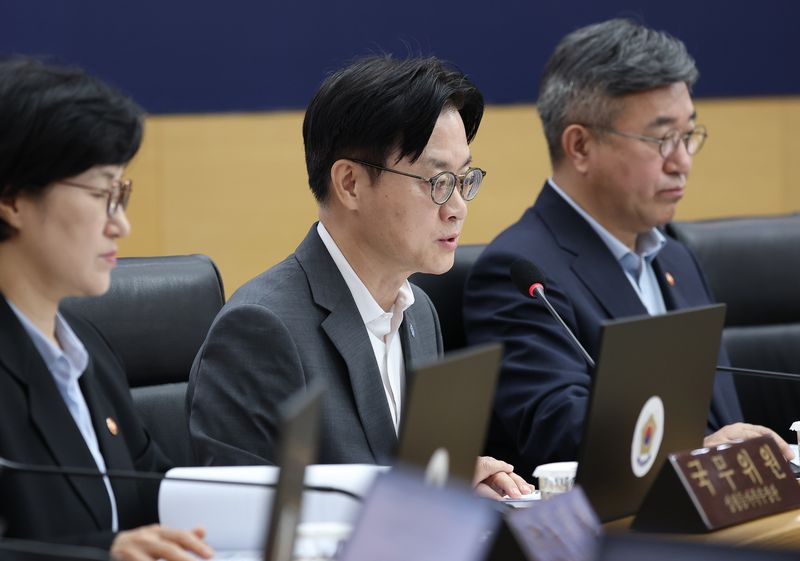
At a Cabinet meeting held at Government Complex Sejong on the 11th, Kim Jung-kwan, Minister of Trade and Industry, said that regarding the Honam Semiconductor Cluster, "We decided to push ahead quickly with the development of the National Industrial Complex and the establishment of the industrial complex plan, led by the Ministry of Land, Infrastructure and Transport, with the goal of completing the first semiconductor fab in 2029."
This is the first time the government has presented a specific completion target for a fab in the Honam Semiconductor Cluster. Previously, it had announced plans to build a large-scale semiconductor production base in Honam, but it had not specified when the fab would actually be built or completed.
The government has decided to speed up the launch of the cluster by temporarily relocating the functions of Gwangju Military Airport, which has been designated as the site for the Honam Semiconductor Cluster, to another military airport by mid-2028. To that end, it plans to move forward at the same time with the temporary relocation of Gwangju Military Airport's functions and the groundbreaking for Muan Military Airport.
It will also carry out preliminary procedures in parallel, including the development of the National Industrial Complex and various permits, so that semiconductor fab construction can begin as soon as the Gwangju Military Airport site is secured. The goal is to shorten the overall project timeline by moving related procedures forward at the same time, rather than proceeding step by step after the airport relocation.
Kim said, "In the Honam region, we have agreed to review measures to secure land and infrastructure for the early launch of the semiconductor cluster, and to cooperate with the central government, local governments and companies so that the project can get on track quickly."
Given the semiconductor industry's heavy power demand, the government will also work in parallel to secure local power generation sources and expand the power grid. It plans to establish a stable power supply base by using renewable energy, Energy Storage System (ESS), combined heat and power generation, and liquefied natural gas (LNG) power generation.
To shorten the power grid construction period, it will also seek to reduce the duration of the first-phase underground cable work. The government will also work with relevant ministries to flesh out plans for water infrastructure so that water can be supplied stably in line with the cluster's launch.
Kim added, "For key infrastructure such as power and water, we will support stable electricity supply through local renewable energy, ESS, combined heat and power generation, and LNG power generation. In particular, we will provide thorough support led by the Ministry of Climate, including shortening the first-phase underground cable construction period."
[email protected] Park Ji-young Reporter