Hyundai Motor Union resumes strike after vacation, with up to six-hour partial walkouts for four days starting on the 12th
- Input
- 2026-08-11 16:52:51
- Updated
- 2026-08-11 16:52:51
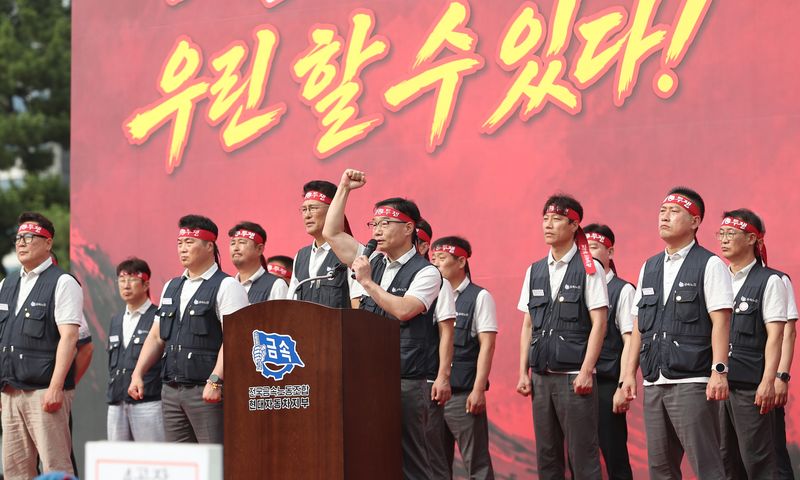
On the 11th, the Hyundai Motor Union held a meeting of its Central Strike Countermeasures Committee and decided, through its fifth directive, to stage partial strikes over four days from the 12th to the 18th. The union will strike for four hours per shift on the 12th and 13th, and for six hours on the 14th and 18th. Since the three strikes held last month also gradually increased in length by shift, the latest decision is seen as another step up in the intensity of its campaign.
Under the detailed schedule, on the 12th and 13th, the first shift and the regular first shift will stop work from 10:50 a.m. to 3:30 p.m., while the second shift will strike from 7:30 p.m. to 12:10 a.m. the next day, each for four hours. The permanent daytime shift will strike from 12:40 p.m. to 4:40 p.m., and the regular daytime shift from 1 p.m. to 5 p.m.
On the 14th and 18th, the strike will be extended to six hours. The first shift and the regular first shift will stop production from 8:50 a.m. to 3:30 p.m., while the second shift will strike from 5:30 p.m. to 12:10 a.m. the next day. The permanent daytime shift and the regular daytime shift will also join the walkout from 10 a.m. to 4:40 p.m. or 5 p.m. During this period, the union also plans to hold division- and district-level briefing sessions to strengthen members' resolve.
The reason the union has once again turned to strikes is the wage and collective bargaining process, which has been stalled for more than a month since the 15th round of talks on July 8. Although labor and management are said to have maintained behind-the-scenes working-level contact during the vacation period, they have reportedly made no meaningful progress and remain at an impasse.
The company has proposed a monthly base-pay increase of 89,000 won, a performance bonus of 350 percent plus an additional 10 million won, and the distribution of 15 treasury shares. The union, however, is demanding a 149,600 won increase in base pay, a performance bonus equal to 30 percent of last year's net profit, and higher bonuses, leaving the gap unresolved.
Beyond wages, the union's so-called three key demands are seen as the biggest obstacles to a deal: reinstating dismissed members to their original posts, a prior labor-management agreement before any legal extension of the retirement age, and higher bonuses. The company maintains that these issues should be handled separately from this year's wage negotiations, while the union insists they must be settled in this round of talks, leaving the two sides far apart.
As the strikes continue, production disruptions and wage losses for union members are also mounting. Last month's three partial strikes and refusals to work overtime already caused production losses of more than 42,000 vehicles, and the resulting sales losses are estimated by the industry to reach the 1 trillion won range.
If the newly announced four-day strike is added, the losses are expected to grow even larger. Under the no work, no pay principle, individual wage losses for union members are also continuing to accumulate, increasing the burden on both the company and its workers as the strike drags on.
Still, the union has not completely closed the door on negotiations. Its directive keeps the existing policy that if main talks resume, the strike schedule for that day will be suspended. The next meeting of the Central Strike Countermeasures Committee is scheduled for the 18th, when the union is expected to review whether talks have restarted and how far to escalate its action. With a series of new vehicle launches planned for the second half of the year, attention is now focused on whether the two sides can find a way back to the table.
[email protected] Kim Dong-chan Reporter