CSAT application period begins on the 24th... 'Make your final strategy for the last test under the current system, D-100'
- Input
- 2026-08-11 12:00:00
- Updated
- 2026-08-11 12:00:00
[Financial News] Applications for the 2027 CSAT will begin on the 24th. As Korean language and mathematics elective subjects will be abolished and the science and social studies system will be completely overhauled starting with the 2028 academic year, this year's exam will be the last CSAT held under the current elective-subject system.
Admissions experts stressed that with 100 days left before the CSAT, students should focus on strengthening weak areas and sharpening test-taking instincts rather than blindly increasing the number of new problems they solve.
■ Online pre-entry begins on the 20th
The Ministry of Education of the Republic of Korea said on the 11th that applications for the 2027 CSAT will be accepted from Aug. 24 to Sept. 4 for 10 days, excluding Saturdays and Sundays, at education support offices in 85 test districts nationwide and at local high schools.
From the 20th, test-takers can enter their application information in advance through the online pre-entry system and conveniently pay the exam fee by credit card, virtual account, or simple payment methods. However, online pre-entry alone does not complete the application. To prevent proxy registration, applicants must visit the designated on-site registration center, undergo identity verification, and receive their application receipt. After the on-site deadline, no changes or additional applications will be allowed, so all information must be checked carefully before submission.
Current high school students apply in bulk through their schools, while graduates may register at their former high school or at the education support office in the district where their resident registration address is located. The exam fee ranges from 37,000 won to 47,000 won depending on the number of selected sections, and applicants who receive National Basic Livelihood Security benefits, are in the legally designated lower-income bracket, or are from single-parent families may apply for a fee exemption.
■ More repeat test-takers, and the shift toward social studies
Because this year's CSAT is the last exam under the current system, more top-tier repeat test-takers are expected to enter the competition, making it even fiercer.
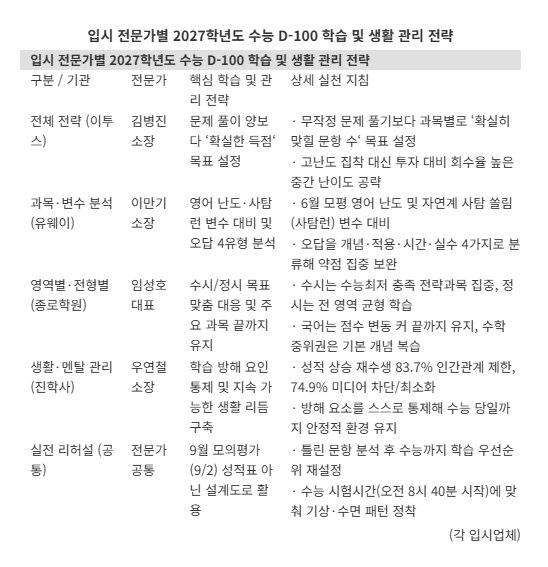
Kim Byung-jin, head of the Etoos Education Evaluation Institute, advised that the remaining 100 days should be used not to solve as many problems as possible, but to set specific goals for how many more questions to get right in each subject and to focus on mid-level question types that offer the greatest score gains relative to the effort invested.
Lee Man-gi, head of the Uway Education Evaluation Institute, pointed to volatility in English and the science and social studies sections as key battlegrounds. He said the June mock test was so difficult that the share of students earning a top grade in English was only 4.13%, and that grade volatility in the science and social studies subjects has also increased as natural science students have shifted toward social studies. Rather than adding new textbooks, he said students should repeatedly review wrong answers from past exams by categorizing them into concept, application, time management, and careless-error types.
Targeted study plans tailored to regular and rolling admissions strategies are also needed. Lim Seong Ho, CEO of Jongro Academy, said, "For rolling admissions, students should devote more study time to strategic subjects that are likely to meet the minimum CSAT requirement. For regular admissions, they must keep a balanced approach across Korean, math, English, and the science and social studies sections until the end." He added, "In Korean, scores can change dramatically right up to the day of the CSAT, so students should not give up regardless of their current level. In math, top students should focus on improving accuracy on semi-difficult questions, while mid-level students should concentrate on basic concept-based problems."
■ Use the September mock test as a blueprint
Along with study strategy, managing daily habits that can disrupt study rhythm is also seen as a major late-stage variable.
Woo Yeon-cheol, head of the Jinhaksa Admissions Strategy Institute, said, "A survey of repeat test-takers whose CSAT scores improved last year found that 83.7% reduced interpersonal contact and 74.9% minimized media use." He emphasized, "What matters is not a one-size-fits-all cutoff, but checking the factors that disrupt your study rhythm and creating a daily environment that helps you stay in control."
Experts also urged students to use KICE's September mock test, scheduled for Sept. 2, not merely as a score check but as the final blueprint for the CSAT. Analyzing the causes of wrong answers, resetting study priorities for the remaining period, and establishing wake-up and sleep patterns aligned with the actual CSAT start time of 8:40 a.m. are expected to determine the outcome of the 100-day race.
[email protected] Kim Man-gi Reporter