"Up 32.5%" ... KOSDAQ rebounds sharply as leverage funds exit 'Samsung Electronics-Nix'
- Input
- 2026-08-11 04:20:00
- Updated
- 2026-08-11 04:20:00
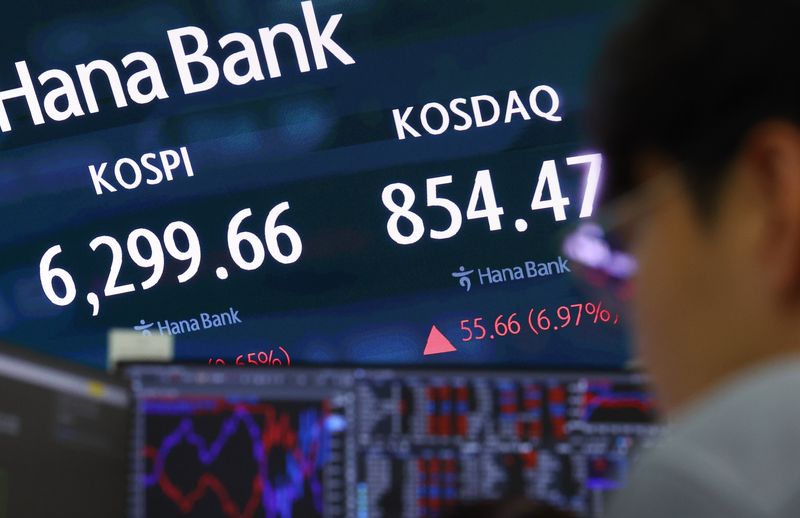
[Financial News] KOSDAQ, which had been weak for nearly two months, is quickly recovering its losses. As money that had flowed into single-stock leveraged products declines, supply and demand in the KOSDAQ market are also improving.
After the financial authorities introduced supplementary measures, trading volume in single-stock leveraged products tied to Samsung Electronics and SK hynix fell sharply, leading analysts to say funds are moving back into KOSDAQ.
According to the Korea Exchange and Yonhap Infomax on the 10th, KOSDAQ closed at 854.47. That was up 55.66 points, or 6.97%, from the previous session.
The index opened at 807.66, up 8.85 points, or 1.11%, from the previous close. It then widened its gains from the start of trading and rose as high as 855.38 intraday, up 7.08%.
Buying by foreign and institutional investors drove the index higher.
On the KOSDAQ market, foreigners bought a net 105.4 billion won, while institutions bought a net 566.1 billion won. Individuals, meanwhile, sold a net 672.7 billion won, apparently taking profits.
Large-cap battery stocks strengthen ... Alteogen jumps more than 14% after BlackRock stake disclosure
By sector, biotech, materials, parts and equipment, and large-cap battery-related stocks showed strength.
Alteogen Inc., the largest company by market capitalization on KOSDAQ, surged more than 14% after a disclosure showed that BlackRock held a stake in the company. The filing said BlackRock owned 5% of Alteogen.
Buying also flowed into related stocks in South Korea. On the New York stock market late last week, SpaceX jumped 15.83% even after the lock-up period ended, lifting names such as Sphere (+8.89%).
As KOSDAQ surged early in the session, a buy-side sidecar was triggered around 9:50 a.m. As a result, program buy orders on the KOSDAQ market were suspended for five minutes.
This was the third time this month that a buy-side sidecar was triggered on KOSDAQ. Of the six trading days in August, the index surged enough to trigger the sidecar on three days.
Since July 31, the buy-side sidecar has been triggered four times over the past seven trading days. On this day, KOSPI and KOSDAQ rebounded sharply as the financial authorities implemented supplementary measures for single-stock leveraged products tied to 'Samsung Electronics-Nix,' which had been cited as a source of volatility during the global semiconductor correction. Over the same period, KOSDAQ rose 32.5%.
KOSDAQ jumped 11.63% on July 31, when the supplementary measures took effect. It rose 2.44% on Aug. 3, 5.88% on Aug. 4, 2.42% on Aug. 5 and 0.26% on Aug. 6, extending its gains for five straight sessions. It fell 0.36% on Aug. 7, but climbed nearly 7% again on this day.
Trading volume in single-stock leveraged products: 12.4485 trillion won → 845.2 billion won
Trading volume in single-stock leveraged products swelled to 12.4485 trillion won the day before the regulations took effect, but fell to about 845.2 billion won on the 7th.
Analysts say that as trading funds concentrated in Samsung Electronics-Nix single-stock leveraged products declined, money has been flowing back into the KOSDAQ market.
KOSDAQ trading value rose from 449.29 billion won on July 30 to 543.57 billion won on July 31, the first day the supplementary measures were implemented. It reached 638.27 billion won on Aug. 5 and increased to 706.73 billion won on this day, recovering to the 700 billion won range.
Since the start of the year, KOSDAQ trading value had generally stayed above 1 trillion won and even exceeded 2 trillion won through May 12. However, after single-stock leveraged products were first listed on May 27, it continued to decline.
On July 27, KOSDAQ trading value fell to 446.16 billion won, marking the lowest daily level of the year. Since July 31, however, it has been rising again.
KOSPI market trading value moved differently. It rose from 3.83209 trillion won on July 30 to 4.95677 trillion won on the day the regulations took effect, but then fell quickly and came to just 1.88402 trillion won on this day.
KOSDAQ accounted for 27.28% of the combined trading value of KOSPI and KOSDAQ on this day.
That was the highest level since 28.48% on May 26, just before the single-stock leveraged products were listed. The share of KOSDAQ trading value, which had fallen after the listing of the Samsung Electronics-Nix leveraged products, has returned close to pre-listing levels in about two and a half months.
After the listing of the single-stock leveraged products, KOSDAQ's share of trading value remained in the low 20% range or below. It fell as low as 9.88% on July 31, but moved back into double digits this month and climbed to nearly 30% on this day.
There are also concerns that another concentration could emerge after tighter regulation of single-stock leveraged products. That is because the top five exchange-traded funds by return from July 31 to Aug. 7 were all KOSDAQ leveraged products.
Improved liquidity conditions, along with policy-related factors, are also being seen as drivers of KOSDAQ's rise.
Korea Exchange to newly apply delisting rules for penny stocks
Meanwhile, in the second half of this year, discussions on introducing a KOSDAQ promotion and demotion system are expected to take shape, and procedures for removing distressed companies will also be fully implemented.
The Korea Exchange is also newly applying delisting rules for penny stocks. Stocks that have stayed below 1,000 won for 30 consecutive trading days since the 1st of last month are scheduled to be designated as administrative issue stocks from the 13th.
KOSDAQ's share of market capitalization is also rising again.
On this day, KOSPI market capitalization was estimated at 5,194.282 trillion won, while KOSDAQ market capitalization stood at 469.438 trillion won.
KOSDAQ accounted for 8.29% of the combined market capitalization of KOSPI and KOSDAQ. It was the first time in about two months that KOSDAQ's market-cap share had recovered to the 8% range.
At the start of the year, KOSDAQ's market-cap share stood at 12.67%. It then fell quickly as the stock market rose on the back of large-cap KOSPI stocks.
KOSDAQ's market-cap share entered the single digits at 9.98% on May 6. On June 25, it fell to 6.39%, the lowest level in about 27 years since 6.35% on May 12, 1999.
KOSDAQ's market-cap share, which had remained in the 6% to 7% range through last month, began rising this month and reached 8.29% on this day. Its return to the 8% range came about two months after June 11.
[email protected] Han Seung-gon Reporter