[Editorial] Accelerating the Development of the Northern Sea Route, While Solving Ice-Season Navigation Issues
- Input
- 2026-08-10 18:46:40
- Updated
- 2026-08-10 18:46:40
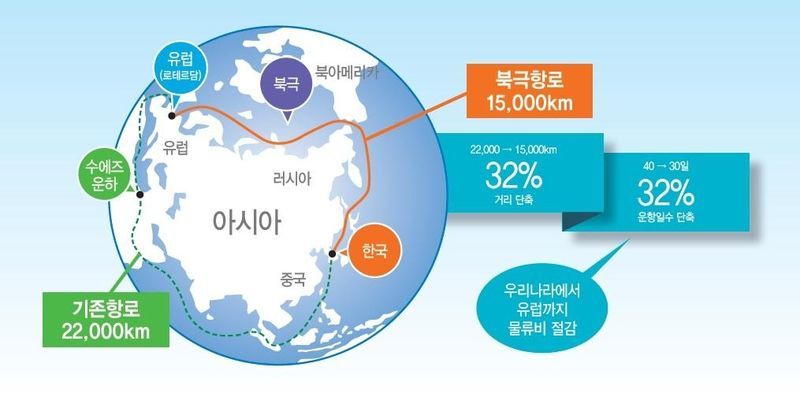
For South Korea, an export-driven country, the NSR is essential for future logistics expansion. Using the NSR reportedly shortens the distance between Busan and Rotterdam by about 35% compared with a route via the Suez Canal. For a country with large import and export volumes, the NSR could strengthen logistics competitiveness. A shorter route would reduce both transportation time and costs. That would help exporters improve their competitiveness by shortening delivery times and easing cost burdens.
The importance of the NSR has recently been highlighted again amid growing instability in the Middle East. As tensions in the region rise, the risks facing existing routes through the Red Sea and the Strait of Hormuz have increased. Rather than relying on a single logistics route, South Korea can develop the NSR and make it a pillar of alternative logistics. Other countries have already recognized the commercial appeal of the NSR and are competing to secure an early advantage.
The problem is that developing the NSR is not as easy as hoped. The government plans to launch a regular service route by 2030 and then deploy large container ships in 2035 to secure profitability. However, if it fails to create demand for the route, the effort will be meaningless. To that end, the government has commissioned research on shippers, shipping lines and logistics companies to refine its cargo attraction strategy. It plans to secure commercial viability by encouraging cargoes such as containers and bulk shipments to use the new route, depending on their characteristics. To make that happen, practical incentives must also be introduced so that shippers are willing to shift to the new route.
The climate and environmental conditions are also far from favorable. The government must closely assess the Arctic region's unique characteristics, where freezing and thawing seasons overlap. Extreme seasonal conditions are tied to icebreaker support, port infrastructure and safe navigation systems, so these issues must also be addressed.
There are also diplomatic risks. To pass through the NSR, ships need route guidance support from Russia, but this process could potentially violate sanctions on Russia, among other unresolved issues. Depending on changes in the international situation, not only the development of the route but even the operation of routes already secured could face disruptions.
Developing the NSR is clearly a path South Korea must take. Rather than rushing to meet a schedule, what is needed is policy agility that ensures safety and effectiveness. In addition to securing cargo and building logistics networks, the government should carefully establish a system for continuously monitoring the risks of international sanctions.