KOSDAQ jumps 32% in 10 days as money leaves Samsung Electronics and SK hynix for growth stocks [KOSDAQ surges, KOSPI lags]
- Input
- 2026-08-10 18:26:50
- Updated
- 2026-08-10 18:26:50
According to the Korea Exchange on the 10th, KOSDAQ rose 32.52% from the 31st of last month through the 10th. Over the same period, KOSPI (Korea Composite Stock Price Index) gained 12.62%, less than half of KOSDAQ's increase. Samsung Electronics and SK hynix also rose 11.11% and 7.41%, respectively, but still fell far short of KOSDAQ's gain.
The rebound in KOSDAQ is also being attributed to a easing of the concentration of funds in large semiconductor stocks and leveraged products. As the semiconductor sector has recently taken a breather and overheating in single-stock leveraged exchange-traded funds (ETFs) has cooled, investor attention has shifted toward KOSDAQ, according to market watchers.
Trading in related products also cooled quickly. For example, trading value in the 'KODEX SK hynix single-stock leveraged ETF' fell from 362.54 billion won on the 30th of last month to 125.96 billion won on the 31st, and then to 17.82 billion won on the 10th. Compared with July 30, that marked a plunge of 95.1%.
Institutions led the rebound in KOSDAQ. During the period, they posted net purchases of 1.5224 trillion won in the market. That contrasts with net sales of 1.0519 trillion won by foreign investors and 552.9 billion won by individual investors. Among institutions, financial investment firms bought the most at 537.4 billion won, followed by asset management firms with 492 billion won, private equity funds with 233 billion won, and public pension funds with 211 billion won. In other words, buying was broad-based across the institutional sector, not limited to financial investment firms.
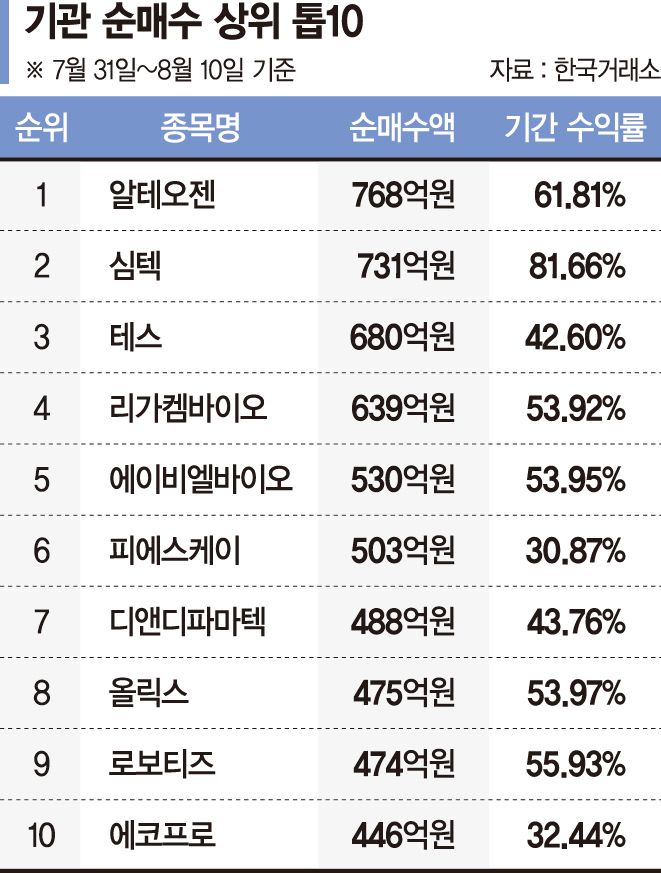
Institutions focused their buying on growth stocks. The top net-bought names included Alteogen Inc. (76.8 billion won), SIMMTECH Co., Ltd. (73.1 billion won), TES (68 billion won), LigaChem Biosciences Inc. (63.9 billion won), ABL Bio Inc. (53 billion won), PSK Inc. (50.3 billion won), D&D Pharmatech Inc. (48.8 billion won), OliX (47.5 billion won), Robotis (47.4 billion won), and EcoPro (44.6 billion won). Semiconductor materials, parts and equipment, biotech, and robotics stocks dominated the upper ranks. Over the same period, SIMMTECH rose 81.66%, Alteogen 61.81%, Robotis 55.93%, OliX 53.97%, ABL Bio 53.95%, and LigaChem Biosciences 53.92%, meaning all 10 of the top net-bought stocks by institutions gained more than 30%.
Brokerages say KOSDAQ does not appear overly expensive despite the recent sharp rebound. They note that the earlier selloff eased valuation pressure and that earnings outlooks remain relatively solid, leaving room for further gains.
Kwon Beom-seok, a senior analyst at Samsung Securities, said, "KOSDAQ's maximum drawdown (MDD) in July this year was 47.4%, larger than the 44.2% seen during the 2020 pandemic." He added, "As of August, KOSDAQ's forward 12-month P/E ratio stands at 18.0 times, in line with the historical average of 17.5 times, so valuation pressure has eased significantly."
Still, some analysts say it remains to be seen whether the sharp rebound will translate into a long-term rally. KOSDAQ's average daily trading value fell from 1.1559 trillion won in May to 667.7 billion won in June and 519.8 billion won in July. So far this month, it has stayed at a similar level of 517.5 billion won. Weak fundamentals, high valuations and declining market confidence are seen as structural problems. However, if policy measures such as stricter delisting requirements, a KOSDAQ entry-and-exit system, and the National Growth Fund take hold in earnest, upward momentum could expand again after September and help the index recover to the 1,000 level.
Lee Sang-jun, a researcher at NH Investment & Securities, said, "The market needs to become one that can push out marginal companies, prevent quality companies from leaving, and absorb promising firms such as unicorns." He added, "Once trust is established, long-term institutional funds such as public pension funds are also expected to flow in naturally."
[email protected] Bae Han-geul Reporter