Ruling Party Raises Questions About U.S. Cross-Listings, Touting 'Korea Premium' Amid Fears Retail Investors May Flee
- Input
- 2026-08-10 16:30:32
- Updated
- 2026-08-10 16:30:32
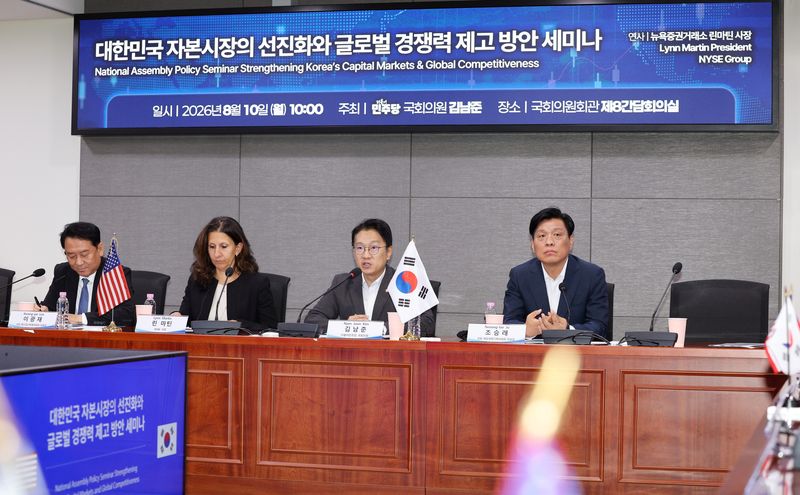
On the 10th, DPK lawmaker Kim Nam-jun, who served as the first Blue House spokesperson under the Lee Jae Myung administration, held a seminar at the National Assembly titled "Measures to Advance Korea's Capital Market and Enhance Global Competitiveness." Lynn Martin, president of the New York Stock Exchange (NYSE), was also invited to the event. Her invitation is seen as an extension of President Lee Jae Myung's visit to the NYSE in September last year, when he urged investment in the Korean stock market by highlighting the "Korea premium," including stronger corporate governance transparency and investor protection. The fact that Kim, one of the president's closest aides, hosted the event in person is also being interpreted as support for the government's and ruling party's push to advance the capital market.
With many securities firm CEOs in attendance, DPK lawmakers repeatedly asked Martin detailed questions about ways to improve the competitiveness of the domestic stock market. As the questions continued on issues facing the local market, Martin's side even requested that the seminar be closed to the press.
Lee Kwang-jae, chairperson of the Special Committee on Budget and Accounts of the National Assembly, referred to SK hynix's recent American Depositary Receipt (ADR) listing and asked, "What factors would work as the 'plus and minus' when a Korean company seeks a cross-listing on the New York Stock Exchange?" Oh Gi-hyoung, the ruling party's floor deputy on the Strategy and Finance Committee and chair of the DPK's "K Capital Market Special Committee," also asked in succession, "What are the threat factors facing the Korean stock market?"
Martin gave a fairly general answer, saying that key conditions for cross-listings include a system for sharing corporate information between South Korea and the United States, regulatory coordination, and investor protection to strengthen market interconnectedness. However, she did not offer a separate response on the specific threats facing the Korean stock market.
Their interest appears to reflect concern that the recent "Samsung Electronics, SK hynix leverage" controversy could push retail investors out of the domestic market. Retail investors, in particular, are seen as a key constituency the DPK wants to embrace as it expands beyond its traditional organizational and ideological base toward the political center. Analysts say the Lee Jae Myung administration's efforts to promote capital market reform and boost shareholder value under the banner of the "Korea premium" are closely tied to that strategy.
For the DPK, it is essential to prevent the controversy over single-stock leveraged products from escalating beyond backlash among retail investors and into an actual exodus from the domestic market. Since capital market reform is one of the administration's key policy goals, the party plans to push amendments to the Financial Investment Services and Capital Markets Act in the second half of the 22nd National Assembly, including the introduction of a mandatory tender offer system and tougher rules on the return of short-term trading profits. The goal is to strengthen investor protection and shareholder returns in the domestic market and continue attracting both retail and foreign investors.
[email protected] Song Ji-won Reporter