Yeouido securities firms to seek crypto business models at next month’s KBW [Crypto Briefing]
- Input
- 2026-08-10 15:14:55
- Updated
- 2026-08-10 15:14:55

[Financial News] As South Korea's financial investment industry expands its push into virtual asset businesses, with Korea Investment & Securities investing in Coinone and Mirae Asset Financial Group acquiring Korbit, executives from global crypto and financial infrastructure companies will gather in Seoul next month. Business models that connect traditional finance with on-chain finance, including tokenization of real-world assets such as stocks, stablecoins and custody services, are expected to become a major focus for the industry.
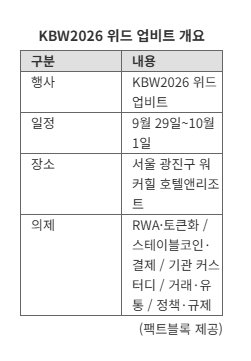
According to FACTBLOCK and industry sources on the 10th, Johann Kerbrat, senior vice president and head of crypto at Robinhood, Monica Long, president of Ripple, Mike Belshe, co-founder and CEO of BitGo, and Yuval Rooz, co-founder and CEO of Canton Network, will speak at 'KBW 2026 with Upbit,' which will be held from Sept. 29 to Oct. 1 at WALKERHILL HOTELS & RESORTS in Gwangjin District, Seoul. Chetan Karkhanis, senior vice president in charge of digital asset clients at Franklin Templeton, and Bruno Favier, head of institutional custody sales at Kraken, will also attend.
Financial firms in South Korea and abroad are widening the link between virtual assets and existing financial infrastructure. Korea Investment & Securities previously made a strategic investment in Coinone, while Mirae Asset Financial Group acquired Korbit. Overseas, BNY has introduced a digital transfer-agent service that records fund transactions and shareholder registers on the blockchain, and BlackRock has launched a tokenized money market fund (MMF) aimed at the reserve-asset demand of stablecoin issuers. Visa and Mastercard are also integrating stablecoin functions into their existing payment networks. Beyond issuing and distributing tokenized products, the key challenge is how to connect blockchain with existing financial infrastructure for payments, settlement, custody and transfer-agent services.
For domestic securities firms, the challenge is how to turn their exchange investments into actual services. They are reviewing how to link securities accounts with virtual asset trading accounts, which entities should handle the issuance, distribution and custody of tokenized financial products, and how existing financial regulations and rules for virtual asset service providers would apply if stablecoins are used for payments and settlement. Industry officials say business models and regulatory responses must be designed together, especially because the scope of work and outsourcing rules between financial firms and virtual asset service providers are still being refined.
That is why Robinhood's Kerbrat is drawing strong attention as a KBW speaker. Robinhood is expanding beyond stock and crypto trading into on-chain finance, including stock tokens and RWA. Canton is building tokenization and interoperability infrastructure for institutions, while BitGo and Kraken are expanding institutional custody services. Ripple is also broadening its payments and stablecoin businesses.
KBW's decision to separately host the invitation-only 'Upbit Institutional Summit' on the first day of the event, next month on the 29th, also reflects this trend. The summit will feature separate sessions for financial institutions and policymakers, in addition to existing blockchain projects and virtual asset companies, and will cover business and policy discussions related to institutional entry into the crypto market. For securities and asset management firms, a key issue will be how to apply overseas examples of tokenization, custody and payment infrastructure to South Korea's regulatory environment.
On the policy side, Chris Land, staff director of the Digital Assets Subcommittee of the United States Senate Committee on Banking, Housing, and Urban Affairs, is on the speaker list. In the United States, the Senate is continuing discussions on the Digital Asset Market Clarity Act, which would define the oversight boundaries of the SEC and CFTC and set rules for the virtual asset trading market.
An industry official said, "Securities firms' crypto businesses are moving beyond partnerships with exchanges and into the stage of building actual service models." The official added, "Interest in KBW is high because the key challenge ahead is how to connect the distribution and custody of tokenized products, as well as payments and settlement, with existing securities infrastructure."
[email protected] Kim Mi-hee Reporter