[Editorial] Japan's Self-Reflection on 'Failure in Digital Transformation' Is Not Far-Fetched
- Input
- 2026-08-09 19:07:21
- Updated
- 2026-08-09 19:07:21
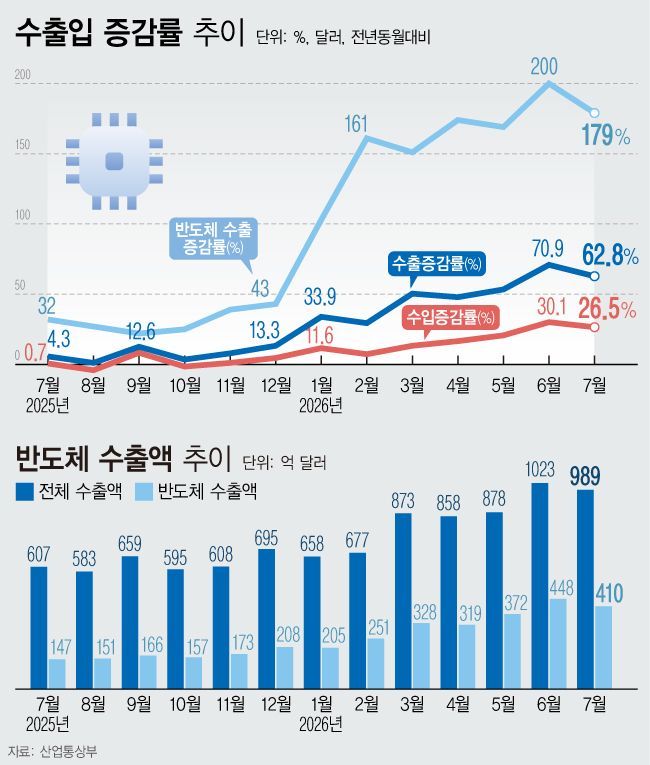
Nikkei, Inc. reported on the 7th that, after analyzing trade statistics from South Korea, Japan and Taiwan, as well as UN trade data, Japan's exports in the first half of this year totaled $384.4 billion, trailing South Korea's $496.3 billion and Taiwan's $416.6 billion. It was the first time the two countries had overtaken Japan. While Japan's exports rose only 10% from a year earlier, South Korea and Taiwan posted gains of nearly 50%.
AI semiconductors made the difference. Samsung Electronics, SK hynix and Taiwan's TSMC absorbed demand driven by the global expansion of AI investment. Semiconductor exports in the two countries accounted for 30% of total exports. South Korea surpassed last year's full-year export total in just six months. By contrast, Japan's semiconductor exports accounted for only 5% of the total. Japan remains strong in manufacturing equipment, but it has failed to close the gap with the rapidly growing market for finished advanced semiconductors.
That does not mean there is room for complacency. It is now time to turn attention to the gap with Taiwan. TSMC's global foundry market share exceeds 70%, while Samsung Electronics' share is still below 10%. Taiwan is emerging as an AI hub through an ecosystem that spans design, foundry and packaging. High Bandwidth Memory made in South Korea is assembled into AI semiconductors in Taiwan and then supplied to NVIDIA. That is why concerns persist that South Korea could remain merely a parts supplier to Taiwan's ecosystem. Nomura Securities' warning in April that "in the AI era, relying only on memory semiconductor exports could leave us at risk of becoming a subcontractor to Taiwan" was especially sobering.
These concerns are also reflected in economic indicators. The International Monetary Fund (IMF) projects that South Korea's Gross Domestic Product (GDP) per capita will lag Taiwan's by more than $10,000 in five years. Overseas investment banks (IBs) expect Taiwan's growth rate this year to be in the 7% range, while South Korea, despite recent upward revisions, is still seen in the 3% range.
Experts point to differences in industrial structure as the cause. Taiwan built a semiconductor ecosystem covering design, production and back-end processes early on, while South Korea has yet to move beyond an export structure centered on memory chips. Once the boom from the memory semiconductor supercycle ends, the current pace of export growth will inevitably slow. Government support is also essential. Taiwan has given priority support to strategic industries in semiconductors and AI, including tax incentives, research and development (R&D) subsidies, and even electricity and water supplies.
We must not forget that if we miss the window for structural reform, as Japan did, we could quickly fall behind. The government and the National Assembly should focus on tax incentives and national support such as electricity and water supplies to build an ecosystem for advanced industries. This is not the time to argue over exceptions to the 52-hour maximum workweek regulation within the 'three major mega-project' special zones. Japan may not be the only one that needs to reflect.