"Bus Depot Is a New Town" and "I Live in Banpo" ... Criticism and Mockery Explode Over 'Bus House' Proposal
- Input
- 2026-08-10 06:00:00
- Updated
- 2026-08-10 06:00:00
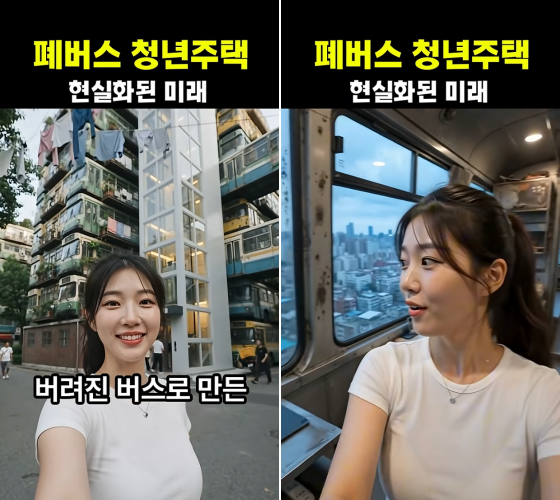
[Financial News] Three days have passed since DPK lawmaker Hwang Hee proposed using discarded buses as housing for young people, but criticism online has not subsided.
Hwang deleted the post, saying it was only an idea, but the controversy continues as memes and generative AI images mocking the proposal keep appearing.
Anger among young people is growing in particular. Along with backlash such as, "We may not have homes, but we do have pride," they are criticizing the proposal as evidence that politicians are out of touch with the housing crisis.
"Turning Buses Into Homes" ... Satire Floods the Internet
On the 7th, Hwang said on social media that he was considering "a program that would remodel discarded buses into residential spaces and provide them as short-term housing for young people near university districts."
He described it as an idea inspired by Amsterdam's 'Boat House' and explained that even if remodeling costs were set at 50 million won per unit, supplying 10,000 units would cost about 500 billion won. He also said mobile or trailer-type Bus Houses would be possible.
But once the post was made public, a backlash erupted on social media and online communities. AI images and edited photos mocking Hwang's proposal spread quickly across social platforms such as X, Threads, and Instagram.
One online community posted an AI-generated image titled 'I Live in Banpo~.' Several buses are parked at the Central City Terminal in Seocho-gu, Seoul, and the front bus is labeled 'Bus House 01.'
Despite the title, the image is interpreted as meaning that the resident does not actually live in a home in Banpo, but in a discarded-bus youth housing unit.
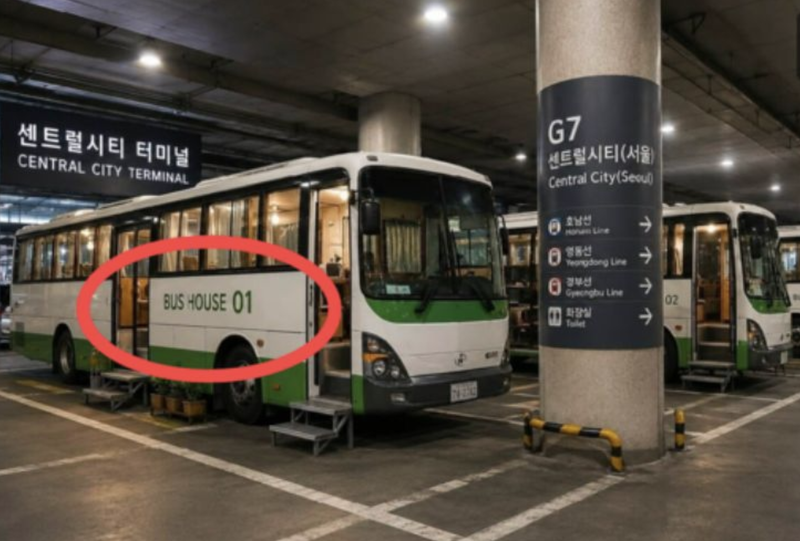
In addition, parody images have been posted one after another, including a 'bus apartment' made by stacking old buses into multiple levels, along with phrases such as 'DPK Moving Castle,' 'The First Moving Castle,' 'Han River Bus Apartment,' 'Youth Happy Housing Manager Hwang Hee,' and 'Democratic Real Estate.'
Satire also continued with slogans that resembled real policy promotional materials, such as "Turning buses into new homes, into tomorrow for young people" and "Youth housing where we live together, value together."
Satirical videos using generative AI also appeared.
In a YouTube video titled 'A Future Virtual Vlog of Youth Housing Made from a Discarded Bus,' a fictional reporter asks a "resident in their sixth month of move-in" how life is, and the resident replies, "Everything is good. In summer it becomes a sauna, and in winter it becomes a freezer."
Subtitles also appear showing a moldy interior and metal bunk beds, saying, "It feels like exactly 50 million won was spent per unit."
Comments expressing sympathy were also posted on the video, including remarks such as, "Some people are working hard to eliminate shantytowns, but this is creating something even worse than a shantytown," and "If human rights abuses against foreign workers in rural areas are so serious, why build dormitories with taxpayers' money while treating young Koreans in their 20s and 30s as less important than foreign workers?"
Beyond simple mockery, some users pointed to overseas examples of reusing discarded buses and criticized politicians for repeatedly floating irresponsible policies.
One netizen introduced a case in which the Indian government used buses that had been taken out of service in New Delhi in 2014 as temporary shelters for homeless people and low-income patients' families staying near hospitals, by installing mattresses and blankets inside them.
The user also noted that in 2017, authorities considered converting old train cars into temporary housing and using them as shelters for the homeless in 16 cities, including Hyderabad in Telangana State.
In the United Kingdom, the social enterprise Buses 4 Homeless has been operating a facility that converts retired London double-decker buses into accommodations with beds and living space, helping homeless people become self-reliant.
The netizen added, "There have been cases overseas where discarded buses or retired transport vehicles were used as housing spaces," but pointed out that "most of them were temporary shelters for the homeless or other vulnerable groups in urgent need of protection, and it is hard to find examples presented as housing measures for ordinary young people."
Both ruling and opposition parties voice criticism
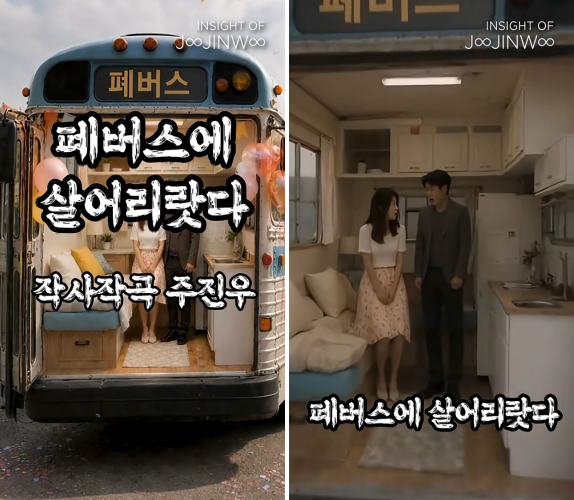
Criticism also continued in political circles. In particular, the People Power Party intensified its criticism for the third straight day.
In a written statement on the 9th, People Power Party chief spokesperson Choi Bo-yoon said, "As the Lee Jae Myung administration's policy incompetence has blocked the path to normal housing supply, an astonishing proposal has even emerged telling young people to 'live in discarded buses.'" She added, "The sheer absurdity of claiming that 10,000 households will be supplied through discarded buses and comparing it to overseas cases clearly shows how lightly the current administration and the ruling party have treated the lives of the public and the desperate situation of young people."
She continued, "Because they lack the ability to come up with a proper urban housing supply plan, they are ultimately mocking the younger generation with a deceptive stopgap called 'Bus House.'"
People Power Party lawmaker Joo Jin-woo also uploaded a short-form video in music-video format to YouTube the day before. The song, titled 'I Will Live in a Discarded Bus' and credited to Joo Jin-woo for lyrics and composition, begins with the line, "I dreamed of a home of my own, but a bus pulled up instead." It continues with lyrics such as, "A new world of youth housing arrived on wheels," "A parking lot is our neighborhood," and "The bus depot is a new town."
Park Chung-kwon, another chief spokesperson of the same party, also criticized Hwang, saying, "Hwang Hee and his family should be the first residents of Bus House." Reform Party deputy spokesperson Nam Kyung-soo said, "He should just honestly admit that he will never be able to buy a house in his lifetime."
Kim Jong-hoon, leader of the Progressive Party, also pointed out, "Even if the best housing is provided to young people, it is still not enough. Why should the burden of hardship fall on young people?"
Negative reactions also emerged within the DPK.
Kim Bo-mi, former chair of Gangjin County Council, criticized the proposal, saying, "If you are a three-term lawmaker who has even served as a minister, you should have thought carefully about the urgency of the youth housing problem and the quality of housing." She added, "The reason young people are angry is the hypocrisy of living in good homes themselves while offering discarded buses to young people, along with armchair theorizing."
[email protected] Seo Yoon-kyung Reporter