"Rental homes may disappear after the tax overhaul" ... Buying of homes under 1 billion won rises in Seoul [Real estate tax backlash]
- Input
- 2026-08-09 18:38:09
- Updated
- 2026-08-09 18:38:09
"We already know there are no jeonse listings. These days, some people skip rental inquiries altogether and go straight to purchase inquiries. Since the government has signaled restrictions on non-owner-occupied homes, purchase inquiries have been steadily increasing," said an authorized real estate agent in Nowon District, Seoul.
As the number of homes available for jeonse in Seoul shrinks, buying demand is spreading to the city's outskirts and to smaller apartments. In the field, agents say inquiries from newlywed couples without homes, who are trying to secure a new place with as much borrowed money as possible, have risen sharply. Market watchers say the tax reform plan, which includes restrictions on non-owner-occupied homes, is likely to further fuel buying sentiment.
■ Looking at buying demand in Nowon, Gangseo and Guro
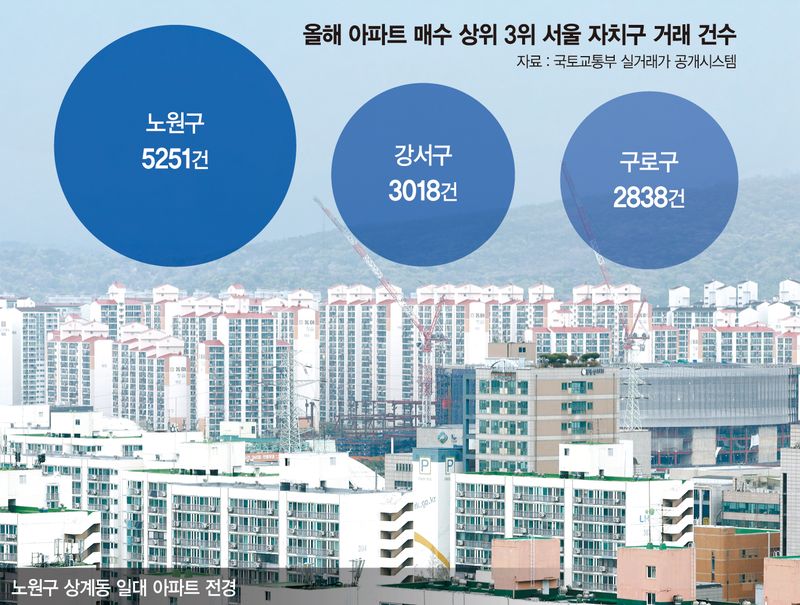
According to the real estate industry on the 9th, the top three districts in Seoul for apartment purchase transactions through July this year were Nowon District, Gangseo District and Guro District. All three areas have many small apartments, making them popular with single-person households and newlyweds.
Nowon District recorded 510 transactions in July alone. Of those, the vast majority, or more than 440, were deals under 1 billion won. On the 31st, five properties changed hands, including Hyundai 2nd Apartment in Sanggye-dong, with an exclusive area of 83 square meters, which sold for 545 million won. The highest sale price among them was 800 million won for Junggye 3 Woosung in Junggye-dong, with an exclusive area of 84 square meters.
Buying demand is also active in Gangseo District and Guro District. The two districts recorded 293 and 302 transactions in July, respectively, meaning about 9 to 10 deals were made each day. The average apartment transaction price in Gangseo District in July was 940 million won, while Guro District posted 808 million won.
The reason buying demand in Seoul's outskirts continues is that there is still no sign of an increase in jeonse or monthly rental listings. Last year, all of Seoul was designated as a land transaction permit zone, tightening owner-occupancy requirements. Now, with the tax burden on non-owner-occupied homes included in the tax reform plan, more homeowners are seeking to move into their properties after their lease ends.
■ Popularity is also surging in Gyeonggi Province near Seoul
Buying demand is visible not only in Seoul but also in Gyeonggi Province. In particular, areas near Seoul such as Gwangmyeong-si, Anyang and Namyangju remain popular. An authorized real estate agent in Doksan-dong, Geumcheon-gu, Seoul, said, "Of course, demand for apartments near Doksan-dong is higher, but some people are widening their search to Gwangmyeong because they are worried prices will rise further." He added, "If you just cross Anyangcheon, you're in Seoul, so even end users do not feel much resistance."
As buying demand concentrates on Seoul's outskirts, apartment prices are rising. In the first week of August this year, apartment sale prices in Nowon District rose 0.46%, far above Seoul's overall increase of 0.26%, according to the Korea Real Estate Board (KREB). Looking at cumulative gains this year, Guro District ranked second with 9.13%, while Gangseo District ranked third with 8.99%. Industry watchers also say the tax reform plan has ignited buying sentiment, as stronger owner-occupancy rules make a decline in jeonse and monthly rental supply inevitable.
The government's hint that it may ease restrictions on non-owner-occupied homes is also seen as related. Under the tax reform plan, if a homeowner who has lived in a house continuously for at least one year moves to another city or county for unavoidable reasons, the stay period will be recognized for up to three years only. In this regard, Deputy Prime Minister and Minister of Economy and Finance Koo Yun-cheol said on a recent radio program, "If there are truly unavoidable exceptions, we will listen to public opinion and review it once more."
[email protected] Kwon Jun-ho Reporter