Kim Min-seok and Jung Chung-rae in a razor-thin 1.48-point race; Honam and the Seoul metropolitan area seen as decisive
- Input
- 2026-08-09 19:00:04
- Updated
- 2026-08-09 19:00:04
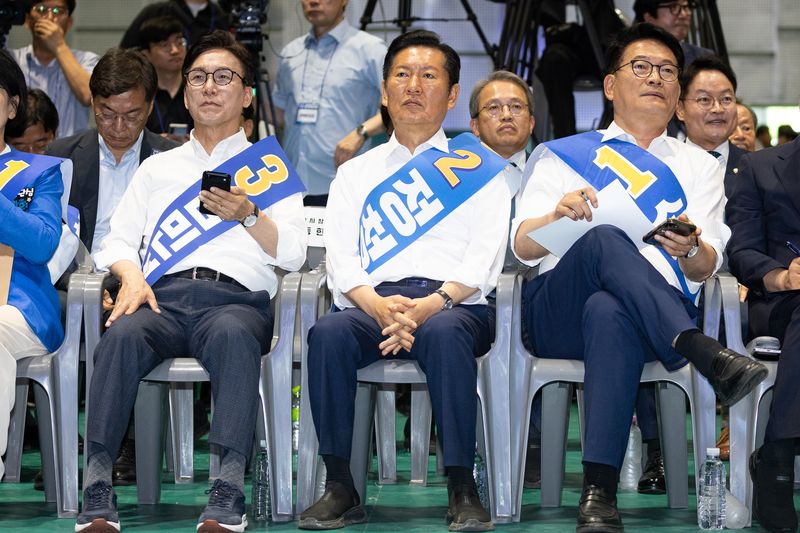
[Financial News] A fierce showdown is unfolding in the DPK leadership race, which will determine the party's future. Kim Min-seok, seen as a close confidant of President Lee Jae Myung, and Jung Chung-rae, who is campaigning on a platform of making the party more true to the DPK, are locked in a tight contest separated by just 1.48 percentage points, or 3,086 votes. The race is expected to be decided in Honam and in the Seoul-Gyeonggi primaries, where 70% of eligible party members are concentrated.
According to ruling party officials on the 9th, the DPK held regional primaries on the 8th and 9th in Jeju and Incheon, and in Gangwon Province and Daegu-Gyeongbuk (TK), ahead of its Aug. 17 party convention. Kim Min-seok won both rounds, taking a 3-1 lead over Jung Chung-rae. In Jeju and Incheon, Kim secured 47.75% to Jung's 42.08%, a gap of 5 percentage points. In Gangwon Province and TK, Kim received 48.54%, while Jung took 44.40%. Song Young-gil trailed with 10.17% in Jeju and Incheon and 7.04% in Gangwon Province and TK.
Earlier, in the regional primaries held on Aug. 1 and 2 in Daejeon, Sejong City, South Chungcheong Province, North Chungcheong Province, and Busan-Ulsan-Gyeongnam (PK), Kim and Jung each took one win. Jung narrowly lost in the Chungcheong primary, his hometown region, by 303 votes, but rebounded in PK. Combined, he edged Kim 45.52% to 44.51% in the Chungcheong and PK vote.
The mood shifted again after the Jeju and Incheon results were announced, with Kim winning both regions. He also led in two of the three areas in Gangwon Province and TK, excluding Daegu. As of the 9th, the cumulative vote share stood at 46.01% for Kim, 44.53% for Jung, and 9.47% for Song, before applying strategic-region weighting.
Seoul-Gyeonggi and Honam, home to 590,000 and 510,000 eligible party members respectively, are expected to be the biggest battlegrounds. A win in either region could quickly overturn the rankings. That is why all eyes are on the regional primary in Honam on the 15th. The candidates have also continued appealing for support from Honam in speeches in other regions. Kim has highlighted his experience as prime minister and said he is the best candidate to help build a successful semiconductor cluster in Honam, while Jung has referred to Honam as "the mother of the DPK" and urged voters to back him.
The Supreme Council race, widely viewed as a contest between pro-Lee and pro-Jung factions, is also drawing attention. A key point of interest is how many of the five Supreme Council seats, which make up the party leadership, will go to each camp. As of the 8th, after three rounds of primaries, pro-Jung candidate Choi Min-hee was leading with 21.28%. She was followed by pro-Lee candidate Park Sun-won at 16.74%, pro-Jung candidate Han Min-soo at 14.39%, and pro-Lee candidates Seo Mi-hwa and Kim Yong at 14.24% and 12.65%, respectively. Pro-Jung candidate Lee Sung-yoon is in sixth place with 11.88%, making the race for fifth place with Kim Yong highly competitive. Im Mi-ae has 6.67%, and Kim Young-ho 3.14%, leaving them outside the winning range.
The remaining regional primaries will be held on the 15th in Jeonnam-Gwangju and North Jeolla Province, and on the 16th in Seoul and Gyeonggi Province. The final results will be announced on the 17th after combining delegate votes and a public opinion poll. The voting formula gives 70% weight to delegates and eligible party members, each with one vote, and 30% to the public opinion poll. The party leadership race is being conducted under a preferential voting system. If no candidate wins a majority in the overall vote, the winner will be determined by adding the second-choice preferences of voters whose first-choice candidate finished last, excluding the top two candidates.
[email protected] Lee Hae-ram Kim Hyeong-gu Reporter