Foreign Exchange Market Finds Stability as Won–Dollar Rate Nears 1,300 Won
- Input
- 2026-08-09 18:15:47
- Updated
- 2026-08-09 18:15:47
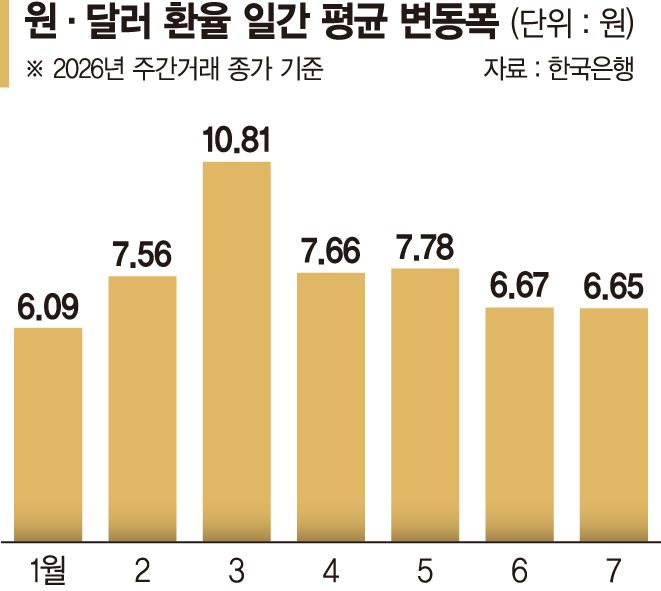
The won–dollar exchange rate and its volatility have gradually stabilized. As demand for won increased following SK hynix's listing of its American Depositary Receipt (ADR), foreign selling in the stock market eased and the Japanese yen strengthened, the exchange rate has continued to fall and is now threatening the 1,300-won level.
An analysis of the Bank of Korea's Economic Statistics System on the 9th showed that the average daily fluctuation in the won–dollar exchange rate in July, based on the closing price in onshore trading, stood at 6.65 won. Including data through the 6th of this month, the figure falls further to 6.17 won. The rate had been 6.09 won in January, rose to 7.56 won in February, and then jumped sharply to 10.81 won in March. It has since returned to the 6-won range since June.
What has recently calmed both the level and volatility of the won–dollar exchange rate was expectations that proceeds from SK hynix's American Depositary Receipt (ADR) listing would be converted into won. By converting a large portion of the $26.5 billion in proceeds into the local currency, the move put downward pressure on the exchange rate while also setting a clear direction, easing market swings.
Another factor has been the slowdown in foreign investors' selling of domestic stocks, which had previously pushed the exchange rate higher. Foreign investors posted net sales of 47.0338 trillion won in the domestic stock market in June, but that figure dropped sharply to 9.8143 trillion won in July. It was also far smaller than in March, when the exchange rate was highly volatile and net sales reached 35.7123 trillion won.
Recently, a physical intervention by the United States and Japanese governments, in which they jointly bought Japanese yen, also helped stabilize the exchange rate. In the foreign exchange market, the yen and the won are often viewed as a package, so they frequently move in tandem. Until now, the won had tended to weaken alongside the yen, but this time it is benefiting from the yen's strength.
Cho Yong Gu, a researcher at Shinyoung Securities Co., Ltd., said, "After the ADR listing proceeds were converted, exporters such as shipbuilders appear to have adjusted their foreign exchange positions." He added, "At the same time, funds from the World Government Bond Index (WGBI) are coming in and foreign stock selling is easing, so supply and demand have aligned in one direction all at once."
Exchange rate levels and volatility are not always linked, but swings tend to intensify when the exchange rate is high. In particular, currencies against the dollar tend to weaken during crises such as financial turmoil, COVID-19, or war. At such times, market participants are less certain about the direction, leaving the foreign exchange market vulnerable to confusion.
A foreign exchange market source said, "There are still factors that could spur volatility, including tightening by the Federal Open Market Committee (FOMC), escalating tensions in the Middle East, and a shift toward yen weakness." The source added, "Still, with the exchange rate staying in the 1,400-won range for 18 trading days through the 7th, confidence in the path ahead is gradually becoming clearer."
[email protected] Kim Tae-il Reporter