Labor and industry ministries again out of sync... 52-hour workweek exemption takes on the shape of a labor-management proxy battle
- Input
- 2026-08-09 18:10:33
- Updated
- 2026-08-09 18:10:33
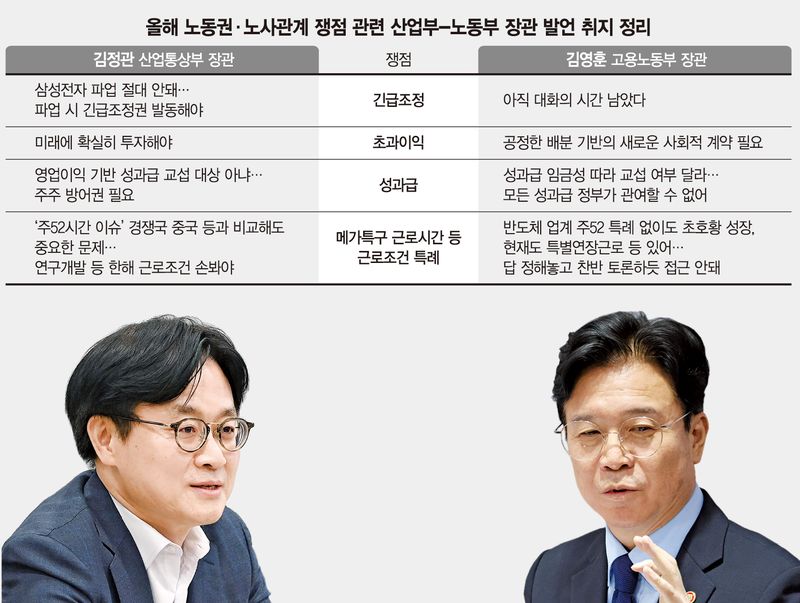
As the dispute over special working-condition rules in the Mega Special Zone has exposed differences between ministries and begun to look like a proxy battle between labor and management, calls are growing for someone to sort things out. Given the unprecedented scale of investment and the discussion of special labor rules, the government needs not only to find a compromise but also to establish a system that allows it to speak with one voice. Possible options include a decision by the Office for Government Policy Coordination or the Prime Minister's Office, tripartite social dialogue, or a standing interministerial consultative body. The fact that the Ministry of Trade, Industry and Energy is considering joining meetings with the two major umbrella labor unions is also being seen in that context.
■ MOTIE and MOEL: a proxy battle between labor and management?
According to the government on the 9th, MOTIE and the Ministry of Employment and Labor have been sending different signals this year on labor issues such as labor-management relations and working conditions. The two ministers have already clashed indirectly over issues including the emergency arbitration order in Samsung Electronics' labor negotiations, the method of sharing excess profits at large companies, and whether performance pay should be negotiated based on operating profit. A similar pattern is now emerging over special working-condition rules in the Mega Special Zone.
Recently, Industry Minister Kim Jung-kwan pointed to China's "996" system, in which employees work from 9 a.m. to 9 p.m., six days a week, and raised the need for an exception to the 52-hour workweek. Labor Minister Kim Young-hoon, meanwhile, argued that dialogue with labor should come first before any special rule is applied.
A MOEL official explained, "The labor minister's recent remarks were not meant to suggest that things can be done without the 52-hour limit. Rather, they mean the issue should not be pushed forward as if the answer has already been decided and people are simply debating for or against it." The official added, "This is not a situation in which there is a concrete split such as 'MOTIE says it must be done' and 'MOEL says it must not.'" A government official said, "From MOTIE's perspective, it is only natural to want as many regulatory exceptions as possible included in the relevant law. On the other hand, MOEL, which must keep communicating with labor groups, would inevitably feel burdened by that stance."
■ "The government must try to speak with one voice"
To reduce this kind of discord, voices are calling for procedures and decisions that would allow the government to speak with one voice. Discussions on the Mega Special Zone began in April, when the special committee on the Mega Special Zone was launched within the DPK. Since then, there has been no formal or regular communication channel between the two ministries. It is understood that they have mostly exchanged materials in writing only when opinions were requested on issues or suggestions were being reviewed. There is also no formal communication channel for other labor-management issues, not just the Mega Special Zone.
Yoon Dong-yeol, a professor at Konkuk University, said, "The government is not two separate entities, so it is not appropriate for MOTIE and MOEL to keep appearing to disagree on labor issues." He added, "I think a standing consultative body between ministries is needed, and if necessary, the Office for Government Policy Coordination or the prime minister should actively step in and resolve the matter."
He also said that labor-rights issues should be approached through tripartite social dialogue rather than one-sided implementation. Some critics say the Mega Special Zone is being pushed too quickly and that deliberation has not matured enough. They argue that caution is needed because the project involves investment on the scale of trillions of won. No existing special zone law has granted exceptions to working conditions. Yoon said, "We need to create a tripartite social dialogue channel for the Mega Special Zone so that labor-rights issues are not pushed through unilaterally and enough consultation can take place between labor and management." He added, "This should not be seen only as a race for speed. Based on deliberation, there could also be discussion of compromises between labor and management, including special rules and health rights."
[email protected] Kim Jun-hyuk Reporter