"Recovering Samsung Electronics and SK hynix losses here"...Money is flowing into construction and secondary batteries
- Input
- 2026-08-10 06:00:00
- Updated
- 2026-08-10 06:00:00
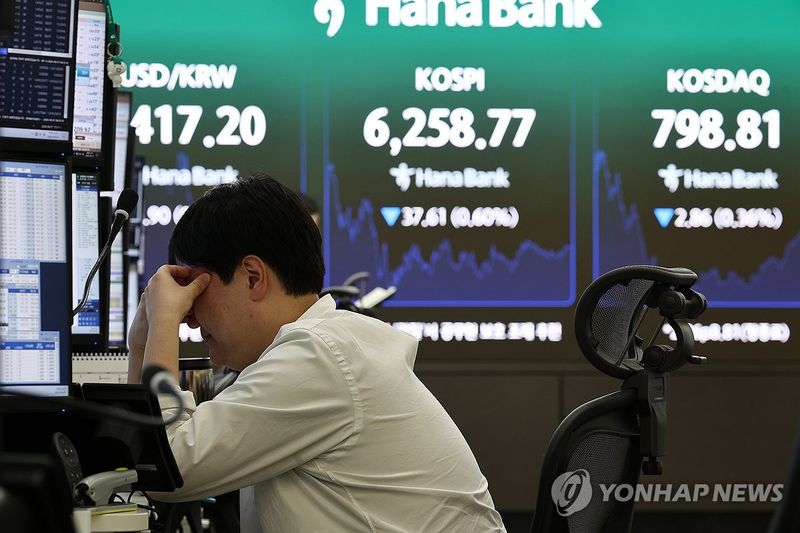
[Financial News] Although KOSPI (Korea Composite Stock Price Index) has fallen more than 5% so far this month, nearly 9 out of 10 stocks in the KOSPI market have actually risen. Analysts say that as leveraged positions concentrated in large semiconductor stocks in the first half of the year were largely unwound during last month's sharp selloff, money is now rotating into neglected sectors and small- and mid-cap stocks.
According to the Korea Exchange on the 9th, the KOSPI fell 5.1% during the period from August 3 to 7. The decline was largely driven by Samsung Electronics and SK hynix, the market's No. 1 and No. 2 companies by market capitalization, which fell 12% and 17.23%, respectively, over the same period.
But the movement in individual stocks was the opposite. Of the 917 listed stocks in the KOSPI market, excluding suspended stocks, 794 rose during the same period, accounting for 86.6% of the total. Only 7 were unchanged, while 116 fell. The number of gainers was about seven times the number of decliners.
The KOSDAQ (Korean Securities Dealers Automated Quotations) also rebounded over the same period. On July 31, August 3 and August 4, a temporary suspension of program buy orders (buy-side sidecar) was triggered in the KOSDAQ market for three consecutive trading days for the first time ever. As a result, the KOSDAQ rose 10.98% so far this month. In particular, small- and mid-cap growth stocks that had been overlooked, such as pharmaceuticals, biotech and robotics, led the rebound. As of July 30, the KOSDAQ had fallen 30.33% from the start of the year, underperforming the KOSPI.
Brokerage firms say the recent market shift reflects large-scale deleveraging that took place during July's sharp selloff. They say the unwinding of excessive leveraged positions has eased supply-demand pressure across the stock market.
In fact, the combined margin loan balance for KOSPI and KOSDAQ had surged to a record 38.6328 trillion won on June 24, but it fell to 27.4038 trillion won on August 4, the lowest level this year, in just a little over a month.
Lee Sang-heon, an analyst at iM Securities, said, "In the first half of the year, leverage positions centered on margin trading became heavily concentrated, causing the index to rise rapidly on the back of large semiconductor stocks while other stocks fell behind." He added, "As deleveraging progressed in July, volatility in the index increased. But the recent sharp decline in margin loans and the fact that more stocks are rising even as the index falls suggest that the liquidation of leveraged positions is now largely in its final stage."
This month, gains in the KOSPI have spread to construction, secondary batteries, defense and nuclear power. The construction index rose 17.42%, while GS Engineering & Construction jumped 34.97% and Daewoo Engineering & Construction rose 28.40%. Expectations for AI data centers, power infrastructure and overseas plant orders were reflected in the gains. Samsung SDI rose 15.62%, and LG Energy Solution gained 9.76%, supported by expectations for ESS demand from the expansion of AI data centers. Hanwha Aerospace rose 19.63%, Doosan Enerbility 14.90% and LG Electronics 14.13%, all posting double-digit gains.
The outlook is that the market may continue to be driven by individual stocks rather than the index. Lee said, "Samsung Electronics and SK hynix could face weaker investor sentiment as earnings growth slows and interest rates rise." He added, "Since much of the earnings outlook has already been reflected in share prices, the stocks are more likely to move within a range for now rather than suffer another sharp drop." He also noted, "Going forward, what matters is not how high the index can rise, but how broadly the rally spreads to other stocks while large-cap names remain range-bound."
[email protected] Park Ji-yeon Reporter