"Before the shock from the plunge has even faded..." Retail investors are back to 'margin buying'; credit loan balance jumps by 1 trillion won in a day
- Input
- 2026-08-08 08:50:41
- Updated
- 2026-08-08 08:50:41
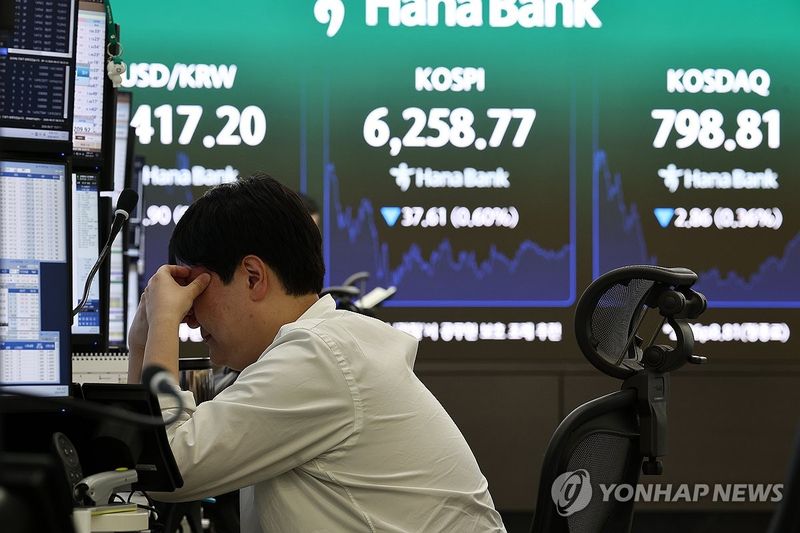
[Financial News] Retail investors' appetite for 'margin buying' has resurfaced before the shock from the market plunge has even worn off. The balance of credit loans, which once came close to 33 trillion won, fell to the 27 trillion won range during the selloff. But after KOSPI rebounded more than 3% in a single day on the 5th, it surged by more than 1 trillion won again.
Credit loan balances jump again as KOSPI posts a brief rebound
According to the Korea Financial Investment Association on the 7th, credit loan balances stood at 28.4179 trillion won as of the 5th. That was up 1.0141 trillion won in just one day from the year's low of 27.4038 trillion won recorded the previous day.
Credit loans refer to the amount investors borrow from securities firms to buy stocks. They are widely seen as a key indicator of margin buying.
As KOSPI posted a record rally this year, credit loan balances at one point approached 33 trillion won. They then fell to 28.935 trillion won on July 31, the lowest level in about six months.
After the sharp decline began on the 28th of that month, the downward trend continued through the 4th of this month. The market slump deepened investors' losses, while forced selling tied to falling stock prices and the unwinding of credit positions took place at the same time.
That did not last long. Once the market turned higher, sentiment changed quickly. On the 5th, KOSPI rose 3.76% and KOSDAQ (Korea Securities Dealers Automated Quotations) gained 2.42%, and credit loan balances immediately returned to an upward trend. With much of the leverage liquidation from the selloff already completed, investors appear to have resumed borrowing to buy stocks as the market rebounded.
Waiting funds for the market evaporate by 7 trillion won in a day... forced selling also eases
By contrast, cash waiting to enter the market fell sharply. According to the Korea Financial Investment Association, investor deposits, which had climbed into the 110 trillion won range on the 4th, dropped by about 7.2 trillion won in a single day to 103.2125 trillion won the next day. Investor deposits are the uninvested cash that investors keep in securities accounts for stock purchases, and are often called 'waiting funds for the stock market' or 'ammunition for retail investors.' Because the deposits fell sharply at the same time the market rebounded, some of that waiting cash may have been used for actual stock purchases.
Forced selling, which had surged during the plunge, is also showing signs of quickly calming down. On July 30 and 31, when market volatility was extreme enough to trigger the circuit breaker mechanism on two consecutive days, the scale of forced selling jumped to 103.8 billion won and 122 billion won, respectively. But on the 5th, it plunged to 11.7 billion won. As much of the forced liquidation that flooded the market during the selloff has now been absorbed, pressure from forced selling appears to have eased.
[email protected] Ahn Ga-eul Reporter