SK hynix Presents Direction for Next-Generation Memory Architecture at U.S. FMS 2026
- Input
- 2026-08-07 16:07:02
- Updated
- 2026-08-07 16:07:02
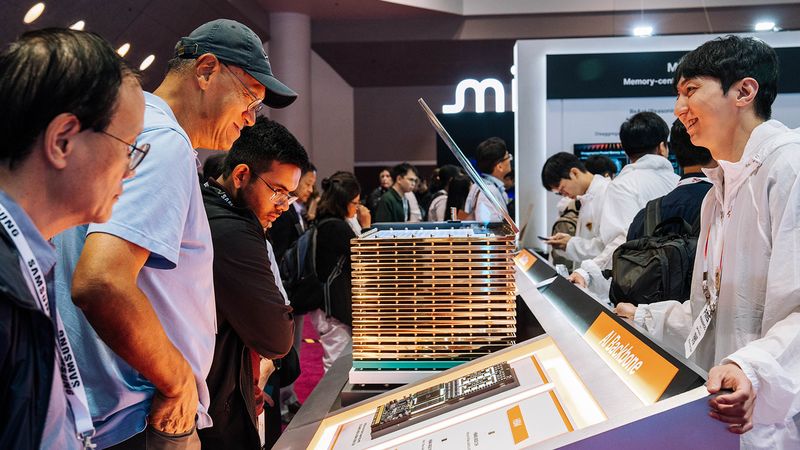
[Financial News] At FMS 2026, the world's largest exhibition and conference in the memory and storage sector, SK hynix showcased its latest portfolio of high-performance artificial intelligence (AI) memory and NAND-based server memory products, led by high-bandwidth memory (HBM).
According to the industry on the 7th, FMS 2026 was held from the 4th to the 6th local time at the Santa Clara Convention Center in California. More than 350 AI experts gathered this year to share the latest technology trends and insights, while cutting-edge products and technical information that will shape the future of the AI industry were presented at the exhibition. More than 3,500 participants visited the event over the three days.
At the conference, SK hynix highlighted its technological capabilities as a "full-stack AI memory creator" set to lead the AI era. Its booth was designed so visitors could take in the key memory solutions driving performance across AI systems at a glance.
The "Partnership Zone" focused on highlighting SK hynix's strong collaboration with major tech companies, including NVIDIA and Dell Inc., which are driving the evolution of AI technology, as well as the company's technological capabilities that make such partnerships possible. On the right side of the display table, models of HBM4, the sixth-generation product, and NVIDIA's next-generation AI accelerator, Vera Rubin, were placed side by side to show how the two companies' technologies connect.
SK hynix also demonstrated next-generation memory technology based on CXL, drawing strong interest from visitors to the booth.
On the first day of the event, Kim Cheon-seong, head of solution development, and Kang Wook-seong, who oversees next-generation product planning, took the stage for a joint presentation as the third speakers in the keynote session.
Kim said, "As AI expands from training to large-scale inference and further into Agentic AI, infrastructure competitiveness will no longer be determined by the performance of individual memory products alone." He added, "How each memory layer, including HBM, DRAM, NAND (HBF), and solid-state drives (SSD), is placed and connected to minimize data movement will determine overall efficiency." He emphasized, "Going forward, the ability to implement an optimized architecture that spans all memory layers will be a core factor in AI infrastructure competitiveness."
Kang also said, "SK hynix has a broad portfolio that spans every layer of AI infrastructure, from HBM to CXL-based memory and enterprise solid-state drives (eSSD)." He added, "Going forward, SK hynix's role will be to work with customers from the product design stage to develop and provide the optimal solutions they need."
On the final day, Lim Eui-cheol took part in a panel discussion titled "Breaking Through Memory Performance Limits with High Bandwidth Flash (HBF)." Lim said, "HBF is a new concept in memory that applies Through-Silicon Via (TSV) technology like HBM, achieving both the large-capacity characteristics of conventional storage and bandwidth comparable to DRAM. It has enough potential to establish itself as a new memory layer between HBM, the ultra-fast memory, and SSD, the large-capacity storage device."
He went on to describe HBF as a key solution for improving the scalability of AI systems and reducing operating costs. He said a co-design approach that develops hardware and software together is important for that goal. He also explained that SK hynix is working with major partners to secure next-generation technologies and advance standardization.
[email protected] Lim Su-bin Reporter