A Man in His 50s Says, "I Didn't Know I Was Subject to Mandatory Cash Receipt Issuance"... How to Avoid a Heavy Penalty [Tax and Investment Q&A]
- Input
- 2026-08-08 08:00:00
- Updated
- 2026-08-08 08:00:00
[Financial News] A man in his 50s, identified as A, has run an indoor sea fishing pond in Gangwon State for 10 years. Most customers paid in cash or by bank transfer, and until now he had issued cash receipts only when requested. Recently, however, he heard from an acquaintance who operates an indoor fishing venue that fishing ponds were newly added to the list of businesses subject to mandatory issuance this year. He then applied for a consultation to find out the exact rules.
According to BDO Sunghyun LLC on the 9th, the obligation to register as a cash receipt merchant applies to individual business owners whose revenue in the previous taxable period was at least 24 million won and who operate consumer-facing businesses, as well as to all corporate businesses. If a consumer pays in cash and requests a receipt, they must issue a cash receipt.
However, businesses designated by the National Tax Service as mandatory issuers must issue cash receipts even if the customer does not request one.
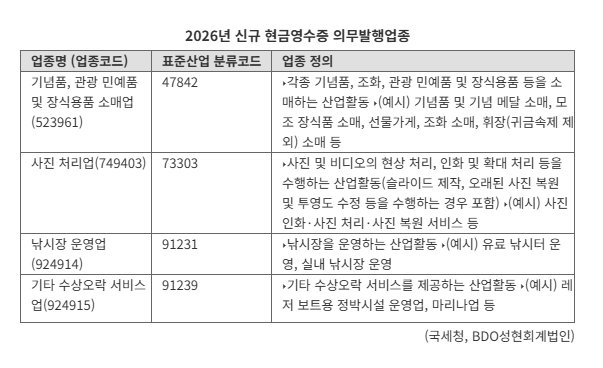
Starting with transactions made on January 1 this year, four business categories, including retail sales of souvenirs, tourist folk crafts and decorative goods, photo processing services, fishing pond operations, and other water-based entertainment services, were added to the mandatory cash receipt issuance list. As a result, the total number of mandatory categories has risen to 142 this year.
Kim Hyoyoung, a partner at BDO Sunghyun LLC, said, "The National Tax Service expands the list of mandatory cash receipt businesses every year, focusing on sectors with a high share of cash transactions."
Businesses in mandatory categories must issue a cash receipt even without a request when a customer makes a cash transaction of 100,000 won or more per transaction, including value-added tax. If the customer's personal information is unknown, they can still make a voluntary issuance within five days of the transaction by using the National Tax Service designated number (010-000-1234).
Even when no physical cash changes hands and payment is received by bank transfer or deposit without a bankbook, the transaction is still treated as a cash transaction, so the cash receipt obligation remains in place. A receipt must also be issued when a cash discount is offered on the condition that no cash receipt will be issued.
One important point is that the 100,000 won threshold refers to the total transaction amount, not just the cash portion. For example, if A is owed 200,000 won from a customer and the customer pays 50,000 won in cash and 150,000 won by credit card, a cash receipt must still be issued for the 50,000 won cash payment.
What penalties apply if a mandatory issuer fails to issue a cash receipt?
First, if the issuer violates the obligation and fails to issue a cash receipt, a penalty tax equal to 20% of the unissued amount will be imposed. Even if the failure was due to an error or omission, 50% of the penalty tax can be reduced if the receipt is voluntarily issued within 10 days of the transaction.
In addition, businesses that have not joined the cash receipt merchant system are also subject to fines or penalty taxes for non-issuance. Newly designated businesses in mandatory categories must join the cash receipt merchant system within 60 days for individual businesses or within three months for corporate businesses from the designated date, or from the opening date. If they operate without joining, a penalty tax of 1% of revenue will be imposed for the non-member period.
Consumers who paid 100,000 won or more in cash to a business subject to mandatory issuance but did not receive a cash receipt can file a report within five years of the transaction date through Hometax (Consultation, Objection, and Report → Report of Non-Issuance/Refusal to Issue Cash Receipts or Credit Card Receipts) or by mail to the tax office, along with supporting documents such as receipts or contracts. If the report is accepted, they can receive a reward equal to 20% of the unissued amount. The reward is capped at 250,000 won per case and 1 million won per person per year. Workers may also receive the cash receipt income deduction benefit.
Kim Hyoyoung said, "Because the penalty tax for failing to comply is significant, businesses serving consumers should be careful about issuing cash receipts." She added, "Even if the business code on the business registration certificate is different, the issuance obligation still applies if the actual business falls under a mandatory category. So businesses should not feel reassured just because their registered code is different."
The [Tax and Investment Q&A] series, based on consultations with experts at BDO Sunghyun LLC, is published every second week of the month.
[email protected] Park Ji-yeon Reporter