"But China Can't Be Trusted"...Cheap and Good, Yet Security Concerns Stall Adoption in a 'China Phobia' [AI Hegemony, China's Counterattack 5]
- Input
- 2026-08-11 05:00:00
- Updated
- 2026-08-11 05:00:00

Chinese AI models are entering the overseas developer market by emphasizing low cost and an open-model strategy. But outside China, data handling, security, and censorship standards can matter more than performance. In the fifth installment of [AI Hegemony, China's Counterattack], we look at the trust issues Chinese AI models face in overseas markets.
[Financial News] Chinese AI models are already being used overseas. Developers can download or access models such as DeepSeek, Qwen, Kimi AI, and GLM from Hugging Face, GitHub, and third-party cloud services. Their low cost and fast deployment make them attractive to startups and researchers.
However, governments and companies abroad look at different criteria. They check where the AI model was built, where user data goes, whether it can be used for sensitive tasks, and whether its responses are restricted by specific political standards. Even if Chinese models are cheap and high-performing, they undergo separate reviews in sensitive areas such as government, finance, healthcare, and defense.
Qwen, DeepSeek, GLM, and Kimi AI cross borders through third-party hosts
Chinese open models are spreading quickly overseas. Once model weights are made public, developers can test the models without going through the original developer's servers. If a third-party cloud hosts the model, users can access the service without signing a direct contract with a Chinese company.
The Center for Strategic and International Studies (CSIS), a U.S. think tank, said in a report last month that open models are spreading through Hugging Face, GitHub, cloud providers, local deployments, and third-party inference platforms. CSIS also found that startups in Europe, government agencies in Asia, and developers in Latin America can use Qwen, DeepSeek, GLM, and Kimi AI through third-party hosts.
This structure reduces political friction. Users do not need to install a Chinese company's app directly to use the model. It is also possible to host the model on an internal company server so that input data does not go back to the original developer. For companies that value cost and control, that is an advantage.
Stanford University's Institute for Human-Centered AI (HAI) and DigiChina Project, which studies China's digital policy, also addressed the global spread of Chinese open models in a report released in December last year. The report said Chinese open-weight models such as DeepSeek R1 and Alibaba Group's Qwen family are taking an important place in global AI competition.
Data location and privacy become issues
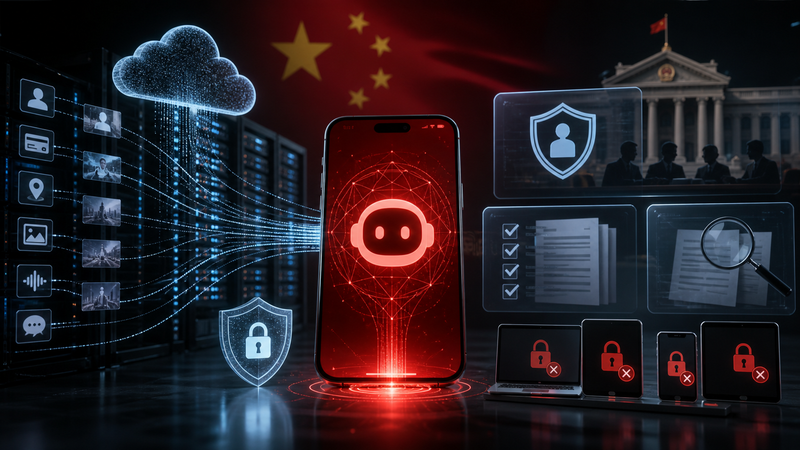
The problem arises when these models are offered as apps or services. Depending on where information entered into a chatbot app is stored, whether it is shared with third parties, and whether users can request deletion, the service may run into conflicts with privacy rules in each country.
In South Korea, DeepSeek's app was temporarily blocked from new downloads. The Personal Information Protection Commission (PIPC) said in February last year that new domestic downloads of the DeepSeek app were suspended from February 15. At the time, PIPC explained that DeepSeek had temporarily halted its app service to strengthen compliance with South Korea's Personal Information Protection Act and would resume after improvements and fixes.
In April that year, PIPC released the results of its review of DeepSeek's personal data handling practices. The review found that, when it launched in South Korea, DeepSeek had not sufficiently disclosed the fact that personal data was being transferred overseas, the recipient company, or the categories of data transferred. It also did not provide a Korean-language privacy policy. PIPC recommended better notice on overseas transfers, stronger user choice, and improved handling of prompt information.
DeepSeek later published a Korean-language privacy policy and resumed new downloads in domestic app stores. The South Korean case shows that if a Chinese AI service fails to meet privacy standards abroad, the service itself can be halted.
Italy's data protection authority also took action against DeepSeek. The Italian authority announced blocking measures related to DeepSeek on January 30, 2025. Before that, it had asked DeepSeek what personal data it collects, the purpose and legal basis for collection, and whether the data is stored in China.
Australia banned the use of DeepSeek on government devices over security concerns. Under the Australian Government Protective Security Policy Framework (PSPF), government agencies were instructed to block the installation and use of DeepSeek products, apps, and web services and to remove any existing installations.
Censorship standards in Chinese AI models are another variable in overseas adoption
Chinese AI models also come with censorship concerns. Generative AI services in China must follow registration requirements and content management standards set by the authorities. Overseas users check how the same models respond to sensitive political and historical topics.
For companies, predictability matters more than censorship itself. If a model refuses to answer certain questions or repeats a particular viewpoint, it becomes difficult to use for customer service, information retrieval, or educational services. Whether the model can be adjusted to meet local laws and internal company rules is also part of the review.
Open models can ease this problem to some extent. If a company downloads the original model and fine-tunes it internally, the service operator can change some response policies. But if the base training data and safety alignment process are not disclosed, it is still hard to fully understand why the model gives certain answers.
Chinese companies are also designing separate models and services for overseas markets. Multilingual support, local cloud hosting, enterprise deployment, and open-weight releases are all ways to reduce these concerns. Still, government procurement and sensitive industries often require additional security reviews simply because the model is Chinese.
Concerns for companies preparing to adopt Chinese AI
Chinese AI models have a price advantage. Open models lower the cost of experimentation for developers and startups. Bringing in an existing model and adapting it for specific tasks can also shorten initial development time. For companies trying to cut costs compared with closed U.S. models, they are an attractive option.
On the other hand, adoption reviews can take longer in overseas markets. Privacy impact assessments, cross-border data transfers, security logs, model update cycles, vendor location, and the possibility of government access all become review items. Even if the price is low, companies handling sensitive data do not make decisions lightly.
As a result, the overseas spread of Chinese AI is splitting into two paths. One is the rapid testing of open models by developers and startups. The other is the limited use of these models by governments and large corporations after security and privacy checks. The same model can be judged differently depending on the organization and the task.
CSIS said Chinese AI models are not necessarily used only through Chinese companies' apps. Through Hugging Face, GitHub, cloud providers, and third-party inference platforms, overseas companies and developers can also use models such as Qwen, DeepSeek, GLM, and Kimi AI.
In its report, CSIS explained that "startups in Europe, government agencies in Asia, and developers in Latin America can use Qwen, DeepSeek, GLM, and Kimi AI through third-party hosts." This means the channels through which Chinese AI models spread overseas have already expanded beyond Chinese companies' own apps.
However, using a third-party host does not eliminate security reviews. Companies and governments still ask who built the model, what data it was trained on, and what security standards are applied during operation. Even if Chinese AI models are not used directly through an app, their origin and data management methods remain under scrutiny during overseas adoption.
[email protected] Han Seung-gon Reporter