"Factories Before Chatbots": China's AI Rides on Industry, with the Government as Architect [AI Hegemony, China's Counterattack 4]
- Input
- 2026-08-10 05:00:00
- Updated
- 2026-08-10 05:00:00
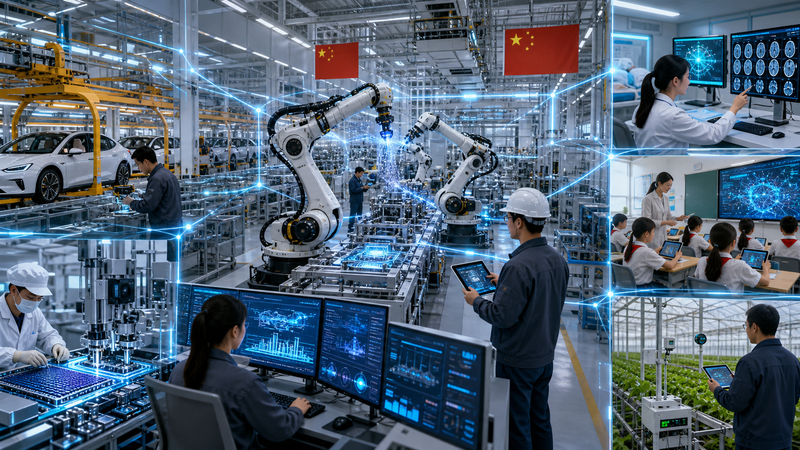
China's AI policy is not limited to chatbot competition. Through its 'Artificial Intelligence+' policy, the State Council of the People's Republic of China is expanding AI applications across manufacturing, science and technology, consumption, livelihoods, governance and global cooperation. In the fourth installment of [AI Hegemony, China's Counterattack], we examine how China is embedding AI in industrial settings and pursuing a manufacturing-centered strategy.
[Financial News] China's artificial intelligence policy is closer to the factory floor than to chatbots. DeepSeek and Qwen have become familiar names to consumers, but policy documents repeatedly emphasize factories, laboratories, hospitals, schools and farms. The focus is not on producing more AI models, but on attaching AI to existing industries to raise productivity.
Last August, the State Council of the People's Republic of China unveiled the 'Artificial Intelligence+' policy. It is a national action plan to integrate AI into the economy and society as a whole. The policy covers six areas: science and technology, industrial development, consumption upgrades, livelihoods, governance and global cooperation.
The targets are also numerical. By 2027, China aims to raise the adoption rate of next-generation smart terminals and AI agents to more than 70%, and to more than 90% by 2030. The direction is clear: AI is to be used not as a side business for a few companies, but as a foundational technology across the economy.
The industrial settings targeted by 'Artificial Intelligence+'
Manufacturing is the sector where China is moving fastest to apply AI. It is the backbone of the Chinese economy, and it is tied to supply chains for electric vehicles, batteries, solar panels, robots and electronics. If AI is used for quality inspection on production lines, predictive maintenance, logistics optimization, product design and process automation, it could reshape the cost structure of manufacturing.
The State Council policy also includes improvements in foundational AI model capabilities, innovation in data supply, expansion of intelligent computing power, development of an open-source ecosystem and talent cultivation. That means the policy is aimed not only at companies building AI services, but also at industrial sites with data, cloud companies with computing resources, and manufacturers producing equipment and robots.
Shanghai has also rolled out a local 'AI+ manufacturing' plan. Financial News reported that Shanghai announced its 'AI+ manufacturing' development plan last August. The plan views AI as a core technology for industrial transformation and focuses on expanding its use in manufacturing sites.
Including semiconductors, advanced materials and biotech
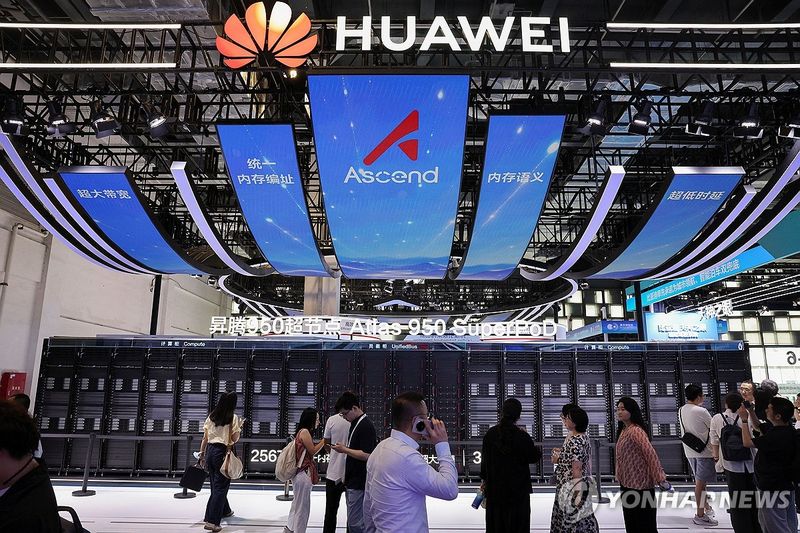
The scope of manufacturing applications is broad. According to a Chinese 'AI+ manufacturing' document cited by CSET at Georgetown University, China is considering ways to apply large AI models across a range of manufacturing fields, including advanced materials, aerospace, pharmaceuticals, biotechnology, semiconductors and software. The document emphasizes not only generative AI, but also agentic AI.
Agentic AI refers to systems that go beyond simply generating answers and can carry out multiple tasks in sequence. In factories, it could be used to adjust production plans, check parts supply and detect signs of equipment malfunction. That is why China is looking at factories before chatbots.
China's manufacturing sector already has a strong automation base. Robots, sensors and data systems are already in use in electric vehicles, batteries, electronics manufacturing, logistics warehouses and port automation. AI is being deployed as the technology that connects those devices and data. Even if model performance is the same, industrial impact varies depending on how deeply the system is linked to real process data.
AI is expanding into education, healthcare and agriculture
Artificial Intelligence+ is not limited to manufacturing. In education, it mentions personalized learning, teacher assistance and automated assessment. In healthcare, it includes diagnostic support, drug development and hospital workflow automation. In agriculture, AI can be used for pest and disease diagnosis, smart farm machinery, yield forecasting and distribution management.
The policy also covers livelihoods. It reflects efforts to use AI to address aging and urban management challenges. Voice guidance, one-touch calling and public service consultations for older adults who struggle with smartphones are part of this effort. AI guidance kiosks and digital public facilities seen across Chinese cities are examples of this trend in practice.
China often prefers to attach AI to existing services rather than sell it as a standalone product. E-commerce platforms use AI for product recommendations and seller support, while local government administration uses it for complaint handling and document processing automation. Consumer chatbots may attract attention, but policy funding and local government projects are more closely tied to industrial applications.
The pros and cons of government-led AI expansion
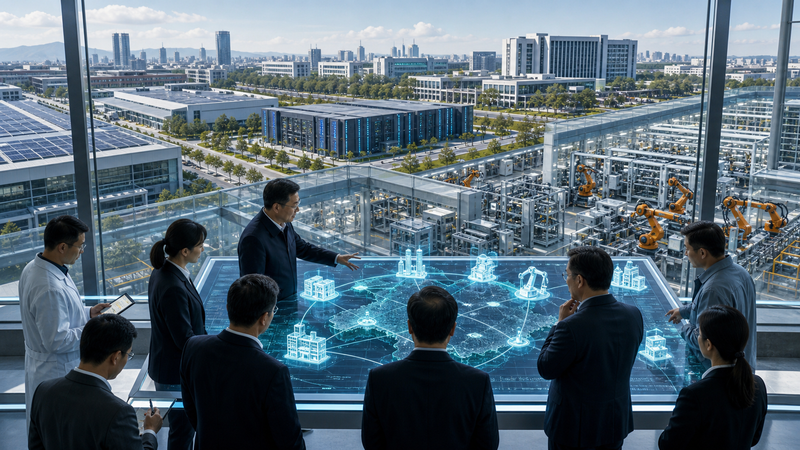
China's model of AI diffusion is one in which the government sets the direction, and local governments, state-owned enterprises, big tech firms and universities follow. The advantage is speed. Once a policy is set, local governments create industrial parks and pilot projects, and companies win markets through supply contracts and project work.
On the other hand, there is also a risk of excessive investment and overlapping projects. If every region builds an AI industrial park and tries to attach AI to every industry, the number of projects may grow faster than actual demand. Performance evaluation may also become skewed toward adoption counts rather than technological improvement.
For AI to enter factory operations, the quality of on-site data is crucial. If equipment data is not standardized or factory systems differ from site to site, models are difficult to apply immediately. Small and medium-sized manufacturers also struggle to absorb the cost of AI talent and computing resources.
The Chinese government is trying to solve these problems through infrastructure and policy funding. National-level policy sets the direction, while local governments attach implementation projects to factories and industrial parks. Big tech and cloud companies provide models and computing resources. That is the route AI is taking into factories.
In an explanation of the State Council policy, Xu Xiaolan, vice minister of the Ministry of Industry and Information Technology, said the Artificial Intelligence+ policy would help promote deep integration between AI and various sectors of the economy and society, while also boosting total factor productivity. He stressed, "The Artificial Intelligence+ initiative aims to promote the deep integration of AI across many sectors of the economy and society."
[email protected] Han Seung-gon Reporter