"Cheaper AI Is Not Better Than Widely Used AI"... Chinese Open Models Shake Up the Developer Market [AI Hegemony, China’s Counterattack 2]
- Input
- 2026-08-08 06:00:00
- Updated
- 2026-08-08 06:00:00

Chinese AI companies are rapidly expanding their developer base by releasing their models. Models such as DeepSeek-R1 and Alibaba’s Qwen, which can be downloaded and modified, are spreading in a different way from the closed AI services offered by U.S. Big Tech. In the second installment of [AI Hegemony, China’s Counterattack], we look at how Chinese open AI models are entering overseas developer markets by emphasizing cost and deployment speed.
[Financial News] Chinese artificial intelligence companies are broadening their reach by making their models available for external developers to use. DeepSeek-R1, Alibaba’s Qwen, and Moonshot AI’s Kimi have entered overseas developer markets as open models that can be downloaded or modified. This differs from the way companies such as ChatGPT, Claude, and Gemini provide models through APIs and apps.
This trend is also how Chinese AI companies are confronting U.S. Big Tech head-on. Developers and startups that cannot afford massive cloud fees can download open models and run them on their own servers or on third-party cloud services. In other words, cost and deployment speed have become as important as performance.
DeepSeek sparks open-model competition

DeepSeek released its reasoning model R1 on Jan. 20 last year. In its announcement at the time, the company said it would release the model and technical report, and distribute the code and model under the MIT License. It also said commercial use and distillation would be allowed.
DeepSeek-R1 quickly became a turning point that raised the profile of Chinese AI models. At a time when competition in large language models was centered on U.S. companies, the Chinese startup released a reasoning model as an open model. Not only the R1 model itself, but also smaller distilled models based on it were made available. Developers no longer had to use the large model as is; they could instead adapt smaller models to their own needs.
Open models are different from simply trying out a free service. Once model weights are released, developers can download them, deploy them in their own environments, or fine-tune them for specific tasks. The difference is especially significant in organizations with repetitive work such as internal documents, coding, customer support, search, translation, and document summarization.
That said, not everything is disclosed just because a model is called “open.” Even if model weights can be downloaded, it is rare for the training data, training process, and safety alignment methods to be fully released. For that reason, the industry distinguishes between “open source,” which broadly discloses source code and training processes, and “open weight,” which releases model weights. DeepSeek-R1 and the Qwen family are closer to the latter.
Qwen has been downloaded more than 300 million times

Alibaba’s Qwen also plays a major role in the spread of Chinese open AI models. Last year, Alibaba Cloud released Qwen3 and said it would provide both dense models and mixture-of-experts models as open source. The Qwen3 family includes dense models of 0.6B, 1.7B, 4B, 8B, 14B, and 32B parameters, as well as mixture-of-experts models of 30B and 235B parameters.
Qwen3 supports 119 languages and dialects. Alibaba said Qwen3 was trained on 36 trillion tokens, about twice as much as the previous Qwen 2.5 generation. The models were made available on Hugging Face, GitHub, and ModelScope.
The pace of expansion is also reflected in the numbers. According to Alibaba Cloud, the Qwen family has been downloaded more than 300 million times worldwide since its release. More than 100,000 derivative models based on Qwen have been created on Hugging Face. This means Qwen has spread not as a single chatbot service, but as a model family reused within the developer ecosystem.
There is also a market-entry strategy behind Chinese companies’ push for open models. With closed models, it is difficult to quickly match the brand trust, cloud customer base, and payment ecosystem of U.S. Big Tech. By contrast, releasing a model allows developers to try it, modify it, and connect it to other services. As the number of model users grows, derivative models and use cases grow as well.
Moonshot and MiniMax join the open-model wave
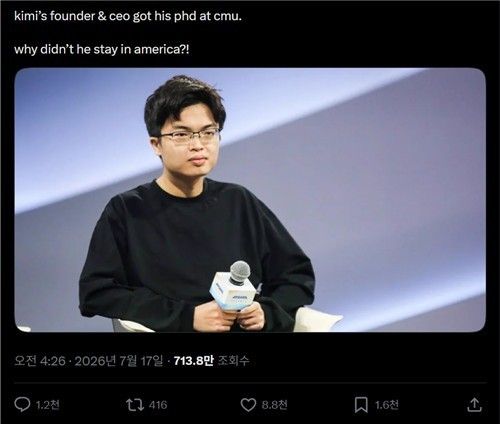
Open models are not a strategy limited to DeepSeek and Alibaba. Moonshot AI released Kimi K2 last year. According to the description posted on GitHub, Kimi K2 is a language model that uses a mixture-of-experts architecture, with 1 trillion total parameters and 32 billion active parameters during inference.
MiniMax Group Inc also released its M1 model. According to the description posted by the company on GitHub, M1 is an open reasoning model that combines hybrid attention with a mixture-of-experts architecture. The company said the model was developed based on its earlier text model, and that 45.9 billion of its 456 billion total parameters are activated per token.
Z.ai’s GLM family has also entered the open-model race. According to the description of GLM-4.5 released by Z.ai, the model is a foundation model designed for agent tasks, with 355 billion total parameters and 32 billion active parameters. A smaller version, GLM-4.5-Air, was also released.
All of these models point in the same direction. They allow developers to download a model directly, test it, adapt it to their needs, and connect it to other services. Chinese AI companies are using this approach to lower the cost of experimentation for overseas developer communities, researchers, and startups.
A different approach from closed APIs
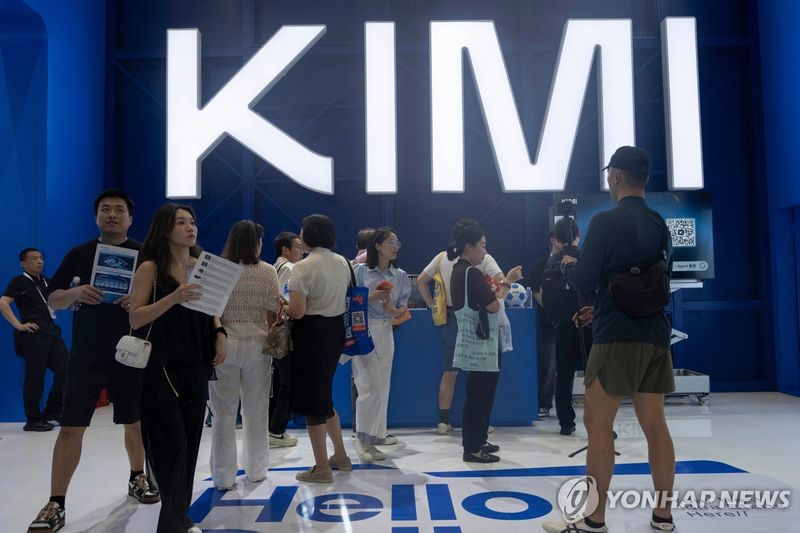
Major U.S. AI companies generally center their strategy on closed models. Users access the models through chatbot services or APIs. It is difficult to download the model itself and run it on internal servers. For companies, this makes it easier to control quality, safety, billing, and user data flows.
Open models work differently. When a company or developer deploys a model directly, the original developer cannot see all usage records. That can be an advantage for companies that find it difficult to send sensitive data to external APIs. On the other hand, the original developer has a harder time securing usage fees and user feedback.
In an analysis last month, the Center for Strategic and International Studies (CSIS) said that when Chinese open models are used through third-party hosting or internal enterprise deployment, the original developer cannot see prompts, logs, feedback, tool calls, or product usage patterns. The report said the open-model strategy is advantageous for spread, but less favorable for monetization and user feedback.
Even so, Chinese companies continue to release open models because they accelerate global adoption. Keeping a model closed limits opportunities to prove its performance. By contrast, releasing it allows developers around the world to test it, while benchmarks and derivative models accumulate quickly. That is the background behind Chinese AI companies choosing a different path from U.S. firms.
Chinese models narrow the performance gap

The spread of open models is also tied to the performance debate. Stanford’s Institute for Human-Centered Artificial Intelligence said in its 2026 AI Index that the performance gap between U.S. and Chinese AI models has effectively closed. According to the report, U.S. and Chinese models traded places several times in the rankings after 2025. DeepSeek-R1 was assessed in February last year as having reached a level comparable to top U.S. models.
Stanford Institute for Human-Centered Artificial Intelligence (HAI) and DigiChina, which studies Chinese digital policy, also addressed Chinese open models separately in a report released last December. The report said that not only DeepSeek, but also Alibaba’s Qwen, Moonshot AI, Baidu, and Tencent are building an open-model ecosystem.
The report analyzed that Chinese developers mainly use a method in which model weights are released so end users can deploy and modify the models. It said this contrasts with OpenAI and Google DeepMind, which have kept their flagship models as closed software.
As open models proliferate, debate in the United States is also intensifying. One side worries about the security, censorship, and data-handling practices of Chinese models. The other argues that blocking open models would reduce the number of models available to startups and researchers. In the developer market, a trend has already emerged to weigh performance, cost, and deployment convenience together.
The Stanford HAI and DigiChina report said, "Chinese open-weight models have become an unavoidable presence in the global AI competition landscape," and added that "there is room for academic collaboration with Chinese researchers to better understand the risks of open-weight AI models and the effectiveness of safeguards."
[email protected] Han Seung-gon Reporter