K Stock Market Becomes a "Foreigners' ATM"... Even as Leveraged Trading Falls, "Samsung Electronics and SK Hynix" Remain a Roller Coaster [Why the Market Moves]
- Input
- 2026-08-07 12:43:07
- Updated
- 2026-08-07 12:43:07
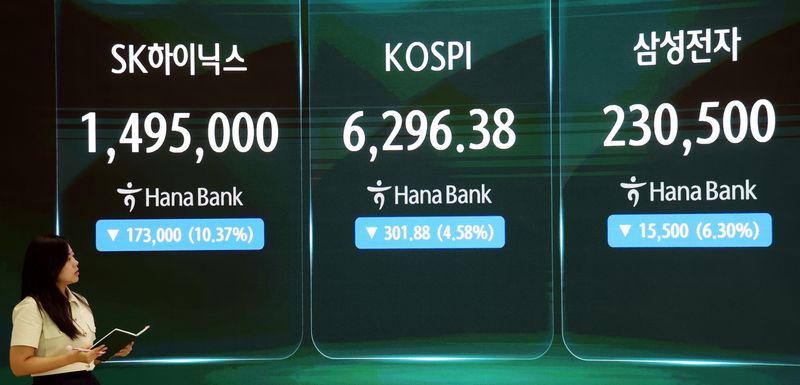
[Financial News] The financial authorities have raised the base deposit requirement for single-stock leveraged exchange-traded funds (ETFs) to 30 million won in an effort to curb speculative trading. But market participants say the move has not changed the market structure. Trading volume has fallen sharply, yet Samsung Electronics and SK hynix shares still swing by around 10 percent a day. Even after the rule took effect, trillions of won continued to flow into single-stock leveraged ETFs. Critics also say the measure is a "half-step policy" because it regulates only individual investors.■ Trading has slowed, but money is still flowing into "Samsung Electronics and SK hynix leverage"According to the Korea Exchange on the 7th, from July 31 to August 6, after the rule took effect, single-stock leveraged ETFs tied to Samsung Electronics and SK hynix still dominated the upper ranks of ETF trading volume.
During that period, KODEX SK Hynix Single Stock Leverage ETF ranked seventh among all ETFs with 296.45 billion won in trading volume. MiraeAsset TIGER SK Hynix Single Stock Leverage ETF followed with 143.02 billion won, and Samsung Electronics Single-Stock Leveraged ETF recorded 119.65 billion won, placing them among the top names as well.
When single-stock leveraged ETFs from other managers such as SOL, ACE, and RISE are included, trading volume for Samsung Electronics and SK hynix products topped 600 billion won over five trading days.
The financial authorities viewed the rule as effective because trading volume in single-stock leveraged ETFs fell from the 1.2 trillion won range to the 300 billion won range on the first day of enforcement, and later dropped below 100 billion won for the first time since listing. However, the market says the scale of trading has only shrunk, while the structure that concentrates money in leveraged products tied to a few stocks has not changed much.■ The underlying stocks are still a roller coaster... volatility remainsEven after the rule took effect, volatility in Samsung Electronics and SK hynix has shown little sign of calming.
Samsung Electronics surged 26.81 percent on July 31, then fell 8.76 percent on August 3, rose 2.50 percent on August 5, and dropped 6.30 percent on August 6. Trading volume also remained in the 500 billion won to 700 billion won range each day after hitting 1.49242 trillion won on July 31.
SK hynix followed a similar pattern, jumping 29.95 percent before posting daily moves of -8.79 percent, 0.64 percent, 5.77 percent, and -10.37 percent, swinging by around 10 percent in a single day.
By investor type, foreigners were net buyers of 1.2139 trillion won worth of Samsung Electronics and 228.3 billion won worth of SK hynix during the period. Institutions, meanwhile, were net sellers of 2.0061 trillion won in Samsung Electronics and 385.9 billion won in SK hynix.
A securities industry official said, "Trading in leveraged ETFs has clearly declined, but the volatility of Samsung Electronics and SK hynix has not eased as much as expected." The official added, "It is hard to say that lower trading volume has directly led to lower volatility."■ "There are limits if only individuals are restricted"... foreign investors account for 40%Market experts say the biggest flaw is that the rule applies only to individual investors.
According to data submitted by the Financial Supervisory Service to the National Policy Committee, total trading volume in single-stock leveraged ETFs from May 27, when they were listed, to July 28 came to 497.9 trillion won. Of that, foreign investors accounted for 202.4 trillion won, or 40.6 percent.
However, the 30 million won base deposit rule that took effect on July 31 applies only to individual investors, while institutional investors and professional foreign investors are exempt.
There are also concerns that when trading volume declines, the influence of high-frequency trading (HFT) and algorithmic trading could grow even stronger. In a thinner market, even relatively small orders can move prices more easily.
A recent case in the NextTrade premarket, where SK hynix hit its daily lower limit with just 11 shares traded, is being cited as an example of how prices can be distorted in a thinly traded market.
An industry official said, "With a system that regulates only individuals, it is difficult to fundamentally reduce the impact of leveraged trading on the market." The official added, "If trading volume falls, it may actually create an environment where foreign algorithmic trading or HFT can move prices with relatively little money."
The official also noted, "There are concerns that if futures and options positions are combined with leveraged ETF trading, volatility in spot prices could widen." The official added, "In the end, the burden of volatility could be shifted onto individual investors, while the market becomes increasingly locked into a foreign-investor-led structure."
[email protected] Choi Du-seon Reporter