"406 AI Specializations, Rewired to the Bone": How China's College Admissions System Changed Parents' Minds [AI Hegemony, China's Counterattack 1]
- Input
- 2026-08-07 18:00:00
- Updated
- 2026-08-07 18:00:00
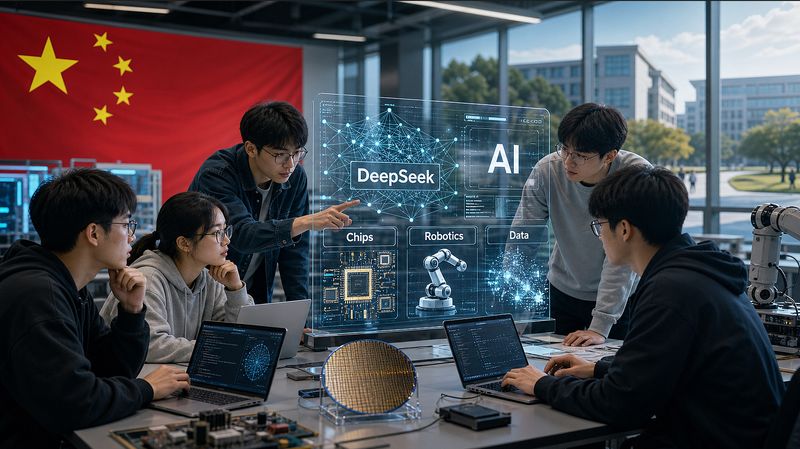
As Chinese AI models such as DeepSeek and Qwen draw global attention, and as the push for semiconductor self-reliance accelerates, the country's technology competition is also influencing university major choices. In the first installment of [AI Hegemony, China's Counterattack], we look at the post-Gaokao trend of students gravitating toward engineering fields and the changes at Chinese universities that are expanding AI and semiconductor majors.
[Financial News] Chinese universities are reshaping their major offerings around artificial intelligence (AI) and semiconductors. As local AI models such as DeepSeek and Alibaba Group's Qwen gain recognition overseas, and discussions continue over semiconductor supply chain independence, universities are rapidly expanding related programs. Students and parents are also paying closer attention to engineering majors that offer stronger job prospects after graduation.
Engineering majors rise to the top of post-Gaokao searches
China's college entrance exam is known as the National College Entrance Examination (Gaokao). It is a nationwide university admissions test and serves as the basis for students' choices of universities and majors. While it plays a role similar to South Korea's College Scholastic Ability Test, the weight of major selection is greater because regional admissions systems are tied to university and major placement procedures.
According to a report by China Daily citing Xinhua News Agency, about 12.9 million students are eligible to take this year's Gaokao. Once the Ministry of Education approves a new undergraduate major, that major is reflected in the university admissions process after the exam.
Local outlet Yicai Global reported on July 1, citing Baidu's admissions big data, that seven of the 10 most-searched majors after the 2026 Gaokao were in science and engineering fields. Electrical engineering and automation, AI, electronic information engineering, computer science, and communication engineering were among the top-ranked majors.
Law and economics also made the top 10, but most of the highly searched majors were in engineering. The data were compiled from real-time search popularity on Baidu's Gaokao big data platform. They do not reflect the actual number of applicants or final enrollment results. Still, they are used as an indicator of which majors students and parents focused on immediately after the exam.
Electrical engineering and automation has been classified as a popular major for several years. Yicai Global, citing MyCOS's "2026 China Undergraduate Employment Report," said the major had an employment satisfaction rate of 87% and ranked third among undergraduate majors. It also noted that demand for electrical engineering talent is linked to new power grids, renewable energy, and the digitalization of power systems.
AI majors have also expanded rapidly. On June 22, China Daily reported, based on data from the Ministry of Education, that more than 600 universities had opened undergraduate AI programs as of 2026. In 2018, only 35 universities received approval for AI undergraduate programs.
Universities opening new AI and semiconductor majors
Semiconductor-related majors have also been added to undergraduate admissions. According to China Daily, Sichuan University received approval to include a semiconductor process and equipment major in its 2026 freshman admissions list. It is the first approved undergraduate program in China focused on semiconductor process and equipment.
New majors are also being added. The Ministry of Education announced 38 new undergraduate majors that will be reflected in this year's Gaokao admissions. The new offerings include brain-computer science and technology, agricultural robotics, business AI, and digital finance. Some universities are also adding AI courses to existing computer engineering and electronic information programs.
The reason students are turning to engineering majors lies in the job market. AI, semiconductors, robotics, and electric vehicles are sectors where government policy and corporate investment move together. As the economic slowdown increases pressure on young people seeking jobs, students and parents are paying closer attention to the chances of being hired after graduation.
The shift in major structures is also visible in the numbers. Yicai Global reported that AI saw the largest increase in new specializations from 2020 to 2024. During that period, AI specializations increased by 406. Digital economy, intelligent manufacturing engineering, and big data management and applications were also among the majors that expanded by more than 200.
Electronic information engineering is also closely tied to the semiconductor industry. Yicai Global explained that high-paying technical jobs such as integrated circuit engineering, semiconductor processes, and automotive electronics are fields closely related to electronic information engineering. As the chip, electronics manufacturing, and automotive electronics industries grow, expectations for employment in related majors have also risen.
"Long-term access to computing resources and industry projects"
However, an increase in the number of majors does not mean that every university offers the same educational environment. An AI major requires knowledge of computer science, mathematics, statistics, data processing, and hardware. Depending on the faculty, lab equipment, computing resources, and opportunities for corporate internships, the content of AI education can differ even when the major name is the same.
For that reason, universities are also creating separate AI colleges and designing curricula together with companies and research institutions. On May 9, China Daily reported that Chinese universities have been establishing AI-focused colleges in cooperation with companies and research institutes in recent years.
Hu Qinghua, dean of the AI College at Tianjin University, told the outlet in an interview that the differences between AI-focused colleges and traditional departments include education centered on real industrial problems and social needs, securing computing resources, data and industry projects, and maintaining a flexible operating structure.
Hu said, "AI colleges break down barriers between disciplines, deepen integration among industry, academia and research, and play an important role in higher education reform by improving customized vocational training." He added, "Through AI colleges, universities can secure long-term access to computing resources and industry projects, and receive support for faculty and student research."
[email protected] Han Seung-gon Reporter