Stanford University researchers succeed in creating an artificial virus with AI, raising both hopes and concerns
- Input
- 2026-08-07 11:04:49
- Updated
- 2026-08-07 11:04:49
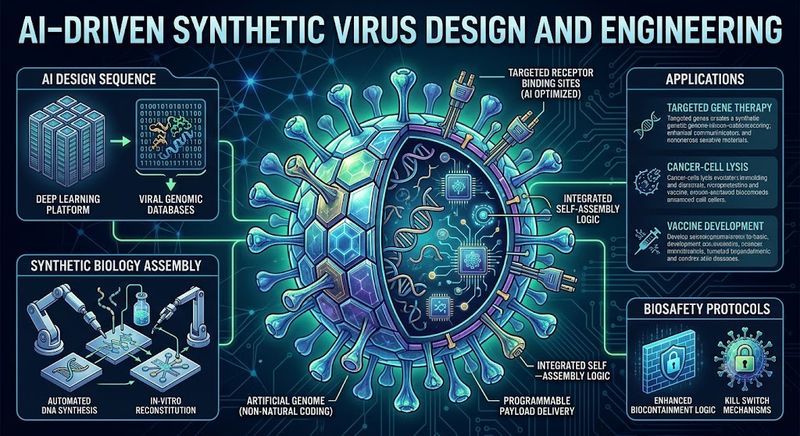
[Financial News] The creation of the first artificial virus designed directly by artificial intelligence has marked a new milestone in the life sciences. While expectations are rising for new drug development and treatments for intractable diseases, calls are also growing for urgent regulations to ensure the safety of the technology.
According to foreign media outlets, including The Guardian, on the 6th local time, a research team led by Dr. Brian Hie in the Department of Chemical Engineering at Leland Stanford Junior University announced in the international scientific journal Science that it had used an AI-based genome language model to design a synthetic genome for a bacteriophage and successfully turned it into a real virus. Bacteriophages are viruses that infect only bacteria and are used to treat drug-resistant bacteria.
Using the AI models Evo1 and Evo2, which were trained on 2 million bacteriophage gene data points, the team generated thousands of candidate genomes. After selecting about 300 of them and turning them into actual viruses in the lab, 16 bacteriophages were successfully activated. A cocktail therapy made by combining these viruses effectively killed E. coli that had developed resistance to existing natural bacteriophages.
To block any possibility that the virus could harm humans, animals, or plants, the researchers deliberately excluded genomic data from viruses that infect humans, animals, and plants during the AI training process.
The scientific community has responded to the achievement with both praise and warnings. The researchers said, "The ability to rapidly design genomes and tailor them to specific strains will transform phage therapy," while also stressing that "safety and security experts must be involved throughout the project."
[email protected] Yoon Jae-jun Reporter