"KOSPI at a Historic Undervaluation as Leverage Shock Winds Down" ... Has the Semiconductor Sell-Off Ended?
- Input
- 2026-08-07 06:28:50
- Updated
- 2026-08-07 06:28:50
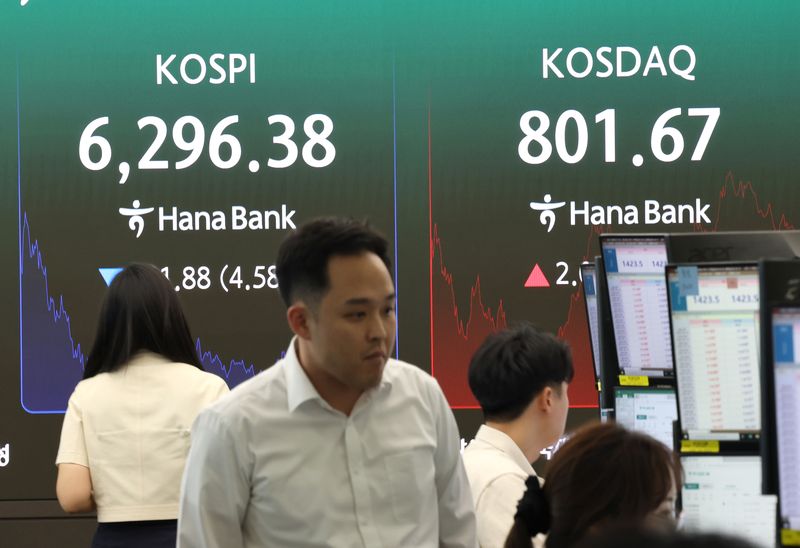
[Financial News] Brokerage analysts said the sharp decline centered on the semiconductor sector last month has eased significantly. KB Securities expects the market to shift this month toward one driven by corporate earnings and fundamentals.
On the 6th, Kim Dong-won, Head of Research at KB Securities, said in a report, "We believe the liquidation of leveraged positions and the supply-demand shock that triggered the July plunge in semiconductors have largely run their course." He added, "A full-fledged earnings-driven rally in semiconductors is expected to begin in August."
Kim said the decline in semiconductor stocks last month exceeded the drops seen during the Financial crisis and the COVID-19 pandemic. He noted, "Semiconductor stocks fell by an average of 34% last month, surpassing the declines seen during the Financial crisis and COVID-19." He explained that speculative positions had built up amid a global rush into semiconductors from April to June and excessive credit leverage. At the same time, concerns over the sustainability of artificial intelligence (AI) investment due to big tech's free cash flow to the firm (FCF) deficits and geopolitical risks emerged together, leading to the largest sell-off in four years.
He also pointed to easing demand and macroeconomic pressures. Kim said, "As North American big tech cloud bookings are being filled through 2028, concerns over FCF deficits are shifting into confidence about AI demand and investment growth." He added, "With the likelihood of an Iran war ceasefire rising, pressure from international oil prices and long-term U.S. interest rates is also expected to ease."
He forecast that supply will lag demand in the memory semiconductors and AI substrates markets for the next three years. According to his analysis, the structure in which demand rolls over into the following year could continue at least through 2028.
As evidence, he cited the fulfillment rate of demand from big tech clients. Kim said, "In the third quarter of this year, the fulfillment rate for memory and AI substrate demand from big tech clients is only 60% to 70%." He added, "Demand that exceeds supply will be carried over to the following year each year, and the cumulative buildup of unmet demand will continue through 2028."
He also said it takes time to expand supply. He explained, "Given that it takes at least two to three years to complete new memory fabs and new production lines for substrates, supply shortages in memory semiconductors and AI substrates appear unavoidable over the next three years."
He also said the KOSPI is now at a historically undervalued level after last month's decline. Kim named Samsung Electronics, SK hynix, Samsung Electro-Mechanics, and LG Innotek as his top picks.
He based his undervaluation assessment on the KOSPI's 2027 valuation. He said, "The KOSPI's current 2027 valuation stands at a price-earnings ratio (PER) of 5.0 times and a price-to-book ratio (P/B Ratio) of 1.26 times, which is a historically undervalued level." He added, "The July plunge in the KOSPI was not a collapse of the bull market, but rather a process of unwinding excessive concentration and absorbing the supply-demand shock. From this month onward, it is time to focus on the semiconductor sector, where earnings improvement is becoming clear."
[email protected] Han Seung-gon Reporter