Even a 7.6 Trillion Won Retail Buying Spree Could Not Lift It... Semiconductors Shake the Index
- Input
- 2026-08-07 08:35:04
- Updated
- 2026-08-07 08:35:04
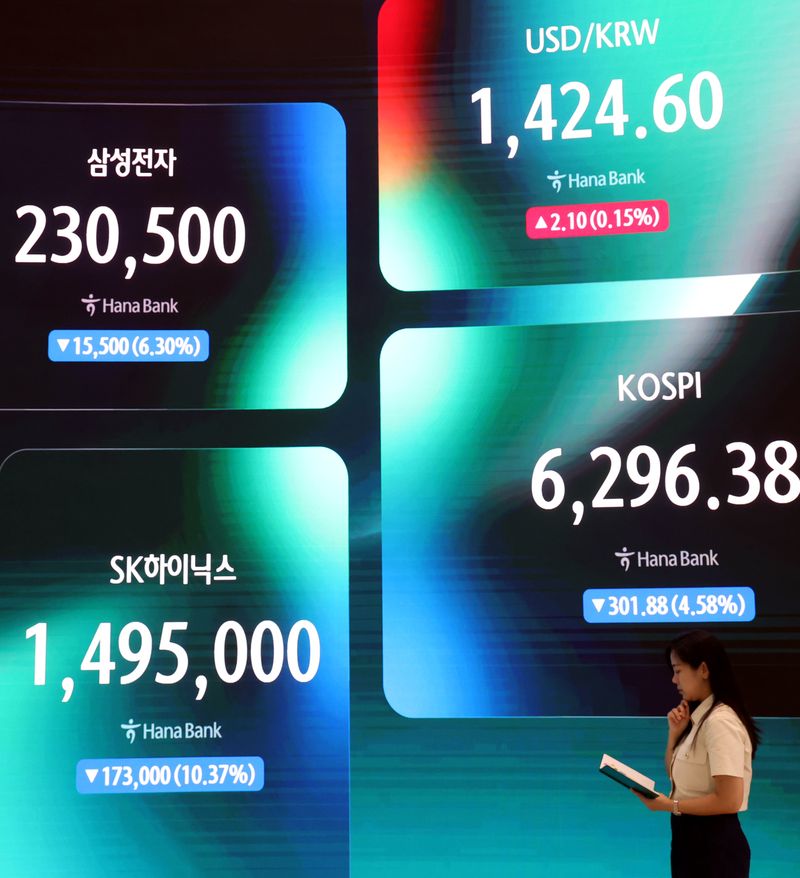
[Financial News] Retail investors poured more than 7.6 trillion won into KOSPI this week, but they could not stop the sharp declines in Samsung Electronics and SK hynix, leaving the index largely unchanged. In contrast, KOSDAQ recovered the 800 level on institutional buying and strength in biotech stocks, showing a starkly different trend.■ Semiconductor market cap evaporates by 105 trillion won... Even 7 trillion won in buying was not enoughAccording to the Korea Exchange on the 7th, retail investors net bought 762.33 billion won worth of KOSPI stocks from the 3rd to the 6th. Over the same period, foreigners net sold 5.0696 trillion won, while institutions net sold 2.8953 trillion won. Still, KOSPI rose only 0.62 percent, from 6,257.45 to 6,296.38.
Samsung Electronics' market capitalization fell by 52.6165 trillion won, from 1,400.1837 trillion won on the 3rd to 1,347.5672 trillion won on the 6th. SK hynix also dropped by 52.5954 trillion won, from 1,144.6815 trillion won to 1,092.0861 trillion won over the same period. In just four days, about 105 trillion won in market value disappeared from the two stocks alone.
On the 6th alone, Samsung Electronics plunged 6.30 percent and SK hynix fell 10.37 percent. Although retail investors net bought 333.67 billion won in KOSPI that day, foreigners net sold 331.15 billion won, and the index ended down 4.58 percent.
What stood out was the gap between the index and the market's actual mood. KOSPI fell 4.58 percent that day, but 490 stocks rose, outnumbering the 381 that declined. Large-cap stocks dragged the index lower, while small and mid-cap shares showed relative strength.■ Not the end of the cycle, but a reset in expectationsBrokerage firms view the recent semiconductor correction as a process of adjusting elevated market expectations rather than a deterioration in industry conditions.
Lee Jae-won, a researcher at Yuanta Securities Korea Co., Ltd., said, "The weakness in semiconductors was the result of expectations that had risen too high being adjusted at the same time as earnings." He added, "SanDisk and WDC beat earnings estimates, but their guidance was more conservative than expected, and related rumors dampened investor sentiment." However, he noted, "It is hard to interpret this as a sign of a worsening industry cycle," and said, "The broader themes of expanding Artificial Intelligence (AI) investment and tight memory supply remain intact."
Lee also said, "Ultimately, this correction was not a decline reflecting the end of the cycle." He added, "Rebounds have appeared whenever uncertainty eases, but they have not led to a sustained trend of net buying."
KOSDAQ moved differently from KOSPI. Institutions net bought 762 billion won in KOSDAQ from the 3rd to the 6th, and retail investors also net bought 251.9 billion won. Foreigners net sold 1.032 trillion won, but the KOSDAQ Index rose 8.72 percent, from 737.35 to 801.67, reclaiming the 800 level.
Lee explained, "KOSDAQ had been a market where retail investors, who had long been the main net buyers, saw trading value and net buying value drift away together after the launch of single-stock leveraged exchange-traded funds (ETFs) due to concentrated fund flows." He added, "With retail investors returning, the market has moved out of its excessive decline zone and continues to rebound."
[email protected] Choi Du-seon Reporter