Despite the sharp drop in Samsung Electronics and SK hynix, Goldman Sachs keeps its KOSPI target at 12,000
- Input
- 2026-08-06 19:51:41
- Updated
- 2026-08-06 19:51:41
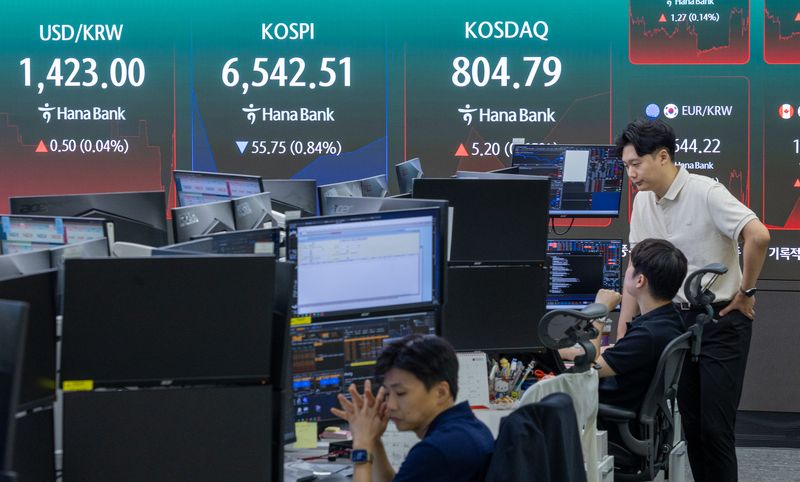
[Financial News] The KOSPI fell sharply on the 6th as Samsung Electronics and SK hynix both plunged. Weakness in AI and semiconductor stocks on the U.S. stock market also appears to have weighed on investor sentiment toward domestic chip shares.
According to the Korea Exchange, the KOSPI opened at 6,478.75 and extended its losses throughout the session before closing at 6,296.38. The decline from the previous session was 1.81% at the open and 4.58% at the close. Much of the 5.38% gain from the previous two trading days was erased.
During the session, the index briefly fell to around 6,238. The decline also widened to 5.46%. At around 10:18 a.m., a sell-side sidecar was triggered, suspending program sell orders for five minutes. So far this year, it was the 24th sell-side sidecar trigger, and the 46th trigger in total when buy and sell sidecars are combined.
By investor group, foreign selling was the largest factor. Foreign investors net sold 332.74 billion won worth of KOSPI shares that day, while institutions sold 121.8 billion won. Retail investors, meanwhile, net bought 333.91 billion won.
The KOSPI's losses were also more pronounced than those in other major Asian markets. Japan's Nikkei 225 fell 0.93%, while Taiwan's Capitalization Weighted Stock Index (TAIEX) slipped 0.48%.
The decline in large semiconductor stocks added to the pressure on the index. Samsung Electronics fell 6.30%, and SK hynix dropped 10.37%.
The weakness in domestic semiconductor stocks appears to have been driven more by the overnight decline in AI and chip-related shares such as Alphabet Inc. and AMD on the New York stock market.
Earlier, Alphabet, the parent company of Google, fell 4.06% after news emerged that Chief Scientist Jeff Dean had stepped down. AMD plunged 7.04% after its forward revenue outlook was seen as falling short of market expectations.
SanDisk also fell 5.4% in regular trading amid earnings concerns. The weakness continued into after-hours trading, with losses exceeding 7%, and the Philadelphia Semiconductor Index ended the day down 1.40%.
Against this backdrop, Goldman Sachs interpreted the recent rise in KOSPI volatility as a correction ahead of a bigger breakout.
Goldman Sachs did not view the decline as the start of a broader downtrend. Instead, it said the move was a sharp correction within a larger bull market and maintained its 12-month KOSPI target of 12,000.
In a report released on the 4th local time, Goldman Sachs strategists including Timothy Moe said, "The market is pricing in a more negative fundamental outlook than is justified," and maintained their "overweight" view. The 12,000 target implies about 92% upside from current levels.
Goldman Sachs cited concerns over the durability of the memory cycle, selling in single-stock leveraged exchange-traded funds (ETFs), the exit of short-term momentum investors, and a technical correction after a brief overheating as reasons for the decline.
Still, Goldman Sachs said the strength and duration of the memory cycle should hold, supported by growing computing demand and a structural supply shortage expected to last through 2030. It added that the pricing power and profitability likely to emerge from that environment are not yet reflected in stock prices.
[email protected] Han Seung-gon Reporter