President Lee says heat wave once seen in foreign reports has become reality, orders full mobilization of all administrative resources
- Input
- 2026-08-06 14:51:04
- Updated
- 2026-08-06 14:51:04
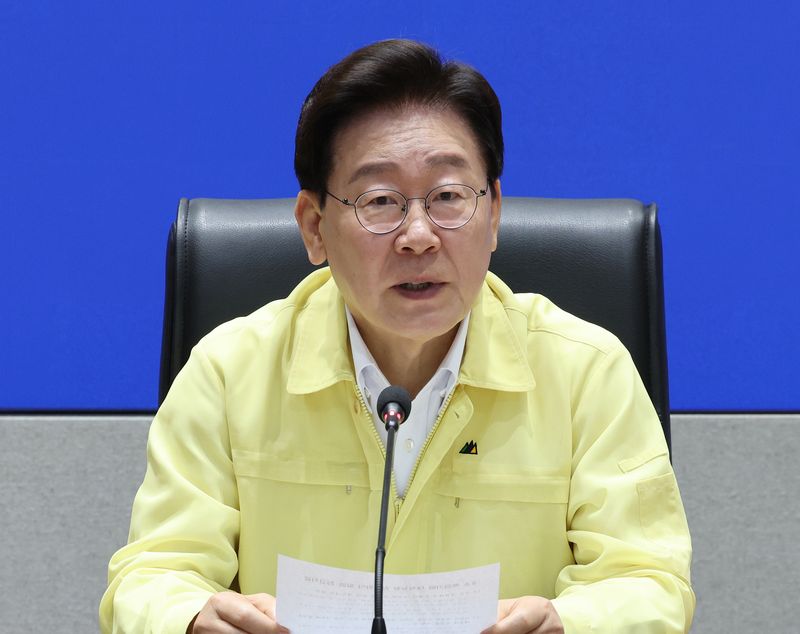
[Financial News] President Lee Jae Myung on Aug. 6 described the prolonged heat wave as "a de facto national climate disaster" and ordered officials to "mobilize all administrative resources" to minimize damage to the public from the heat and drought. He also called for stronger protection measures for vulnerable groups who are suffering more severely from the extreme heat.
At the meeting, which he chaired at the Central Disaster and Safety Countermeasures Headquarters in Government Complex Seoul in Jongno District, Seoul, Lee said the country was facing an unprecedented stretch of extreme heat. He noted that temperatures above 40 degrees Celsius had persisted for several days in Yangsan, South Gyeongsang Province, adding, "The kind of heat wave we used to see only in foreign reports has become our reality."
He stressed that "the most important duty of the government is to protect the lives and safety of the people," and urged officials to "come up with response measures suited to extreme weather."
The meeting was convened to review the government-wide response posture to the severe heat wave that has continued for days and the worsening drought centered in the southern region.
Lee said all ministries and local governments should "mobilize all available personnel and resources to the fullest" to reduce heat-related damage. He also emphasized closer attention to vulnerable groups such as elderly people living alone and residents of one-room housing, saying officials should visit those who have difficulty using cooling facilities and check on their well-being in person.
He also ordered thorough on-site inspections of outdoor worksites. Lee said officials should carefully check whether work stoppages and rest breaks during the hottest hours are being properly enforced, and added that relevant authorities must do their utmost to ensure safety rules are followed at worksites.
He further stressed preventive measures to reduce damage to agriculture, livestock and fisheries from the high temperatures, saying, "We must do everything possible to prevent damage to livestock, farmed fish and crops, and closely manage the safety of roads, railways and other infrastructure, as well as power supply and demand."
On the deepening drought in the southern region, he said, "Since no rain is forecast for the time being, actively push ahead with alternative water supplies and the operation of pumping equipment so that stable water supply is not disrupted." He also instructed officials to pursue not only short-term measures such as emergency water delivery in island and mountainous areas without access to tap water, but also mid- to long-term plans to secure water sources, including the development of alternative sources.
Senior presidential spokesperson Kang Yoo-jung said that in the closed-door meeting that followed, the MOHW reported it was strengthening tailored protection based on the different types of vulnerable groups, including elderly people living alone, households with disabilities, the homeless and residents of one-room housing. The MOEL also reported on stronger field inspections and expanded financial support for workplaces vulnerable to heat, she said. Local governments including Gyeonggi Province and South Gyeongsang Province also briefed the meeting on their heat wave and drought response efforts and future measures.
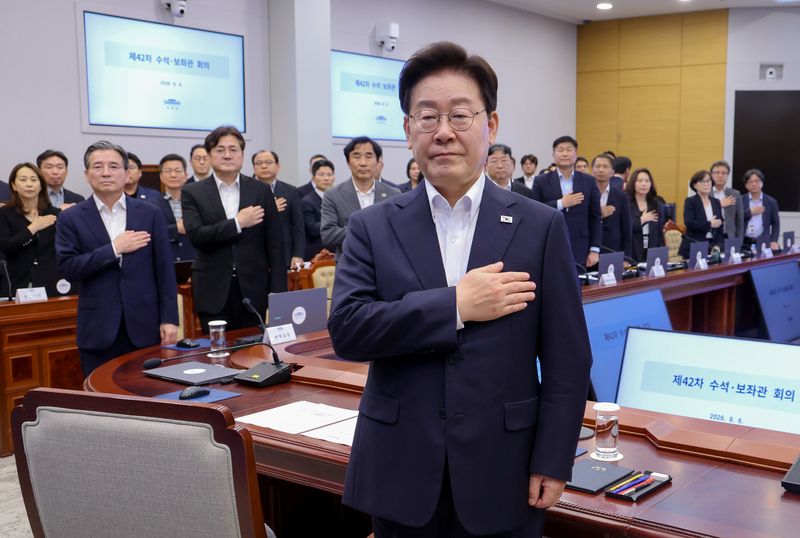
Lee also called for an all-out response during an afternoon senior aides meeting to minimize heat-related damage.
He said the unprecedented heat wave was posing a serious threat to daily life, noting that a heat wave emergency alert had been issued for the Capital Region for the first time the day before, following the southern region. "We need to raise the level, scope and speed of our policy response to the maximum with a sense of urgency greater than ever before," he said.
He added that the top priority is to protect the lives and safety of the public. "All disasters always pose a greater threat to people in difficult circumstances," he said. "We must concentrate all available administrative resources on the safety of residents in vulnerable facilities such as goshiwon rooms, one-room housing and vinyl greenhouses, as well as workers at construction sites and in farming and fishing village parking lots."
He also said a more fundamental response is needed. Lee stated, "More fundamentally, we need to work together to improve infrastructure such as housing and water facilities, the power grid and heat-wave response facilities to match the climate disaster situation that has become the new normal. In the case of traditional markets, they reportedly suffer a double blow every summer as customer traffic drops sharply because of the lack of cooling facilities." He added, "Please also consider reflecting such plans in next year’s budget proposal." He reiterated, "There must never be a situation in which people’s lives and deaths are determined by where they live or where they work."
[email protected] Choi Jong-geun, Seong Seok-woo Reporter