Kim Jung-kwan: "Semiconductor R&D's 52-Hour Work Cap Needs to Be Revised... We Should Not Block the 'Will to Work'"
- Input
- 2026-08-06 14:20:53
- Updated
- 2026-08-06 14:20:53
[Financial News]
Kim Jung-kwan, Minister of Trade and Industry, said that the 52-hour workweek system should be revised, especially in research and development, to strengthen the competitiveness of advanced industries such as semiconductors. He argued that labor-hour regulations must be made more flexible and that investment and technological development must accelerate in response to China's aggressive catch-up. On claims that the gains from the semiconductor industry should be shared more broadly, he drew a line, saying, "We should not try to split up the money earned from semiconductors."
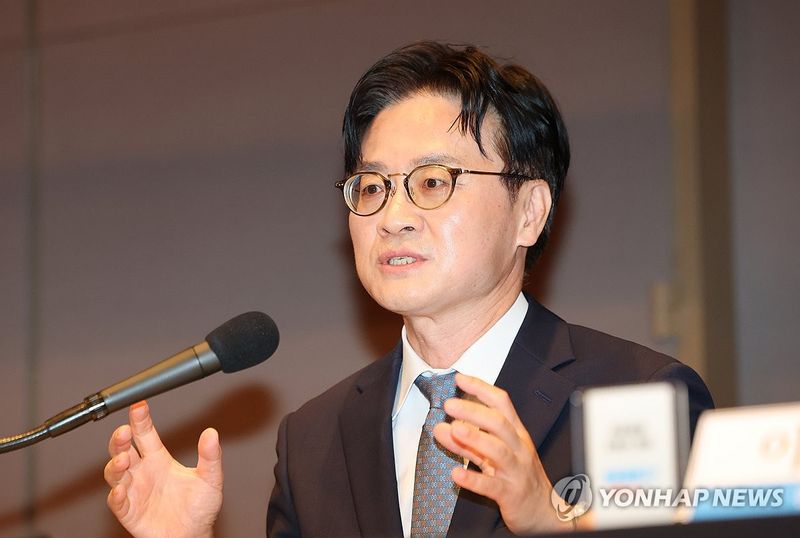
At the forum on the 6th, held at the Korea Press Center in Jung District, Seoul, Kim said, "The 52-hour issue is not just about semiconductors. It is tied to the competitiveness of all industries," adding, "A basic framework is necessary, but it should not block the will to work."
He stressed that the labor-hour system needs improvement not only in R&D but across advanced industries, including startups. "The system should not stand in the way of people who want to work hard and achieve something," he said.
He also cited the intense work culture of Chinese companies. Kim relayed a story about an information technology (IT) company in Chongqing that tried to introduce a '996 work schedule,' only for workers to demand even longer hours so they could compete with other firms. The 996 system refers to working from 9 a.m. to 9 p.m., six days a week.
"Internal competition in China is far fiercer than we think," Kim said. "It is an example showing that workers there also understand that if a company loses competitiveness, it cannot protect jobs or wages."
He also took a negative view of arguments that the fruits of semiconductor industry growth should be shared with other sectors. Kim said, "We should not try to split up the money earned from semiconductors," explaining that the priority is to support the semiconductor industry so it can keep investing and remain competitive.
With China's technological catch-up intensifying, he said policies that weaken semiconductor companies' investment capacity or slow development should be avoided. Rather than immediately redistributing profits from semiconductors, he suggested that they should be channeled into advanced processes, R&D, and infrastructure investment to sustain industrial competitiveness.
In his keynote speech, Kim described the AI revolution as an opportunity to strengthen industrial competitiveness and reverse the decline in potential growth. "Potential growth has continued to fall and is now in the 1% range," he said, adding, "If we fail to reverse the current trend, a drop to the 0% range is inevitable." He went on to warn that if the Republic of Korea responds properly to the AI revolution, it can take another leap forward, but if it fails to turn its current potential into future competitiveness, even its past achievements could collapse.
To that end, MOTIE is pursuing a three-pronged strategy of "building up, expanding, and strengthening" industry under the vision of an "irreplaceable industrial powerhouse." Through three major projects announced in June, including semiconductors, Physical AI, and AI data centers, the ministry aims to mobilize 1,600 trillion won in private investment and boost productivity across industry through the manufacturing AI transformation known as M.AX. "What matters is not the announcement, but making it real," Kim said. "We must move faster than our competitors and make sure the public can feel the results."
Meanwhile, on the Coupang issue that has emerged as a point of contention in South Korea–United States relations, he said there is a gap in perception between U.S. politicians and trade authorities. "When I meet American politicians, I get the impression that they react very sensitively to Coupang, but officials at the Department of Commerce or USTR understand the essence of the case much better," Kim said.
Some in the U.S. political sphere view Coupang as a company that helps expand exports of American agricultural, livestock, and fishery products to South Korea. But Kim said the real issue is the large-scale personal data breach and the company's response afterward. "If the Korean government had discriminated against Coupang simply because it is an American company, could it have grown this quickly?" he said. "The Coupang issue is not serious enough to shake the foundation of the South Korea–U.S. alliance or suggest that bilateral ties are that shallow."
[email protected] Park Ji-young Reporter