AI Model Developed Using AlphaFold3 Improves Accuracy in Drug Candidate Prediction
- Input
- 2026-08-06 10:41:07
- Updated
- 2026-08-06 10:41:07
[Financial News] An AI model has been developed that improves the prediction of drug candidates by using internal representation data from AlphaFold3, one of the world's leading AI protein structure prediction models. The advance is expected to help shorten drug development timelines and reduce costs, while also supporting drug repurposing, which uses existing medicines to treat new diseases.
Gwangju Institute of Science and Technology (GIST) announced on the 6th that a research team led by Professor Lee Hyeon-ju of the Department of AI developed an AI model called AlphaDTA, which can predict the binding affinity of a drug candidate's target protein without experimentally confirming the protein-drug binding structure.
AlphaDTA predicts binding affinity by combining the three-dimensional structure of a protein-drug complex predicted by Google DeepMind's AI protein structure model AlphaFold3 with the internal representation data, or embedding, generated during the prediction process. Binding affinity is an indicator of how strongly and stably a drug attaches to its target protein. The higher the value, the more promising the compound is considered as a drug candidate.
Until now, AI technologies for predicting drug-protein binding affinity have mainly developed along two approaches: sequence-based and structure-based. However, both have faced limitations, including lower accuracy or a severe shortage of available structural data.
To address these limitations, the research team focused on the internal representation data generated by AlphaFold3 while predicting protein-drug binding structures. This data numerically encodes information so that AI can learn the chemical and structural features of proteins and drugs. It consists of a Multi-granularity Encoder, which analyzes single and pairwise representation data, and a Geometric Encoder, which analyzes three-dimensional structural information of protein-drug complexes. The combined AI model is AlphaDTA.
AlphaDTA takes protein sequences and drug information as input, then analyzes the three-dimensional structure generated by AlphaFold3 together with the internal representation data to predict binding affinity.
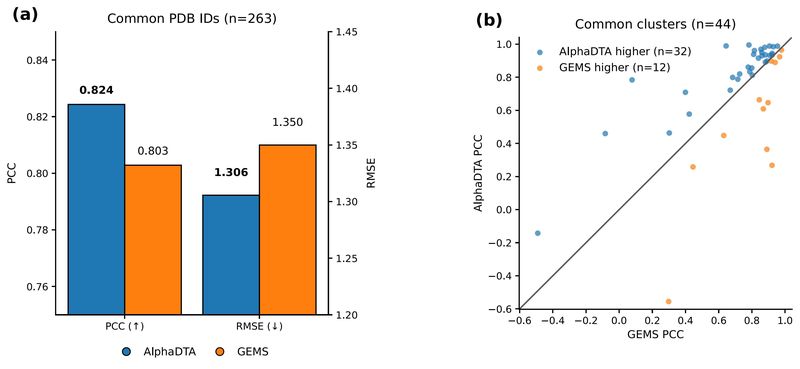
When its performance was tested on new protein-drug combinations that were not used in training, AlphaDTA outperformed existing sequence-based methods and achieved a level of prediction performance comparable to structure-based methods, even without experimentally obtained structural data.
The technology is expected to maintain strong performance even for drug candidates with limited experimentally obtained structural data. As a result, it could improve the efficiency of candidate screening, reduce drug development time and costs, and be widely used in drug repurposing research.
Professor Lee Hyeon-ju said, "This study is meaningful because it shows that the binding affinity of drug candidates can be predicted with high accuracy without experimentally confirming protein-drug binding structures." She added, "We expect it to help efficiently identify promising candidates for a wide range of target proteins with limited structural data, and to contribute to faster and more efficient drug development."
The findings were published online on July 21 in the international journal Journal of Cheminformatics.
[email protected] Yeon Ji-an Reporter