Current Account Balance nears $50 billion, setting a new record [Summary]
- Input
- 2026-08-06 10:47:57
- Updated
- 2026-08-06 10:47:57

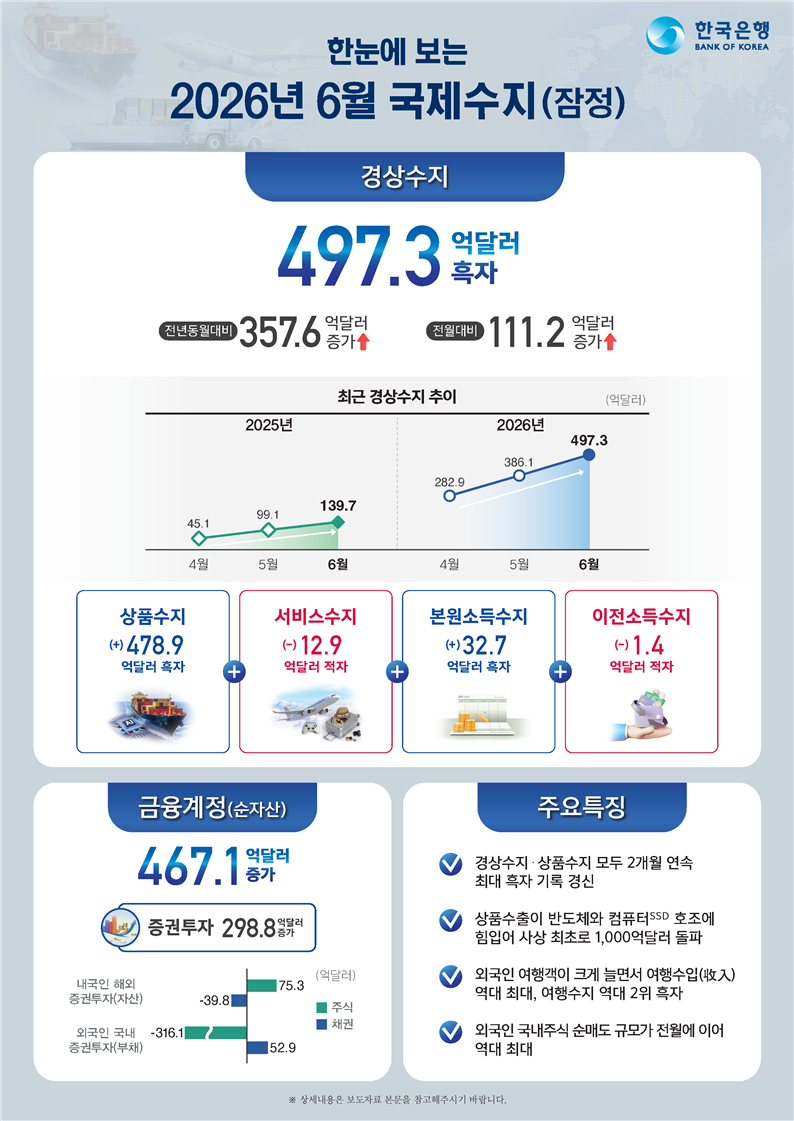
According to the Bank of Korea on the 6th, the preliminary current account balance for June 2026 stood at $49.73 billion. That beat the previous high of $38.61 billion in May by $11.12 billion, or 28.8%, and marked the highest level on record.
The cumulative total for the first half of the year reached $191.01 billion, far above the Bank of Korea's forecast of $151.5 billion. That leaves only about $60 billion before the annual forecast of $250 billion. The figure is expected to be revised upward in this month's economic outlook.
The surplus has continued for 38 straight months. That is the second-longest surplus streak since the 2000s. The previous record was 83 consecutive months through March 2019.
The goods balance, the largest component of the current account balance, came to $47.89 billion in June. That was also 26.5% higher than the previous record of $37.86 billion in May. Kim Young-hwan, director of Economic Statistics Division 1 at the Bank of Korea, said, "The increase in the goods balance, driven mostly by the unprecedented boom in semiconductor exports, accounted for most of the rise in the current account surplus." He added, "Although July will be lower than June, it is expected to be the highest for the same month on record."
Exports within the goods balance surpassed $100 billion for the first time, reaching $112.34 billion. That was up 19.1% from the previous month and 84.5% from the same month a year earlier. By item, total customs-cleared exports in information technology rose 160.4% year on year, led by computer peripherals and SSDs, which jumped 282.7%, and semiconductors, which rose 196.9%. Among non-IT items, which increased 18.6%, petroleum products and chemical products posted strong gains of 47.5% and 18.6%, respectively.
Imports totaled $64.48 billion, up 14.2% from the previous month and 38.6% from a year earlier. Capital goods rose 35.3%, led by semiconductors, information and communications equipment, and semiconductor manufacturing equipment. Raw materials also posted a strong 30.5% increase, driven by coal and crude oil.
The services balance posted a deficit of $1.29 billion. Other business services, processing services, and charges for the use of intellectual property all declined. Travel, construction, and transport increased. In particular, the travel balance was the second-largest on record, helped by a sharp rise in inbound visitors and higher fuel surcharges.
The primary income balance posted a surplus of $3.27 billion, led by investment income of $3.38 billion, including dividend income of $2.56 billion and interest income of $820 million. The secondary income balance recorded a deficit of $140 million.
Direct investment rose 80.7% from the previous month to $3.38 billion. Overseas investment by residents increased by $8.01 billion, while foreign investment in Korea rose by $4.63 billion.
Portfolio investment edged down to $29.88 billion in June from $30.89 billion in the previous month. Overseas investment by residents increased by $3.56 billion, mainly in stocks, while foreign investment in Korea rose by $26.32 billion, also led by stocks.
Financial derivatives increased by $6.11 billion, more than 25 times the previous month's $240 million.
Other investment shifted from a decrease of $190 million in May to an increase of $5.89 billion this time. Assets rose by $14.15 billion, mainly in loans, while liabilities increased by $8.26 billion, led by cash and deposits.
Reserve assets reversed from a decrease of $1.73 billion in the previous month to an increase of $1.45 billion this time.
[email protected] Kim Tae-il Reporter