How much larger has the Samsung Electronics and SK hynix weighting become? KOSPI volatility doubles
- Input
- 2026-08-06 05:40:00
- Updated
- 2026-08-06 05:40:00
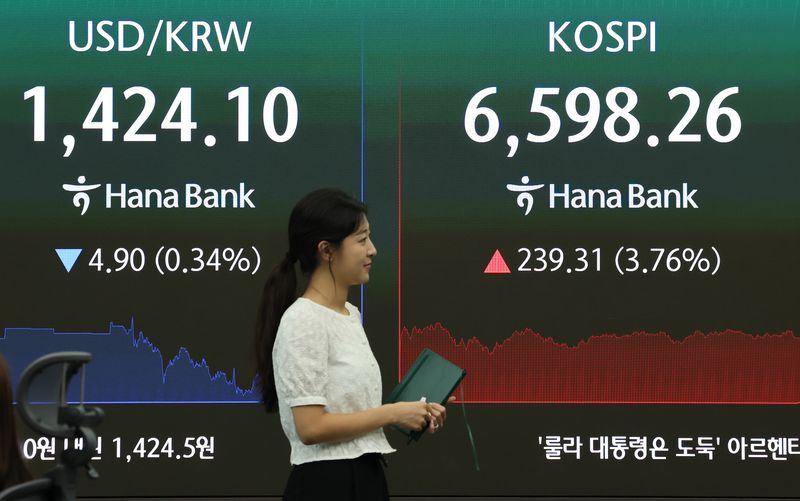
[Financial News] A new analysis says KOSPI volatility rose sharply this year compared with last year because of the heavy concentration in Samsung Electronics and SK hynix, as well as conflicting trading by investor groups. As the influence of the giant semiconductor stocks on the index has grown, selling by foreigners and institutions has clashed with buying by retail investors and securities firms, widening price swings.
According to an issue report released on the 5th by the Korea Capital Market Institute, KOSPI's daily return volatility in the first half of this year stood at 3.6%. That is more than double last year's 1.4%. By month, volatility reached 4.8% in March and 4.7% in June, both higher than the 4.2% recorded in March 2020, when markets plunged during the COVID-19 crisis. Over the same period, the average volatility of stock markets in 36 major countries rose only slightly, from 1.1% to 1.2%.
The institute identified the growing influence of Samsung Electronics and SK hynix on the index as a major driver of the increase. Their combined share of KOSPI market capitalization rose from 23% at the beginning of last year to 55% at the end of June this year. Daily return volatility climbed from 2.2% to 4.9% for Samsung Electronics and from 3.4% to 5.6% for SK hynix. The correlation coefficient between the two stocks' returns was 0.82, and the institute said roughly one-third of the increase in KOSPI 200 Index volatility came from these names.
Global volatility in the semiconductor industry was also cited as a factor. After the expansion of AI investment, the correlation coefficient between KOSPI and the Philadelphia Semiconductor Index rose from 0.29 in 2020 to 0.45 at the end of June this year. The report said concerns over excessive AI investment, higher market interest rates, and uncertainty stemming from the U.S.-Iran war intensified price swings in the semiconductor sector, which then fed into KOSPI volatility through the heavy index weights of Samsung Electronics and SK hynix.
Diverging trading behavior by investor type was also cited as a factor behind the volatility. From January to June this year, foreigners sold a net 15.3 trillion won in KOSPI shares, while institutions sold a net 3.7 trillion won. In contrast, retail investors bought a net 7.3 trillion won, and securities firms bought a net 9.2 trillion won. The intensity of this supply-demand clash was about twice as high as last year. The report said price swings widened as institutions sold to lock in profits while retail investors bought on expectations of further gains.
The institute withheld judgment on the impact of single-stock leveraged exchange-traded funds (ETFs) on KOSPI volatility. It said, "It is difficult to draw a conclusion because the sample since their introduction covers only 32 trading days," adding that further analysis is needed.
[email protected] Han Seung-gon Reporter