"The key to Physical AI is not intelligence, but reliability" [News analysis from the editorial desk]
- Input
- 2026-08-05 18:49:01
- Updated
- 2026-08-05 18:49:01
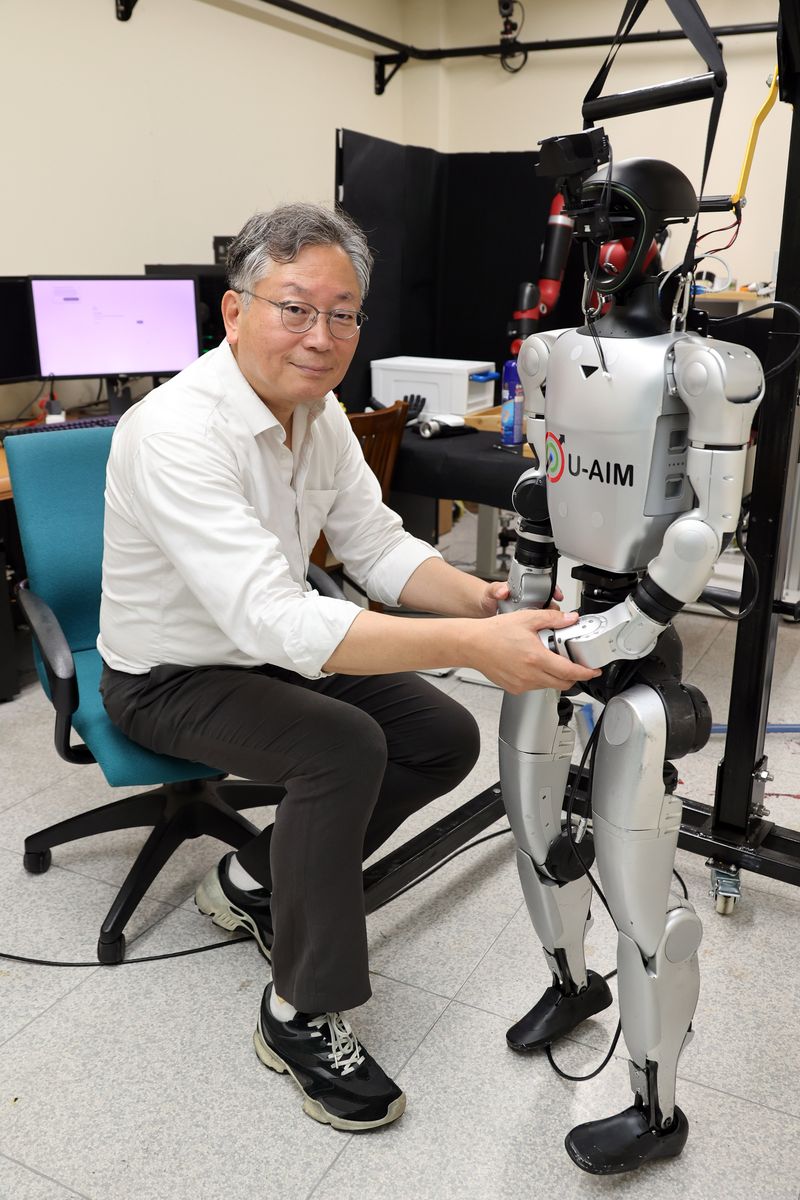
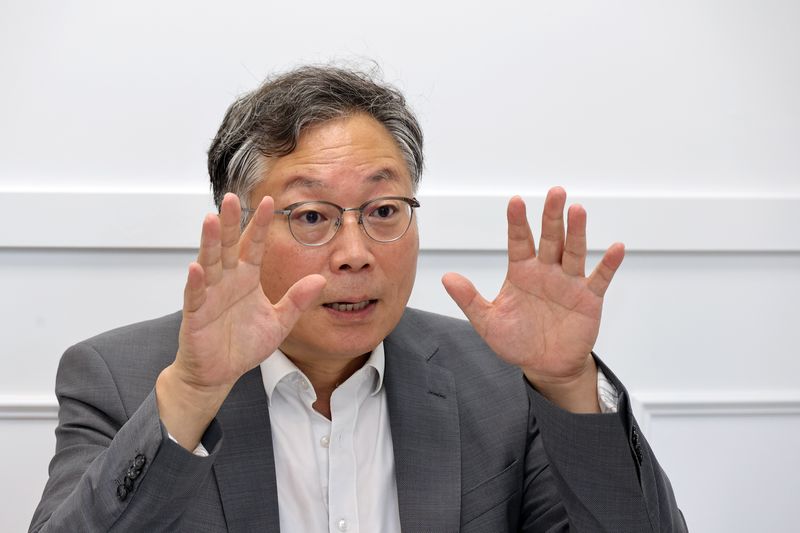
His interest lies in bringing AI out of the screen and into intelligence that acts in the real world. That is also at the core of Physical AI, which has emerged as the new frontier in the AI industry.
Recently, his research team drew attention by developing VOTP (Video-based Optimal Transport Preference), a technology that allows AI to learn human decision criteria from just a few preferred videos.
The global race in Physical AI is already intense. The United States has a major lead in large AI models and semiconductor design.
China has powerful advantages in robot manufacturing, component supply chains, and its huge domestic market. Korea cannot easily join the race in the same way. Instead, the vast manufacturing data accumulated on factory floors is an invaluable asset.
— The center of gravity in the AI industry is rapidly shifting from generative AI to Physical AI. How would you define Physical AI?
▲ If generative AI is an AI that produces answers on a screen, Physical AI is an AI that produces results in the real world. It perceives the world through sensors, decides what to do, and performs actions by moving motors and joints. It then observes the outcome and feeds that back into the next decision. The important thing is not the robot’s appearance. A robot is simply a vessel that holds this intelligence. The essence is the decision-making ability to repeat perception, judgment, and action in the physical world. Autonomous vehicles, logistics robots, and collaborative robots all fall within the scope of Physical AI.
— How does Physical AI compare with conventional industrial robots?
▲ Conventional industrial robots are closer to automated machines that are preprogrammed to repeat fixed paths and sequences. They stop or malfunction if the environment changes even slightly. Physical AI, by contrast, can loop through perception, judgment, and action on its own and generalize to unfamiliar objects or situations. While industrial robots aim to repeat predefined motions accurately, Physical AI aims to make reasonable decisions even in unexpected situations. It is not just a smarter robot, but a more reliable one.
— Some say expectations for Physical AI are running ahead of the actual technology. Where does the technology stand now?
▲ Overseas, large-model architectures that once handled language and images are being adapted for robot control, allowing a single model to handle multiple tasks and generalize to some extent to unfamiliar objects. Toolchains linking VLA models, simulation, data generation, and robot control are also advancing quickly. Still, performance drops sharply outside verified environments and limited object conditions. If we compare it to autonomous driving, the global frontier is roughly at the threshold of conditional autonomy, or Level 3. In terms of generative AI, it is somewhere around the transition from GPT-2 to GPT-3. The potential for explosion is large, but it has not exploded yet. In Korea, strengths lie in large companies’ robot investments and acquisitions, manufacturing and supply-chain capabilities, and hardware foundations. On the other hand, behavior data, simulation, robot foundation models, and software talent remain relatively weak. In short, Korea can build the body, but still has to buy the brain.
— What do you see as the most difficult technical challenge?
▲ The hardest part is reliably repeating the full loop of perception, judgment, and action in the real world. Reality is not as orderly as a simulation. Unexpected exceptions keep appearing, such as contact, friction, object deformation, sensor noise, and mechanical backlash. So the key challenge is not a single success, but reliability — succeeding again and again even when conditions change slightly. Physical failure can also lead to damage or safety accidents, which makes this much harder than generative AI.
— Generative AI can be trained on vast amounts of text and images from the internet. But for Physical AI, even collecting the behavior data needed for training is not easy.
▲ Above all, there is no free data. Text and photos on the internet are things people created for other purposes and AI simply collects them. But the 30 seconds it takes a robot arm to grasp a cup are not automatically stored anywhere in the world. They have to be created directly. Another problem is that time cannot be compressed. Text can be processed at millions of words per second, but a 30-second robot action test really takes 30 seconds. There is no fast-forward button in the physical world. It is also important that data changes when the body changes. Even the same motion produces different data if the number of joints, camera position, or gripper shape changes, so data from one robot cannot be used directly for another. That is why efficiency improvements are urgent. We need to combine low-cost teleoperation devices, shared datasets across institutions, simulation-based synthetic data, and learning methods that convey preferences with only a small number of labels.
— Can VOTP, the video-based preference learning technology your team recently developed, help solve these difficulties?
▲ In the past, determining whether robot behavior matched human intent required thousands or tens of thousands of evaluation data points. In that sense, this technology is practical. VOTP is a system in which, if a person selects the better option only about 10 times, AI fills in the rest of the comparisons on its own. It is similar to a professor grading only 10 answer sheets and then automatically grading the remaining 10,000. The key is that it does not simply follow the single most similar answer, but balances the overall matching at once.
— The United States is strong in AI models and software, while China is powerful in robot manufacturing and supply chains. Where can Korea find its competitiveness?
▲ The United States has overwhelming advantages in foundation models, semiconductor design, and the capital needed to endure long periods of losses. Physical AI requires developing models and robots together. It takes a long time and consumes enormous capital. In that respect, U.S. big tech and its large investment ecosystem have the upper hand. China has deeply internalized its component supply chains and uses its huge domestic market to lower prices and accumulate data through scale. Its hardware cost competitiveness is hard to match. In this landscape, it is not easy for Korea to compete on scale in the same way. Korea’s most realistic strategy is to leverage world-class manufacturing sites, the data they generate, component competitiveness in semiconductors and batteries, and the speed of on-site verification and integration.
— Then what are some concrete ways to connect Korea’s manufacturing base to an advantage in Physical AI?
▲ High-difficulty field data from semiconductor fabs, shipyards, batteries, and automobile assembly lines are unique assets that other countries cannot simply buy with money. Even if we use a general-purpose model, we can differentiate by adding specialized models and integration technologies for shipyard welding, semiconductor processes, and battery manufacturing. Just as Korea became a leader in semiconductors not in CPUs but in the standardized layer of memory, we need to find the layer where we can be overwhelmingly strong in Physical AI as well. In the end, our battleground will not be copying large models, but the ability to make general intelligence take root most effectively in the world’s best manufacturing sites.
— What tasks should the state support?
▲ Korea lacks enough national-level robot behavior datasets and testbeds. This is a public-good area, so it is difficult for individual companies to build on their own. It is also an area where market failure is likely, which makes government intervention especially necessary. The key is to build field data and verification infrastructure as national assets. We need to collect robot behavior data with public funding and establish a national robot data platform. We should also create shared demonstration sites modeled after real factories and logistics centers so that small and midsize firms, as well as startups, can test at low cost. Korea should strategically foster the layers where it can build strengths, such as domain-specific models for each industry. I believe the top national priority is public infrastructure that connects data, verification, and standards, rather than large models.
— How should the shortage of technical talent be addressed?
▲ Career uncertainty is the problem. Doctors spend a long time training, but their income and career path afterward are relatively predictable. By contrast, even after 10 years of study, engineering PhDs often face unclear paths after their 40s. Rather than simply increasing scholarships, we need to give people confidence about what their lives will look like after they choose this path. We should expand permanent research positions and career tracks for engineers in their 40s and 50s, and the rewards for success must be exceptional. We also need a cycle between industry and academia, where students go to the field and field engineers return to school. Personally, I am disappointed by the rigid social culture that leaves young people with little freedom. Korean teenagers are trapped in a formulaic life. They should be able to think freely and try absurd ideas, but it is regrettable that the environment does not allow that. A new world opens in an intellectual climate that is curious about things that seem impossible. I hope we think more seriously about curricula that give these young people opportunities.

[email protected] Reporter