Big Tech Speaks in Unison: AI Supercycle Continues, and Even Musk Says There Is a "Memory Shortage"
- Input
- 2026-08-05 16:40:37
- Updated
- 2026-08-05 16:40:37
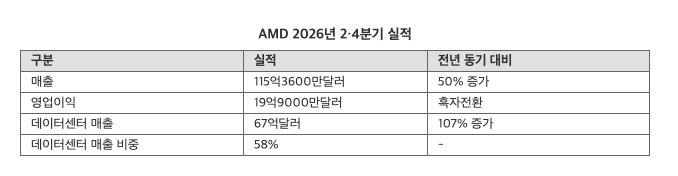
[Financial News] Global Big Tech companies have posted record-breaking results, directly challenging market claims that memory semiconductors have already peaked. Advanced Micro Devices, Inc. (AMD), which is shaking up the global AI accelerator market, set a new all-time high in earnings. Elon Musk, CEO of SpaceX, also warned strongly of supply shortages, saying that "memory is the biggest bottleneck in the AI industry." That has added momentum to optimistic forecasts that K-semiconductor will firmly hold its dominant No. 1 position in the global memory market through 2031, backed by robust AI demand.■ Big Tech directly rebuts the "memory peak" theoryAccording to industry sources on the 5th, AMD said on the 4th (local time) that its revenue for the second quarter of this year came to $11.536 billion, or about 16.45 trillion won, while operating profit reached $1.99 billion, or about 284 billion won. Revenue rose 50% from a year earlier, setting a new quarterly record. Profitability also swung sharply into the black after an operating loss of 190 billion won in the second quarter of last year.
The data center business, which drove the earnings growth, stood out in particular. AMD's data center revenue surged 107% year on year to $6.7 billion, or about 9.55 trillion won. That accounted for 58% of total revenue. The jump reflects a sharp increase in shipments of AI accelerators and server CPUs, and it is being seen as a strong indicator of the ongoing memory boom worldwide. High-bandwidth memory is essential for running AI accelerators, while servers that support them also require large amounts of DRAM and enterprise SSDs. That is why Samsung Electronics and SK hynix, which lead the global memory market, are expected to benefit directly.
Elon Musk, CEO of SpaceX, also dismissed concerns about oversupply by warning of a shortage in memory supply. During SpaceX's earnings conference call, Musk said flatly that "the biggest constraint right now in the AI industry is memory." He added that "memory production is rising by about 20% a year, while demand is exploding by 200% or more," and predicted that "demand growth is outpacing supply, so memory prices will move higher rather than lower."
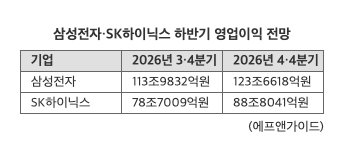
Google parent Alphabet is also sharply increasing its annual investment in step with surging AI demand. Alphabet raised its capital expenditure outlook for this year from a previous range of $180 billion to $190 billion to a new range of $195 billion to $205 billion. Analysts say this reflects strong confidence that massive AI investment can translate into real revenue.■ "South Korea to remain the strongest memory power through 2031"Attention is now focused on the earnings rally expected from Samsung Electronics and SK hynix in the second half of the year. Many forecasts say Samsung Electronics will enter an era of quarterly operating profit exceeding 10 trillion won starting in the third quarter. Consensus estimates for operating profit in the third and fourth quarters stand at 11.39832 trillion won and 12.36618 trillion won, respectively. SK hynix is also expected to post operating profits of 7.87009 trillion won and 8.88041 trillion won over the same period, setting new records for profitability each quarter.
As the global AI industry shifts from training to inference, some forecasts also suggest that South Korea will hold the world's memory semiconductor crown through 2031.
Josephine Lau, a researcher at French market research firm Yole Group, said at the memory event "FMS 2026" in Santa Clara, California, on the 4th (local time) that "South Korea will maintain its leadership in the memory industry at least through 2031." She cited the South Korean government's push for strong support measures to double wafer production capacity over the next five years, along with the fact that Samsung Electronics and SK hynix are continuing aggressive investment in HBM and next-generation DRAM.
[email protected] Jung Won-il Reporter