Takaichi asks BOJ chief to buy more government bonds as U.S. pressures Japan to raise rates
- Input
- 2026-08-05 13:54:16
- Updated
- 2026-08-05 13:54:16
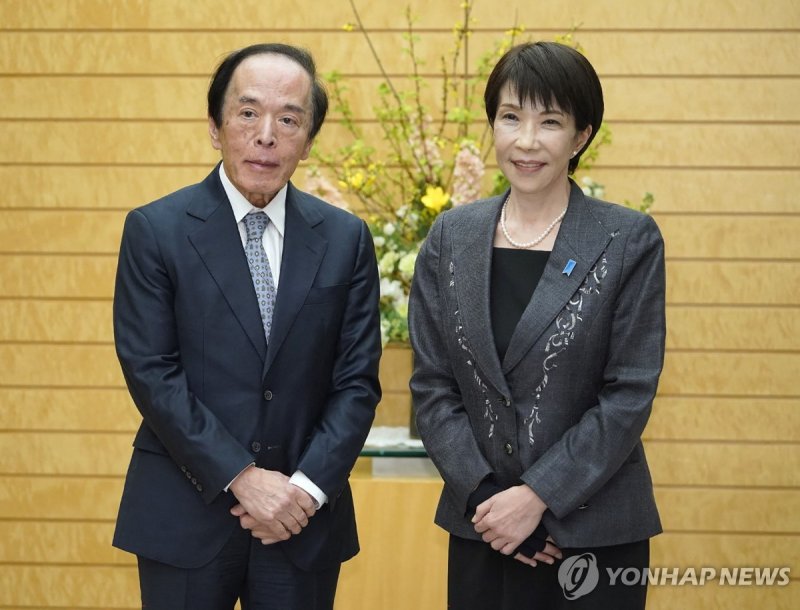
[Financial News] Japanese Prime Minister Sanae Takaichi is said to have asked Bank of Japan (BOJ) Governor Kazuo Ueda to buy additional government bonds if necessary to curb a rise in long-term interest rates. While the United States is pressing Japan to raise rates and tighten fiscal policy, the Japanese government appears to be counting on central bank support as it pushes an expansionary fiscal agenda, highlighting a growing gap in policy direction between the two countries.
JIJI PRESS reported on the 5th, citing multiple government sources, that Takaichi met Ueda at the Prime Minister's Office of Japan on May 22 and asked him to "understand the Cabinet's policy direction and implement appropriate monetary policy."
The move is seen as a precaution against a possible increase in government bond issuance as the administration seeks to mobilize 370 trillion yen, or about 3,350 trillion won, in public-private investment across 17 strategic industries by 2040 and expand defense spending. If bond supply rises, long-term rates could climb and fiscal burdens could deepen.
Ueda reportedly replied that "market reactions must be taken into account," while also saying that the BOJ would respond if necessary.
In fact, three weeks later, at its Monetary Policy Meeting, the BOJ plans to raise its benchmark rate from 0.75% to 1.0% while halting the reduction in government bond purchases that had been scheduled to begin in April next year. The BOJ says the meeting with the prime minister did not influence its policy decision.
However, a Japanese government official said, "The prime minister's side seems to have accepted the rate hike in exchange for the BOJ revising its bond purchase plan." The official added, "If long-term rates rise further, there is a possibility that additional purchases will be requested."
JIJI PRESS noted that "it is highly unusual for the prime minister to mention a central bank's specific monetary policy tools," adding that it could lead to renewed debate over the BOJ's independence. Market watchers also say the controversy could extend to so-called fiscal finance, or the monetization of government debt, in which the central bank effectively supports government finances.
The United States is openly pushing back against Japan's fiscal expansion. In an interview with CNBC, United States Secretary of the Treasury Scott Bessent said, "Foreign-exchange intervention only sends a signal to the market; what ultimately changes the direction of exchange rates is policy," urging Japan to shift course. He also said, "I believe Ueda will take the necessary steps," backing further rate hikes.
The Yomiuri Shimbun reported that in January, Bessent sharply pressed Satsuki Katayama, Japan's finance minister, asking, "Why do you keep raising rates?"
Although the United States and Japan recently carried out joint currency intervention to stem the yen's decline, analysts say Washington is making clear that intervention alone has limits and that Japan must ultimately move away from low interest rates and aggressive fiscal policy.
After the joint intervention, the yen briefly strengthened to 155 per dollar, but in the New York market on the 4th it fell back to the 158-yen range. Kyodo News reported that renewed concerns over Japan's deteriorating fiscal position, driven by tax-cut policies, are once again weighing on the yen.
[email protected] Kim Kyung-min Reporter