Next-Generation Heat Pump System Developed to Cool Using Waste Heat [IT Item of the Day]
- Input
- 2026-08-06 05:00:00
- Updated
- 2026-08-06 05:00:00
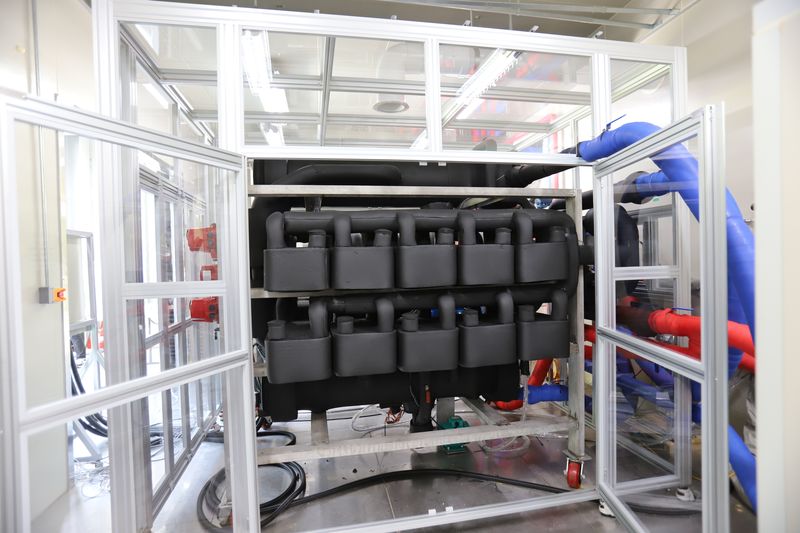
[Financial News] A next-generation heat pump system has been developed that can provide cooling using only low-temperature waste heat of around 40 degrees Celsius, such as heat discarded from factories and data centers. The system is seen as capable of reducing power consumption and improving energy efficiency by achieving world-leading adsorption bed performance.
On the 6th, KIMM said that a research team led by senior researcher Kim Young at the Heat Pump Research Center of KIMM's Carbon Neutral Machinery Research Institute, together with professors Kim Min-seong and Kim Dong-gyu of Chung-Ang University, developed a chemical adsorption heat pump system using an electrochemical compressor with support from the Alchemist Project of the Korea Institute of Energy Technology Evaluation and Planning (KETEP).
KIMM developed the chemical adsorption heat pump driven by low-temperature waste heat of 40 degrees Celsius, while Chung-Ang University developed an electrochemical compressor that produces no noise or vibration. Samjoong Tech also built a 10 kW prototype of the chemical adsorption heat pump.
A chemical adsorption heat pump is a technology that delivers cooling by using low-temperature waste heat, such as factory waste heat or data center exhaust heat. Unlike conventional adsorption cooling technologies, which required heat sources above 70 degrees Celsius, this system demonstrated that cooling is possible using only low-temperature waste heat of around 40 degrees Celsius.
The team also improved the structure of the adsorption bed, a core heat pump component, and achieved a specific cooling power of 346.5 W/kg. That is more than twice as high as competing technologies overseas and represents world-leading performance.
The developed system uses an electrochemical compressor with no mechanical drive parts. It can reduce energy consumption compared with conventional mechanical compressors, and because it generates almost no noise or vibration, it can be used in a wide range of settings, including hospitals, schools, and residential areas.
In the future, the technology could be applied to data centers, factories, and building heating and cooling systems. In particular, it can turn previously unused waste heat into an energy source, offering significant energy-saving benefits. It is also expected to help meet international refrigerant regulations by using ammonia, a natural refrigerant.
Senior researcher Kim Young said, "The biggest achievement of this study is that we were able to provide cooling using only low-temperature waste heat of around 40 degrees Celsius from factories and data centers," adding, "We are currently conducting demonstration tests on a 10 kW prototype, and we plan to apply the technology to data centers, buildings, and industrial sites in the future to help save energy."
Through this project, the research team produced 74 SCI papers, 67 patent applications, and 29 registered patents. It is now conducting demonstration tests using the 10 kW prototype.
[email protected] Youn Ji-an Reporter