Bessent: "The Korean won could have collapsed too"... First disclosure of why the yen intervention was carried out jointly
- Input
- 2026-08-05 09:38:24
- Updated
- 2026-08-05 09:38:24
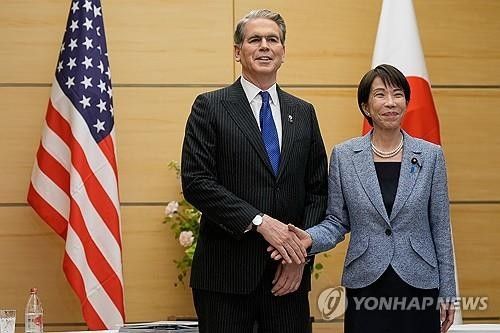
[Financial News] Scott Bessent, the United States Secretary of the Treasury, has revealed the background behind the joint U.S.-Japan intervention to buy Japanese yen. He said the move was driven by concerns that a weaker yen could spread across Asian currencies, including the Korean won and the Chinese yuan, and trigger a crisis similar to the one in 1997. Bessent also said Japan's era of ultra-low interest rates is over and called for further rate hikes and stronger fiscal discipline.
"Abenomics is over... now it's the era of 'Takaichinomics'"
In a solo interview with Nikkei, Inc. on the 4th, Bessent said, "Many Asian currencies move in tandem with the Japanese yen," adding, "The Asian financial crisis of the 1990s was triggered by a sharp decline in the yen."
Commenting on the yen's recent weakness, he said, "As the yen weakens, the Korean won is also weakening, and China is also taking a passive stance toward yuan appreciation." His remarks suggest that the joint intervention in the foreign exchange market with Japan was intended not only to defend the yen, but also to prevent instability from spreading across Asia's financial markets. This was the first time Bessent had directly explained the specific background for the joint intervention.
Bessent also called for a shift in Japan's economic policy. He said, "Abenomics, the economic policy of former Prime Minister Shinzo Abe, laid the foundation for Japan's economy by helping it escape deflation and driving corporate reform," but added, "The 15 years of stimulus have now served their purpose. This is no longer the era of Abenomics, but of 'Takaichinomics,' the economic policy of Prime Minister Sanae Takaichi." This is interpreted as meaning that Japan needs to end its long-running monetary easing and move toward interest rate normalization at the Bank of Japan.
On Kazuo Ueda, Governor of the Bank of Japan, Bessent said, "I have known him for more than 15 years," and added, "He has a strong feel for the market, and I trust him deeply."
U.S. warns over Japan's tax cuts... leaves room for dollar sales
Inside the U.S. administration, there are also concerns about Prime Minister Takaichi's tax-cutting policy.
According to Nikkei, a senior U.S. government official familiar with the joint intervention said, "Japan has two choices," adding, "It can accept tax cuts or focus on lowering prices." He said, "If it were me, I would choose the latter," signaling opposition to a consumption tax cut. The official also pointed out that "because Japan relies heavily on energy imports, a weaker yen further fuels inflation."
The United States has also left open the possibility of further intervention in the foreign exchange market. A senior U.S. government official said, "We are not ruling out any option, including selling dollars." Asked why the joint intervention did not involve direct dollar sales and instead used yen buying and euro selling, the official explained, "It was to avoid undermining market confidence in the U.S. strong-dollar policy."
When asked whether other G7 countries might also join a joint intervention, the official replied, "There will be countries that are willing to do so."
On the Japanese side, Atsushi Mimura, the vice minister of finance, described the joint intervention as "the completed form of the U.S.-Japan currency alliance."
[email protected] Kim Kyung-min Reporter