"The Panic Sell-Off Is Over, But 7,000 Is Still Ahead"... KOSPI Expected to Slow in August
- Input
- 2026-08-04 15:36:22
- Updated
- 2026-08-04 15:36:22
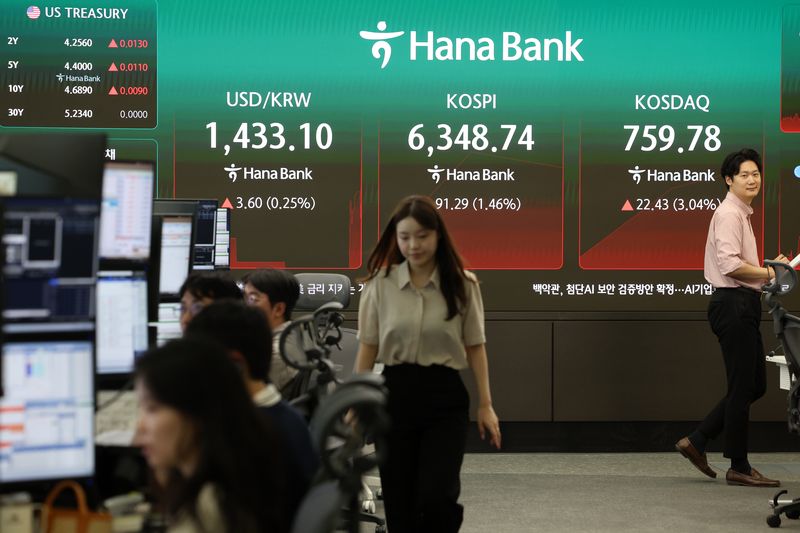
[Financial News] South Korea's stock market, which saw a record-level plunge last week followed by an 18% surge in a single day, has moved out of panic mode. Still, analysts expect volatility to continue for the time being. They say KOSPI will need sustained investment in Artificial Intelligence (AI), stability in U.S. long-term interest rates, and clarity on China's semiconductor developments before it can recover to the 7,000-8,000 range.
According to the Korea Exchange on the 4th, KOSPI closed at 6,358.95, up 1.62% from the previous trading day. At one point during the session, the index rose as much as 2.11% to 6,389.40. Retail investors posted net purchases of about 810 billion won in a single day, driving the index higher. Foreign investors and institutions sold 369.7 billion won and 539.1 billion won worth of shares, respectively.
Market experts said last week's sharp decline was less about worsening corporate earnings and more about a "panic sell-off" triggered by doubts over the sustainability of AI investment and the unwinding of leveraged positions.
Hyundai Motor Securities pointed to concerns over AI monetization and China's semiconductor rise as the two main reasons behind the recent plunge in chip stocks. The firm said doubts grew over whether hyperscalers could continue massive capital expenditures (CAPEX) on AI infrastructure, while the spread of low-cost Chinese AI models and the rise of Chinese memory makers such as ChangXin Memory Technologies (CXMT) shook investor sentiment toward South Korea's semiconductor sector.
On the other hand, it said sentiment recovered quickly as AI cloud demand was reaffirmed, led by Microsoft, and the launch of GPT-5.6 added to the momentum. It also identified several key factors that will shape the domestic market's direction going forward: whether hyperscaler AI investment continues on the basis of actual profits, whether Big Tech companies in the U.S. adopt Chinese-made memory chips, and whether U.S. long-term interest rates remain stable.
Kim Jae-seung, a researcher at Hyundai Motor Securities, said, "For the August market, a rebound after the sharp drop is likely to continue, but it will be difficult to expect the kind of steep rally seen in May and June." He added that foreign investors are likely to keep buying net shares in semiconductors, but the pace of gains will probably be moderate as retail investors are expected to sell into strength around the 7,000-8,000 level.
Kim said, "In August, it will be effective to focus on oversold stocks, especially semiconductors, but the AI investment narrative has not fully recovered yet." He added, "It is necessary to lower portfolio volatility by also investing in financial stocks and covered-call strategies."
[email protected] Choi Du-seon Reporter