"Ban on Bonus Disputes" Opposition Party Pushes to Revise the Yellow Envelope Act Again
- Input
- 2026-08-04 15:35:32
- Updated
- 2026-08-04 15:35:32
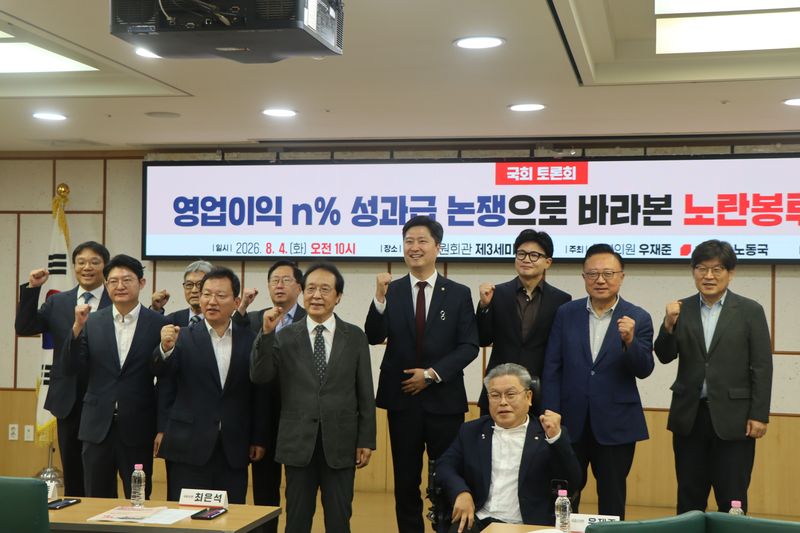
[Financial News] As strikes demanding bonuses tied to operating profit have increased, the People Power Party is considering pushing a party platform bill to revise the Yellow Envelope Act, the amended Articles 2 and 3 of the Trade Union Act. The proposal would exclude "management decisions" such as bonus payments from the scope of labor disputes and clarify the criteria for determining whether a parent company is an employer.
A senior People Power Party floor official told Financial News on the 4th, "We are reviewing a bill to revise the Yellow Envelope Act so that management decisions such as bonus payments are excluded from labor disputes, together with the party policy committee and others," adding, "We plan to introduce it as a party platform bill."
The move follows labor-management conflict at Samsung Electronics in May over bonuses linked to "n% of operating profit." The union demanded that bonuses be paid based on operating profit, and the issue later spread to major companies such as Kakao. President Lee Jae-myung also stepped in, saying, "I think the side that is not subject to labor disputes is more likely to be right." He argued that "management decisions affecting working conditions" should be interpreted narrowly and said the rules should be reorganized through enforcement decrees and Ministry of Employment and Labor guidelines.
The People Power Party says enforcement decrees and guidelines do not carry much weight in court rulings, so the law itself must be amended. At a Yellow Envelope Act forum held that day, Woo Jae-jun said, "The provision that management decisions could become the subject of labor disputes was suddenly added on the day the bill passed," and added, "In a situation where the whole country could be pushed into bonus strikes, we need to think about a reasonable legal line, and it is the government's responsibility to prepare properly."
There were also calls to codify the criteria for determining whether a parent company is an employer. According to data submitted by the Central Labor Relations Commission to lawmaker Na Kyung-won, of 64 appeal cases received from May 15 to July 24, 46 had been decided. In 35 of those cases, or 76.1 percent, the Central Labor Commission accepted the subcontracted unions' claims. In most cases, the regional labor commission rulings were overturned.
Under the current Trade Union Act, the standard for identifying an employer is whether there is "substantial and specific control," but the opposition argues that the wording is too abstract and increases uncertainty in management. Na said, "This sloppy bill, which even labor relations commissions cannot clearly interpret when it comes to who the real boss is, is pushing industrial sites into a swamp of general strikes and a hell of lawsuits," and signaled plans to revise the trade union law.
Earlier, lawmakers from the People Power Party had introduced a bill defining a parent company as an employer when it has the same authority and responsibility as the hiring employer.
[email protected] Lee Hae-ram Reporter