Robot Skin That Feels Human-Like Is Here... It Can Even Handle Hazardous Material Isolation [IT Item of the Day]
- Input
- 2026-08-05 05:00:00
- Updated
- 2026-08-05 05:00:00
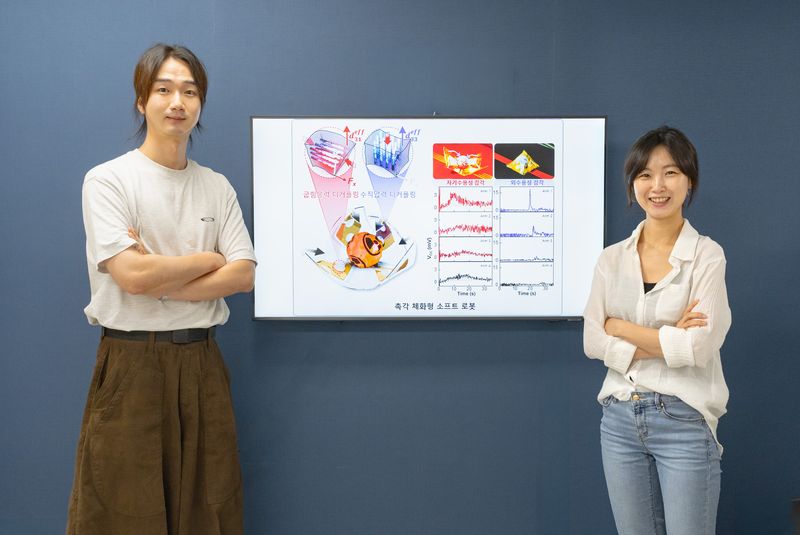
[Financial News] A tactile soft robot has been developed that can distinguish in real time the direction of force, such as contact or bending, much like human skin. The robot also successfully carried out autonomous hazardous chemical isolation.
According to GIST on the 5th, a research team led by Professor Ha Min-jung of the Department of Materials Science and Engineering developed a technology that allows the material itself to distinguish complex forces by direction. Using that technology, the team built a "Perception-Embodied" soft robot.
The robot can identify in real time the direction of complex forces that occur simultaneously, such as contact pressure and bending deformation, without relying on multiple sensors or complicated data processing. Based on this tactile information, it also implements a closed-loop feedback function that lets the robot control its next movement on its own. The achievement is expected to be useful in future robots for exploring sealed or irregular environments, smart electronic prosthetic hands and legs, remote haptic interfaces, and next-generation wearable robots.
The team developed a technique that uses magnetic fields to align the direction of nanowires along a desired axis and make them respond selectively to different forces depending on that direction. For this, it used nanowire, a rod-shaped nanoscale material much thinner than a human hair. Because of their thin, elongated structure, nanowires concentrate external mechanical stimuli and respond sensitively. The barium titanate nanowire used by the team has piezoelectric properties, meaning it generates electrical signals when force or pressure is applied, allowing it to detect external force.
The researchers then coated the surface with iron oxide nanoparticles that respond to magnetic fields to create magnetic-piezoelectric nanowires. These were evenly dispersed in a shape-memory polymer and aligned in the desired direction using an external magnetic field. Once aligned, the nanowires were fixed inside the polymer, maintaining their orientation and designed to respond selectively only to force applied from a specific direction.
In practice, a nanowire structure aligned vertically along the z-axis responded sensitively to vertical pressure from external contact, while a structure aligned horizontally along the x-axis selectively responded to bending force generated when a joint flexes. The team also succeeded in distinguishing the direction of complex three-dimensional forces acting simultaneously along the x, y and z axes by arranging nanowires aligned in different directions at right angles. This created an integrated sensory-actuation structure in which the robot body itself senses force and moves.
After the team built a "tactile embodied soft robot" using this technology and made it carry out autonomous tasks, the robot distinguished between its own bending signals generated during self-folding and contact signals generated when it touched an object. Based on this, it successfully completed the task of isolating hazardous chemicals.
Professor Ha said, "Unlike conventional robotic sensing systems that rely on multiple sensors and large-scale computation, this study is expected to contribute to the development of real-time autonomous robot control technology because it can operate stably even under repeated deformation and recognize touch with high accuracy in environments where visual information is difficult to obtain."
The study, led by Professor Ha Min-jung of GIST's Department of Materials Science and Engineering and with doctoral student Kim Yu-bin as the first author, was published online on July 18 in the international journal Advanced Materials in the field of materials science.
[email protected] Yeon Ji-an Reporter