Consumers Hit by a 1.2 Trillion Won Price-Fixing Scheme... Pork Prices Were Pushed Up for Six Years
- Input
- 2026-08-04 13:22:11
- Updated
- 2026-08-04 13:22:11
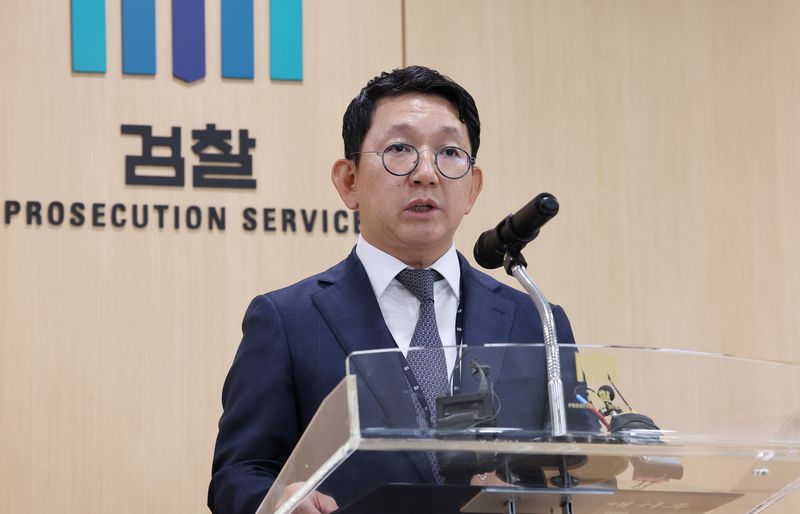
The Criminal Division 6 of the Seoul Eastern District Prosecutors' Office, led by Deputy Chief Prosecutor Lee Jeong-ho, said at a briefing on the 4th at the office in Songpa-gu, Seoul, that it had indicted six pork distributors, including Dodram Food, DeHus Korea, formerly CJ Feed & Care, Daesung Trading, Bodam, the Daejeon-Chungnam Pork Livestock Cooperative, and the Bukyung Pork Cooperative, along with 12 executives at the level of division heads or regional sales managers and above, on charges of violating the MRFTA, without detention.
According to prosecutors, nine major distributors that supplied pork to E-Mart, including the country's No. 1 and No. 2 firms, took part in the collusion. All were found to have participated, but only six were brought to trial, taking into account their cooperation with the KFTC investigation.
The investigation began after the KFTC in 2021 and 2022 uncovered a price-fixing scheme worth about 19 billion won in the bidding process for regular pork and branded pork, and referred six companies to prosecutors in April. Starting on April 23, prosecutors searched the nine companies suspected of involvement and analyzed mobile phones, quotation sheets and messenger chats. They found that the collusion ran from August 2017 to November 2023, during which E-Mart purchased pork worth 1.2 trillion won from the nine companies.
The scheme began in August 2017, when the hypermarket changed the way it bought pork and started receiving company-specific quotes and bid prices. The companies shared confidential information every week, including quote prices for branded and regular pork and the previous week's winning bid prices, and used that to set prices for the following week. Even though each supplier had different costs and inventory levels, the fluctuations in supply prices and bid prices moved in a similar range. Internal documents were also found showing that companies calculated the gap with competitors' prices before deciding the next week's quote.
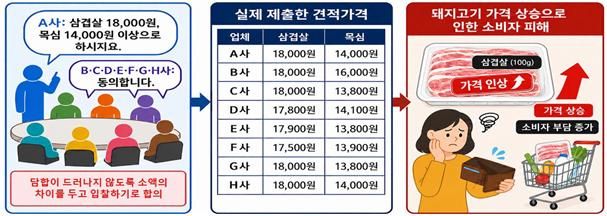
Park Hyung-cheol, the lead prosecutor in Criminal Division 6, explained, "If companies know a competitor's price from the previous week, they can raise their own price or avoid lowering it enough." He added, "Through the exchange of price information, prices were set higher than they would have been under normal competition."
The collusion became increasingly organized over time. At first, the companies used phone calls and one-on-one messenger chats, but in November 2021 they created a Telegram secret chat room called "Piero Room" for all supplier representatives to coordinate prices. They later continued the collusion through "No-Antibiotics Room" and private chats, and investigators found that when a person in charge changed, the network was handed over to the successor, or new suppliers were brought into the scheme.
Prosecutors included not only price-fixing, in which a specific price is agreed upon, but also information-sharing collusion, in which confidential price data is exchanged to restrict competition. Since the punishment provisions for information-sharing collusion took effect in December 2021, criminal charges were limited to conduct after the law came into force. Prosecutors said this was the first case in the food sector to be prosecuted for information-sharing collusion.
Prosecutors believe pork prices at major supermarkets were kept at least 20% higher during the cartel period. After the collusion was exposed, the consumer price index for pork rose 1.9% year on year in 2024, and wholesale prices increased from 5,134 won per kilogram to 5,239 won. Over the same period, however, pork belly prices at large supermarkets fell 25.5%, while shoulder prices dropped 20.8%.
When the KFTC began its on-site inspection, some companies deleted the entire Telegram "No-Antibiotics Room" chat and erased messenger and computer records. Employees were found to have discussed the need to "blow up the group chat first and deal with it later," while a legal team employee in charge of compliance also instructed staff to delete contact records with competitors and pricing data.
Prosecutors indicted four executives and employees who led the obstruction of the investigation on charges of interfering with a probe under the MRFTA. Prosecutor Park said, "Because the KFTC has no compulsory investigative powers, once materials are deleted, its investigative authority can be rendered hollow." He added, "If the full scope of the scheme had been uncovered without obstruction, the fine could have reached hundreds of billions or even trillions of won." During the investigation, prosecutors also confirmed additional evidence of information-sharing collusion, obstruction, and the involvement of individual executives and employees, and twice exercised their right to request a KFTC referral.
Deputy Chief Prosecutor Lee Jeong-ho emphasized, "We concluded that fines or penalties against corporations alone would not be enough to root out organized collusion." He added, "We will respond actively and in accordance with the law and principles to fair-trade offenders who undermine competition and disrupt the national economy, and we will do our utmost to protect consumers."
[email protected] Kim Ye-ji Reporter