SK hynix and SanDisk Unveil First HBF Standard Specification
- Input
- 2026-08-04 09:23:55
- Updated
- 2026-08-04 09:23:55
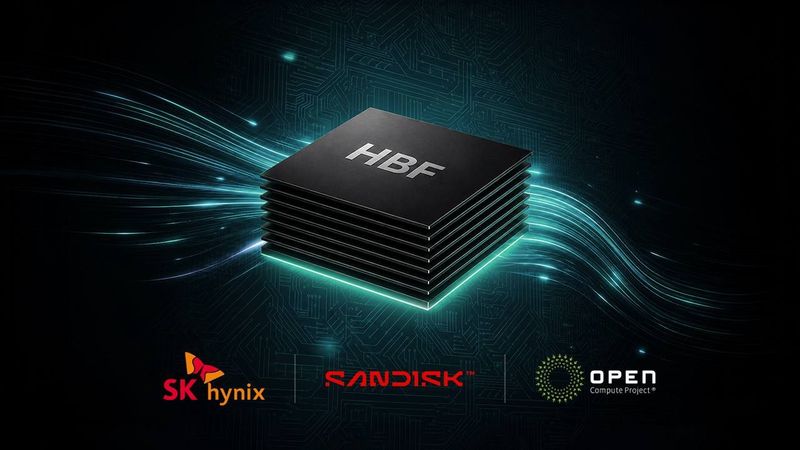
[Financial News] SK hynix said on the 4th that it had unveiled the first standard specification for high-bandwidth flash (HBF), a next-generation storage technology, together with SanDisk Corporation.
The announcement was timed to coincide with the opening of FMS 2026, which runs from the 4th to the 6th local time at the Santa Clara Convention Center in California.
HBF is a new memory layer positioned between high-bandwidth memory and solid-state drives (SSD). Like HBM, it can transfer data at high speed, while its NAND-based structure allows for much greater capacity. As AI inference spreads and the amount of data to be handled rises sharply, the technology is drawing attention as one that can deliver both bandwidth and scalability.
This specification is the first outcome released about six months after the consortium was launched in February, following SK hynix's agreement with SanDisk in August last year to cooperate on HBF standardization. Capacity is defined at up to 512GB based on two stack configurations, with NAND dies stacked in 8-layer and 16-layer arrangements. Bandwidth is divided into three grades, from about 0.4TB per second to 3.0TB per second.
A key point is the way HBF connects to processors. By adopting UCIe, the industry standard for chiplet interconnects, the specification lays the groundwork for flexible connections to different types of processors, including graphics processing units (GPU) and CPUs. The release was made through the Open Compute Project (OCP), the world's largest open data center technology consortium, establishing it as an open standard that the entire industry can use, not just individual companies.
SK hynix plans to expand HBF adoption in the AI storage market and accelerate ecosystem development. The HBF consortium currently includes Google and Tenstorrent, and the company aims to broaden participation through open collaboration while also improving technological maturity and market acceptance.
At FMS 2026, the company will also present HBF as a key technology for removing memory bottlenecks in the AI era. On the first day of FMS 2026, local time on the 4th, Kim Cheon-seong, head of SK hynix's solution development division, and Kang Wook-seong, who oversees next-generation product planning, will deliver a joint keynote speech on the theme, "Efficient implementation of AI infrastructure based on hierarchical memory in the era of AI agents."
SK hynix will also unveil, for the first time during the exhibition, wafers and products for its 10th-generation (V10) 375-layer 4D NAND. The 375-layer 4D NAND is designed to deliver 2.5 times better performance per watt than the previous generation, making it well suited for AI infrastructure environments such as data centers that require both power efficiency and performance. The company plans to begin mass production of high-performance, high-capacity enterprise solid-state drives (eSSD) based on the new NAND in early next year, further strengthening its NAND leadership in the AI market.
Kim said, "As AI adoption spreads rapidly, we are at a point where the entire data processing architecture needs to be redesigned." He added, "Through HBF, we will help expand the boundary between memory and storage and contribute to building a new architecture that improves overall system efficiency."
[email protected] Jeong Won-il Reporter