"What About Small Investors?" Market Volatility Sends Margin Trading Balances Tumbling Below 30 Trillion Won
- Input
- 2026-08-04 04:00:00
- Updated
- 2026-08-04 04:00:00
[Financial News] As the domestic stock market swung sharply, the balance of margin loans, which investors use to buy stocks with borrowed money, fell below 30 trillion won. With the index continuing to fluctuate sharply, the amount of forced selling in overdue margin accounts also stayed in the 100 billion won range for a second straight day.
According to data compiled by the Korea Financial Investment Association on the 3rd, the margin loan balance stood at 28.9349 trillion won as of July 31. That was down 3.2181 trillion won from the previous trading day, and there had been no case in the past year of a daily decline of more than 3 trillion won.
It was the first time the balance had fallen below 30 trillion won since Jan. 28, when it stood at 29.5961 trillion won. It was also the lowest level since Jan. 22, when it was 28.9257 trillion won. Compared with the all-time high of 38.6328 trillion won on June 24, the decline amounts to about 10 trillion won.
By market, the Korea Exchange Main Board saw the sharpest drop. Margin balances on the main board fell by 2.7 trillion won in a single day to 22.8405 trillion won, while the KOSDAQ market balance came to 6.0943 trillion won.
On July 31, the KOSPI jumped 17.91 percent, and individual investors posted net sales of 10.3834 trillion won during the rally. Analysts said the record-breaking scale of net selling by retail investors also contributed to the decline in margin balances.
Forced selling tied to very short-term margin trading also increased. On July 31, unsettled margin debt in brokerage trading was tallied at 1.6614 trillion won. Of that, 122 billion won was forced liquidations after investors failed to repay their obligations.
The forced selling amount followed 103.7 billion won on July 30, marking a second consecutive day above 100 billion won. Including the 61.1 billion won recorded on July 29, the three-day cumulative total reached 300 billion won. The ratio of forced selling to unsettled margin debt was 7.1 percent.
Meanwhile, domestic stocks turned lower on the day as profit-taking emerged after the previous session's sharp gains. The KOSDAQ rose for a second straight day, supported by foreign buying and strength in the pharmaceutical and biotech sectors.
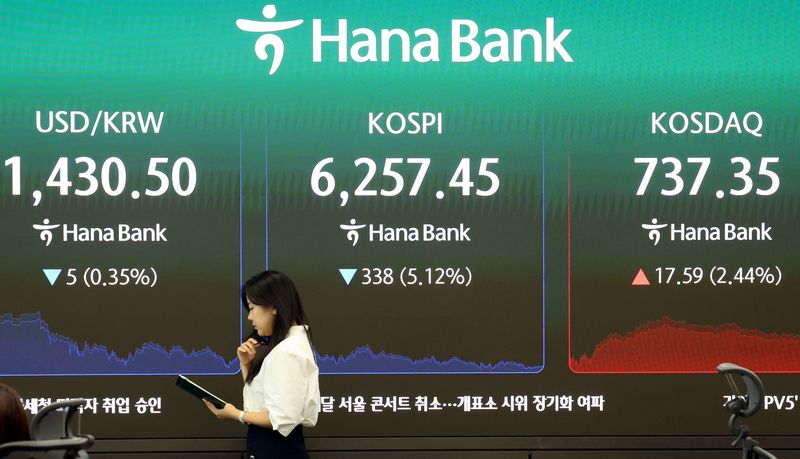
The KOSPI closed at 6,257.45, down 338.00 points, or 5.12 percent, from the previous session. The index had surged 1,001.89 points, or 17.91 percent, on July 31, setting its biggest-ever gain, but some of those advances were erased on the day as foreign and institutional investors sold heavily. Trading volume came to 270.98 million shares, with turnover of 26.1204 trillion won.
The KOSDAQ ended at 737.35, up 17.59 points, or 2.44 percent, from the previous close. A buy-side sidecar was triggered after a sharp intraday rally temporarily suspended the effectiveness of program buy orders.
In the Seoul Foreign Exchange Market, the won-dollar exchange rate closed at 1,429.8 won during daytime trading, up 5.8 won from the previous day's closing level. The rise was attributed to net foreign selling in the domestic stock market and a renewed strengthening of the U.S. dollar.
[email protected] Han Seung-gon Reporter