[Editorial] The two major umbrella unions oppose easing the 52-hour workweek. Can Korea win in competition?
- Input
- 2026-08-03 18:54:56
- Updated
- 2026-08-03 18:54:56
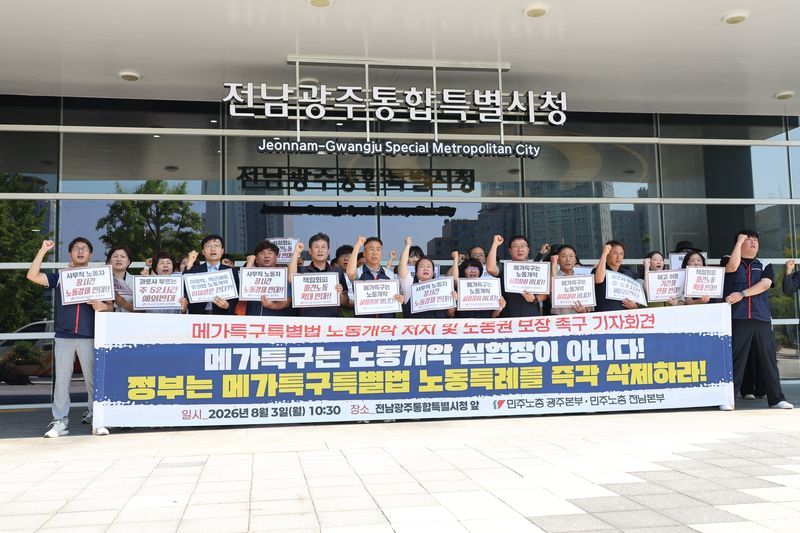
The Honam semiconductor mega-special zone is an industrial complex that the government and companies want to build in the shortest possible time to meet surging semiconductor demand. Competition among countries in semiconductor development and production is intensifying by the day, so all available resources must be mobilized to build factories and focus on research. For that reason, the Honam semiconductor mega-special zone is a project that the public and private sectors must work together to complete early.
The government is seeking to apply the eased 52-hour workweek to this mega-special zone, at least, because of those urgent and pressing circumstances. Semiconductor development and production are a race against time. If the opportunity is missed, a company can fall behind in competition or even be pushed out altogether. Companies have long asked for more flexible working hours, but the National Assembly, which holds legislative power, ignored those requests. That is why the government stepped in and explained to the ruling party that it should at least try a limited version of the policy.
It is no exaggeration to say that Korea is the only country strictly enforcing the 52-hour workweek to this extent. In rival countries such as Taiwan, laboratories stay lit 24 hours a day. That is not the case here. As soon as the workday ends, the lights go off and the computers are shut down. In terms of continuity and concentration in research, we cannot compete with those countries.
The MOEL report included a proposal to abolish the 52-hour weekly cap for managers and researchers in the top 3 percent of income earners, if workers agree, and to introduce the so-called white-collar exemption, under which overtime, night, and holiday pay would not apply and only regular wages would be paid. This is not about all workers, but only about certain occupations, and only with consent. Even so, the two major umbrella unions are fiercely opposed.
No one would dispute the need to observe the 52-hour workweek to protect workers' health and allow them to use their leisure time. However, as long as total working hours are kept within limits, we do not believe it should be impossible to work flexibly in order to keep research and production from stopping. On the contrary, the policy should be tested experimentally in the mega-special zone, and if the results are good, it should also be considered for expansion to research and development work in other fields.
Labor flexibility is essential for industrial growth and corporate prosperity. Rigid application of labor regulations can also become an obstacle to economic growth. Compared with the United States, Japan, Taiwan, and China, Korea's unions remain rigid, clinging to principle and refusing to make even the slightest concession on workers' rights.
In countries where the 52-hour workweek is applied flexibly, there are hardly any known cases of industrial accidents or worker backlash. This would not be a general extension of working hours, but a measure limited to top managers and research and development personnel. It is also different from overworking manual laborers at worksites. Even so, the unions are simply opposing it outright, which is frustrating.