"Samsung Electronics and SK hynix plunged another 8%, but the target price escaped both the surge and the slump"
- Input
- 2026-08-04 06:29:18
- Updated
- 2026-08-04 06:29:18
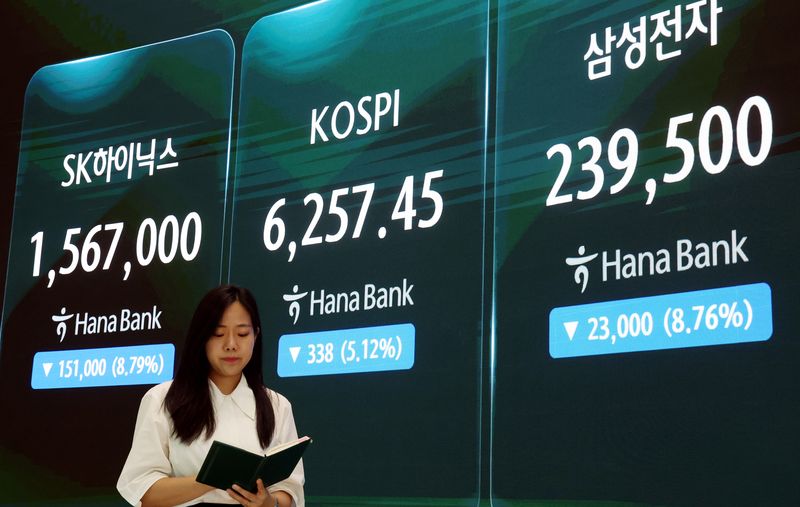
[Financial News] 'Roller KOSPI' swung wildly once again. After rebounding 17.91% on the 31st of last month, following three straight sessions of losses, the KOSPI, which had posted its biggest-ever gain, fell sharply again by 5.12% in just one day on the 3rd after the weekend and closed at 6,257.45. It was an extremely volatile market in which declines, surges, and fresh drops followed one another within days.
As the Korean stock market has been fully exposed to this volatility, securities firms are also lowering their forecasts across the board. Daishin Securities Research Center cut its KOSPI target for this year from 11,500 to 9,300 on the 3rd, a reduction of about 19%. Shinhan Investment & Securities also lowered its second-half KOSPI target from 11,000 to 8,800 on the 30th of last month. DB Securities, which had set a KOSPI target of 11,700 a month earlier, also suggested 5,500 as the index's short-term bottom on the 29th of last month.
They gave up on the 10,000-point KOSPI, but the target prices for Samsung Electronics and SK hynix are still 96% higher
Just a little over a month ago, securities firms were presenting a 10,000-point KOSPI as if it were the default scenario. Only after the market's sharp selloff did their expectations come down significantly. Even as index forecasts were adjusted late, however, the individual target prices for the market's leading stocks still remained nearly twice as high.
The most representative names are semiconductor leaders Samsung Electronics and SK hynix. On the 31st of last month, the two stocks surged 20% to 30%, then plunged again by more than 8% on the 3rd, showing extreme volatility. Yet the gap between the average broker target price and the actual share price narrowed in neither direction.
According to Yonhap Infomax on the 2nd, the difference between the closing prices of Samsung Electronics and SK hynix on the 31st of last month (262,500 won and 1,718,000 won) and their recent one-month average target prices (514,545 won and 3,371,538 won) reached 96%. When the two stocks fell by more than 8% again on the 3rd (Samsung Electronics to 239,500 won and SK hynix to 1,567,000 won), the gap between target prices and share prices widened even further.
1.48 million won and 4.7 million won: different views on the same stock
One interpretation is that the wide gap reflects excessive short-term anxiety being priced in. Shares may have fallen too far, but some also argue that target prices failed to come down in time.
In fact, a comprehensive analysis of about 740,000 domestic analyst reports from 2000 to 2024 by Kim Joon-seok, a senior research fellow at the Korea Capital Market Institute, showed in results released in May that it took an average of 61 days to raise a target price, while it took 72 days on average to lower one. The scale of downward revisions was also larger.
Questions are also being raised over whether target prices function as fair valuations. SK hynix currently has target prices ranging from a low of 1.48 million won, set by BNK Investment & Securities, to a high of 4.7 million won, set by Korea Investment & Securities. That means the same stock is subject to a gap of as much as 3.22 million won.
Samsung Electronics also has a low of 300,000 won from BNK Investment & Securities and a high of 650,000 won from Korea Investment & Securities. Mirae Asset Securities cut its target prices for Samsung Electronics and SK hynix by 33%, from 550,000 won to 370,000 won and from 4.2 million won to 2.8 million won, respectively. Even so, those figures are still more than 60% above the current share prices, drawing criticism that the cuts were not enough.
"More like a relay than a forecast" ... the rarity of 'sell' ratings is the same overseas
The current gap is the exact mirror image of what was seen during the rally. When stock prices were rising, target prices were busy chasing them higher. But as prices fell, reports followed suit, prompting criticism that they were "more like a relay than a forecast."
This optimistic bias is not unique to Korea. According to FactSet, as of December last year, 'sell' ratings accounted for just 4.8% of analyst recommendations on S&P500 stocks in the United States, and that share has stayed in the 5% range for years regardless of market direction.
Academic studies overseas have also repeatedly found that the farther a target price is set from the current share price, the lower its ex post accuracy tends to be. There have also been persistent concerns that the upward bias in target prices is tied to structural conflicts of interest, including underwriting and advisory relationships. Experts therefore advise focusing less on the target price itself and more on the basis for setting it and how quickly it is revised.
[email protected] Kim Hee-sun Reporter