'A 3 Billion Won House' for Four Siblings... The 'Dispute-Free Inheritance' Chosen by a 99-Year-Old Mother [PB's Money Recipe]
- Input
- 2026-08-09 15:25:34
- Updated
- 2026-08-09 15:25:34

A, who owns a detached house valued at approximately 3 billion won, has one greatest wish: that his four children do not clash over inheritance issues. Although he has a deep attachment to the home he has lived in his entire life, he is concerned that if he leaves the property as is, opinions may diverge regarding whether to sell it or how to distribute it in the future. Securing a stable source of living expenses in preparation for a prolonged stay in a nursing home was also a significant consideration.According to the financial sector on the 9th, standards for inheritance are changing as the population ages rapidly. While the primary concern in the past was how much to reduce inheritance tax, the recent trend emphasizes planning that considers not only tax savings but also securing stable living funds and preventing family disputes. One way to minimize family conflict is through a testamentary trust.A testamentary trust offers the advantage of allowing clients to directly manage their assets during their lifetime and modify the contract terms if necessary. After death, since the bank disburses funds to the beneficiary according to the terms stipulated in the contract without the need for negotiations regarding the division of inherited property, it simplifies the inheritance process and reduces the potential for family conflict. When utilizing a testamentary trust, it is crucial to consider one's health status, family relationships, asset composition, and future cash flow needs together.
The advice is that a comprehensive plan is required, taking the situation into account rather than focusing solely on tax savings. The age of the deceased can also be a significant consideration in the inheritance process. In the case of the elderly, enhancing the stability of the contract by thoroughly verifying the deceased's decision-making ability and intent before signing is key to preventing future family disputes.
As the likelihood of cash needs arising for medical expenses and living costs increases with age, it is also important to secure sufficient funds for use during one's lifetime. In Mr. A's case, two options can be considered regarding the use of a testamentary trust.
The first method involves incorporating the detached house into a trust as is, ensuring that inheritance takes place after death according to the terms of the contract. The second method involves selling the house, converting it into financial assets, and utilizing a trust to pre-design the timing and method of payment. The first method has the advantage of preserving the home where one has lived their entire life.
However, considering that financial assets allow for more flexible planning of payment timing and methods compared to real estate, Mr. A chose the second method.
With financial assets, payment ratios for each heir can be determined in advance, and payment methods such as lump sums or installments can be specified in the contract. Since the bank executes the payments according to the contract terms, the inheritance process becomes clearer.
AI-Generated Image [Financial News] #.
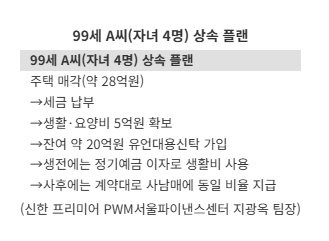
8 billion won, paid the relevant taxes, and separately secured 500 million won to be used for his retirement and nursing care expenses. The remaining approximately 2 billion won was designed to be inherited by the four children in equal proportions after death through a testamentary trust agreement.
The trust assets are managed as one-year fixed deposits; the interest generated at maturity is used for living expenses and medical care, while the principal is automatically reinvested to ensure stable management until death. After death, the bank will directly disburse the funds to the four siblings, who are the beneficiaries designated in the trust agreement, in accordance with the terms of the contract.
Ji Gwang-ok, Team Leader at Shinhan Premier PWM Seoul Finance Center, stated, "It is important to design the most suitable asset succession structure together so that the assets the client has built up over a lifetime can be passed on to their children in the way they desire. " He added, "Good inheritance is not just about leaving behind a large fortune, but about ensuring that the client's wishes are carried on to the next generation in the manner they desire.
" Advice provided by: Ji Gwang-ok, Team Leader at Shinhan Premier PWM Seoul Finance Center
[email protected] Seo Ji-yoon Reporter