"KOSPI to 10,000?" Brokerage houses are belatedly cutting their targets
- Input
- 2026-08-03 09:03:25
- Updated
- 2026-08-03 09:03:25
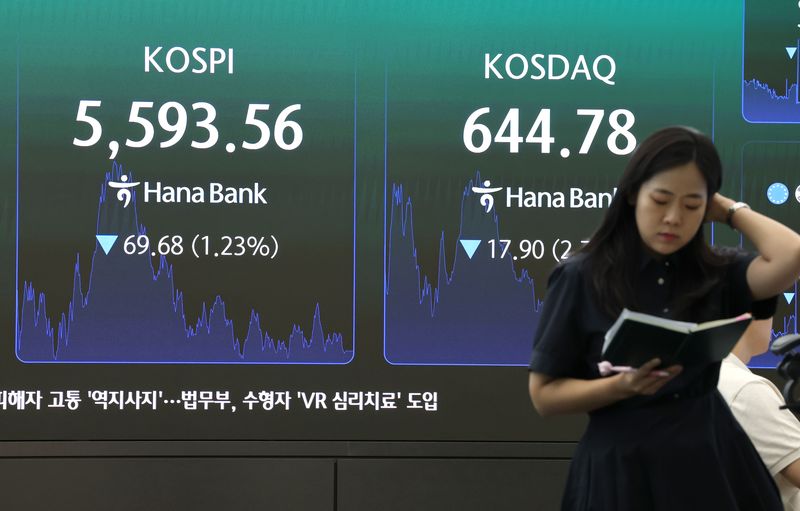
[Financial News] Brokerage firms that had been calling for a "KOSPI 10,000" and "10,000-pi" are now belatedly lowering their forecasts. The move reflects downward revisions to fair valuation, or stock prices relative to earnings, amid rising bond yields and the possibility of further rate hikes. Still, with the domestic market now in a historically undervalued range after its recent plunge, they are recommending that investors increase their exposure around the 6,000 level.
Quietly lowering the outlook below the "10,000-pi" mark
Daishin Securities cut its KOSPI target for this year to 9,300 from 11,500 on the 3rd, a reduction of about 19%. The firm cited changing interest-rate conditions as the reason for the downgrade. Taking into account rising bond yields and the possibility of additional rate hikes, it lowered the target price-earnings ratio (PER) for semiconductors from 8 times to 7 times. The target PER for non-semiconductor stocks was also cut from 15 times to 11 times.
Daishin Securities is not the only firm to have recently lowered its KOSPI target. On the 30th of last month, Shinhan Investment cut its second-half KOSPI target to 8,800 from 11,000, a reduction of 2,200 points. It also lowered its upper-end forecast for the third and fourth quarters to 8,300 from 9,900, a cut of 1,600 points. The firm only lowered its expectations after the index had already fallen sharply.
The brokerage industry is now focusing on where the bottom may be. On the 29th of last month, DB Securities suggested 5,500 as the KOSPI's short-term low. That is less than half of the target it had set just a month earlier, 11,700.
As reports continue to follow stock declines, the market is criticizing them as being closer to live commentary than forecasts. The complaint is that the original role of guiding investors has been undermined by a pattern in which targets are raised only after stocks rise, then lowered again when they fall.
"This is a buying opportunity now"
Experts, however, agreed that the market's undervaluation appeal remains stronger.
Lee Kyung-min, a researcher at Daishin Securities, said, "During July's sharp decline, the concentration in semiconductors eased somewhat, and deleveraging, or the reduction of leveraged investment, has also progressed significantly." He added, "KOSPI has entered an excessive decline phase from both a valuation and technical perspective."
He went on to say, "Even without a special catalyst, improved supply-demand conditions driven by easing uncertainty and calming investor anxiety could generate a rebound as strong as the excessive decline." He emphasized, "We expect a phase in which the market retraces its excessive losses and normalizes its extremely undervalued valuation."
He forecast that KOSPI could recover to the 9,300 level by the end of the year. If the index stabilizes in the 6,500 to 6,800 range, he explained, it could first rebound to around 8,200, which corresponds to a PER of 7 times, and then to around 9,300, which corresponds to a PER of 8 times.
As an investment strategy, he suggested using volatility as a buying opportunity. "The 6,000 range on KOSPI is a zone where upside potential is greater than downside risk," Lee said. "It is necessary to increase exposure, focusing on existing leading sectors such as semiconductors, information technology hardware, IT appliances, rechargeable batteries, shipbuilding, chemicals, and machinery."
[email protected] Han Young-joon Reporter