China's Chery Auto Seeks to Dodge U.S. and European Tariff Risks Through KGM Investment, Aiming to Expand Overseas Markets
- Input
- 2026-08-03 09:00:00
- Updated
- 2026-08-03 09:00:00
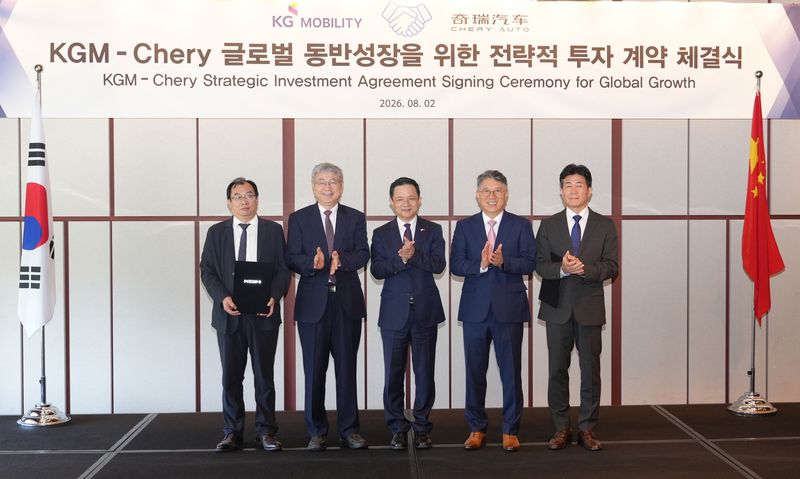
[Financial News] KG Mobility Corporation (KGM) has stepped up cooperation with China's Chery Automobile after signing a strategic investment agreement worth $75 million, or about 109.95 billion won, to strengthen future technology collaboration and their partnership.
Chery Auto said the investment is ultimately aimed at expanding its overseas market presence. It also made no secret of its hope that the deal would help it avoid tariff risks in the United States and Europe. The idea is that using Chery's platform through KGM could help bypass the steep tariffs imposed on Chinese-made vehicles in those markets.
KGM, however, has drawn a line for now on contract manufacturing Chery-branded vehicles. As a result, Chery is expected to focus in the short term on easing tariff risks through exports of jointly developed vehicles.
■ Chery Auto: "There are regions where Chinese tariffs and Korean tariffs differ"
At a press briefing after the KGM-Chery strategic investment signing ceremony on the 2nd at Grand Hyatt Seoul in Yongsan District, Seoul, Chery Auto President Zhang Guibing said of the expected impact of Chery's investment in KGM, "We are operating on the global market, but there will certainly be regions where Chinese tariffs and Korean tariffs are different. If we cooperate in these tariff-related areas, I think it can benefit both sides. I believe this is one of the most important values KGM has."
By citing overseas expansion as the key goal of cooperation with KGM and highlighting tariffs as the most important value, Zhang appeared to signal a willingness to ease barriers to entering the U.S. and European markets through jointly developed vehicles with KGM.
The United States currently imposes tariffs of more than 100% on Chinese electric vehicles, while the European Union levies tariffs of around 45% on Chinese battery electric vehicles, reflecting a tougher stance toward Chinese automakers.
Even amid this environment, Zhang, who had expressed a desire to enter the U.S. market, said, "The United States is a very large market, and all automakers around the world are likely interested in it. But the U.S. also has its own regulations, so meeting those rules is extremely important if you want to enter the market. Chery is also thinking very hard about this part."
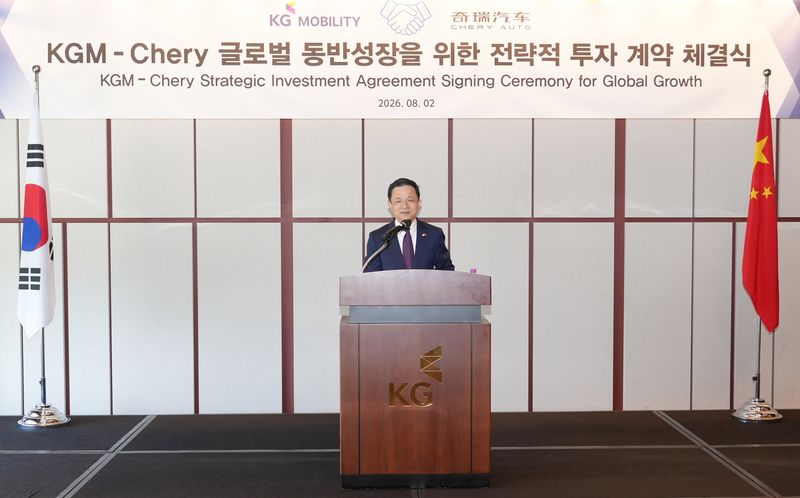
■ Ambassador attends as expectations rise for Chery's export push
Even at the venue, there were signs of expectations that the KGM-Chery partnership would further accelerate Chery's overseas expansion.
Zhang said, "Many Chinese auto brands have their own strengths, and Korean auto brands also have their own unique strengths. Our ultimate goal is to combine those strengths, enter more markets, and create products that satisfy consumers in more markets."
The fact that Chinese Ambassador to the Republic of Korea Dai Bing attended the event and delivered remarks also underscored expectations that cooperation with KGM could boost Chery's overseas exports.
Ambassador Dai said of economic cooperation between Korea and China, "The close interdependence between you and me, competition within cooperation, and cooperation within competition are becoming a new normal in our shared interests." He added, "I hope business leaders in both countries will accurately recognize this new environment and actively seize the opportunities."
Noting that China's technological capabilities have advanced and that economic cooperation between Korea and China has shifted into a more horizontal relationship, Dai added, "Today, the Korean and Chinese auto industries are in a competitive relationship, but at the same time they show very large potential for cooperation."
As concerns emerged that KGM could become a production base for Chery, KGM drew a clear line for now.
KGM CEO Hwang Ki-young said, "People are talking about contract manufacturing vehicles for Chery-affiliated brands, but there are no such plans at this time." He added, "We have never considered that."
[email protected] Kim Hak-jae Reporter