'Samsung Electronics and SK hynix plunge' calls hit the mark: "The rebound is not a one-off... stocks are now in an undervalued range"
- Input
- 2026-08-03 08:53:07
- Updated
- 2026-08-03 08:53:07
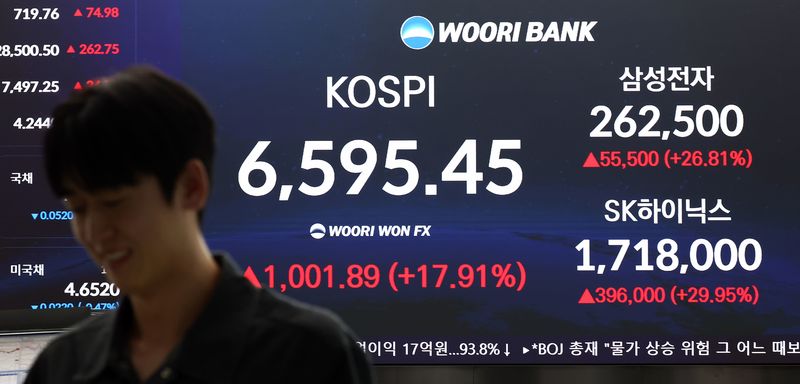
[Financial News] As Samsung Electronics and SK hynix, which had been extending their sharp decline, rebounded more than 20% in a single day and lifted the market, securities firms that accurately predicted the two companies' second-quarter results and the selloff are drawing attention for forecasting further gains ahead.
Meritz, which accurately predicted earnings, says memory shortages will last 12 more months
According to News 1 and Yonhap News Agency on the 3rd, shares of Samsung Electronics and SK hynix surged more than 20% on the 31st of last month. SK hynix in particular rose as much as 29.95% and closed at 1,718,000 won, the daily upper limit, while Samsung Electronics climbed 26.81%. The KOSPI index rose 17.91%, or 1,001.89 points, in a single day, marking its largest-ever gain in both points and percentage terms.
The KOSPI had fallen 1,162.19 points over three days from the 28th to the 30th of last month, after news that China had begun producing semiconductor lithography equipment, the Shanghai Stock Exchange listing of Chinese memory maker ChangXin Memory Technologies (CXMT), and SK hynix's second-quarter earnings that fell short of market expectations. But the one-day rebound recovered 86% of those losses.
In the securities industry, the view is gaining ground that this rebound will not be a one-time event.
Among domestic brokerages, Meritz Securities, which came closest to predicting the second-quarter results of Samsung Electronics and SK hynix, remains optimistic about the local semiconductor sector.
Meritz Securities projected SK hynix's second-quarter operating profit at 6.01 trillion won, the closest estimate to the actual result of 6.05 trillion won. Its forecast for Samsung Electronics' second-quarter operating profit, 9.01 trillion won, was also close to the actual 8.95 trillion won, which exceeded market expectations.
Kim Sun-woo, an analyst at Meritz Securities, said, "As agentic artificial intelligence spreads, the position of memory makers will become even stronger." He added, "The supply shortage caused by capex constraints in 2024 and 2025 is expected to deepen further in 2027, so the memory shortage over the next 12 months or more is clear."
"The bull market ends when SK hynix's market cap surpasses Samsung Electronics'" Hana Securities also sees foreign inflows
In a report released in June, Hana Securities said, "The moment SK hynix overtakes Samsung Electronics in market capitalization could be the signal that the bull market is ending," and assessed that the stocks are currently in an undervalued range.
Lee Jae-man, an analyst at Hana Securities, said, "Foreign net buying as a share of KOSPI market capitalization from May to July 2026 stands at -2.4% (-110 trillion won in net selling), which is even lower than the trough during the Global Financial Crisis (-2.2%)." He added, "As concerns over a stronger dollar are likely to ease, there is significant room for foreign funds to flow back into the domestic market."
BNK takes a bold view: "Short-term rebound possible"... but also flags liquidity weakness and other risks
BNK Investment & Securities also issued a positive outlook for the broader market. In April, when SK hynix was posting record earnings and its stock was hitting all-time highs, the firm was the only domestic brokerage to downgrade its investment rating.
Kim Seong-no, an analyst at BNK Investment & Securities, said, "From a technical perspective, the KOSPI has already met its first downside target, so a short-term rebound appears highly likely."
However, he also pointed to risks such as a possible slowdown in investment in artificial intelligence infrastructure and weakening liquidity.
Kim added, "U.S. big tech companies leading AI investment are seeing credit default swap premiums rise as free cash flow deteriorates despite improved earnings." He said, "Future risk factors include concerns over excessive AI investment and the United States midterm elections."
He went on to say, "The current market turmoil reflects weakening macroeconomic momentum, but corporate earnings momentum remains at its highest level since 2021." He added, "Global liquidity growth is likely to slow as interest rates rise, but share buybacks by domestic companies are expected to increase."
[email protected] Kim Soo-yeon Reporter