KGM Accelerates New Vehicle Development, Secures Investment from China's Chery Automobile and Partners on Automotive Semiconductor Development
- Input
- 2026-08-03 09:00:00
- Updated
- 2026-08-03 09:00:00
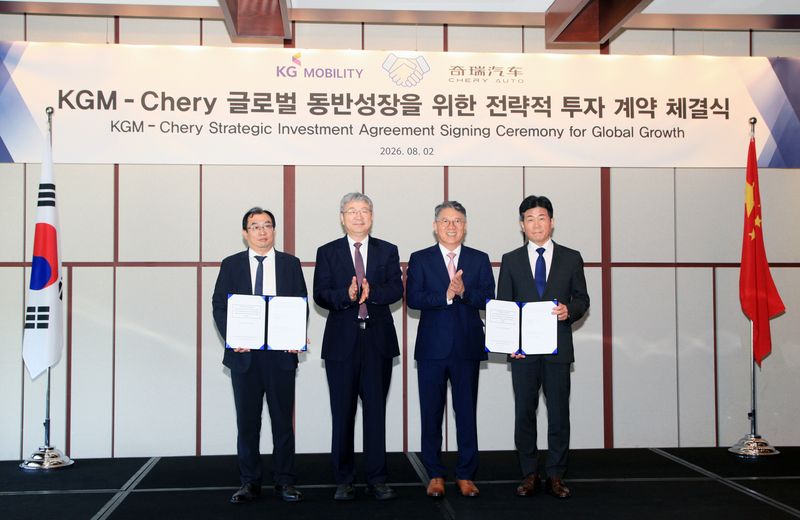
[Financial News] KG Mobility (KGM) announced on the 3rd that it had signed a $75 million strategic investment agreement with China's Chery Automobile to strengthen future technology cooperation and their partnership.
KGM said it aims to do more than simply attract investment. The company plans to maximize synergies in the global auto market and secure a new growth engine. By combining KGM's expertise in product planning, design and vehicle development with Chery's eco-friendly powertrain and global platform technologies, the company intends to speed up new vehicle development.
Earlier, on July 28, KGM said it would borrow $75 million to introduce Chery's plug-in hybrid (PHEV) platform technology. After raising short-term foreign currency funds to pay technology usage fees to Chery, KGM has now deepened cooperation through the $75 million arrangement.
The two companies have continued their partnership through a platform license agreement in 2024 and a joint development deal for midsize and large sport utility vehicles (SUVs) in 2025. Their first result, project 'SE-10,' will be launched early next year as a midsize SUV that carries on the legacy of the Rexton, offered in plug-in hybrid electric vehicle (PHEV) and 2.0-liter gasoline versions.
In addition, KGM and Chery are expanding cooperation in key technologies that could reshape the future of the auto industry, including autonomous driving and software-defined vehicles (SDVs).
The two sides also decided to pursue a second joint development project following 'SE-10.' Their goal is to develop a strategic model that can be sold in major global markets, including Korea, China and Europe, by reflecting regulations, safety standards and customer needs from the product planning stage.
They also discussed specific cooperation measures in future new businesses beyond automobiles, including robots and semiconductors.
Based on the technologies and business capabilities each company possesses, they will review possibilities for joint research, demonstration projects and commercialization. In the semiconductor sector, they agreed to discuss joint investment and development of automotive semiconductors.
To expand global operations, the two companies also agreed to consider joint investment in overseas production and business bases. They will form issue-specific task forces (TFs) involving top executives to flesh out business plans and role-sharing, while senior management from both sides will regularly review progress and major achievements.
In the process, they plan to make mutual use of global production facilities, supply chains, and sales and service networks. For overseas strategic markets where business viability is confirmed, they will examine specific investment methods and cooperation models.
KGM Chairman Gwak Jaeseon said, "The two companies have decided to further advance their ongoing automotive cooperation and form a TF to discuss various possibilities by connecting each side's strengths in semiconductors, robots, steel, and raw materials through a network." He added, "We will also discuss joint investment in overseas production and business bases to expand our global business."
Chery Automobile Chairman Yin Tongyue said, "Korea and China are both major automotive powers, and the two companies have come together to achieve our shared goals of high-quality growth and innovative customer value." He pledged, "We will realize true complementarity and resource sharing."
[email protected] Kim Hak-jae Reporter